Waltz Through Wilting Gardens
by Ava Linda Feliz-Sutter
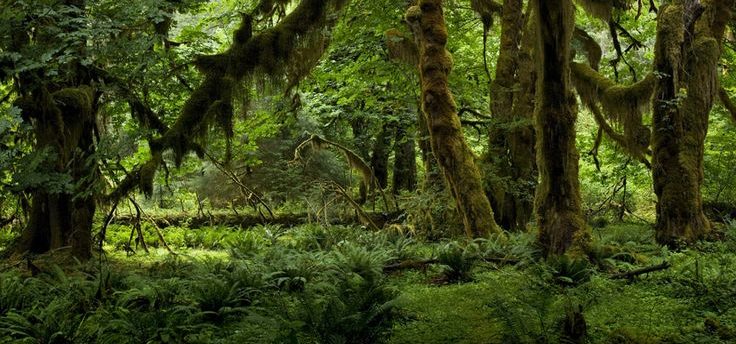
Annie felt guilty for being sad that day. For months, they had dreamt of this place, drained the last of their savings, and plotted every last mile with care. The forest that sprawled before them had already surpassed every hope and expectation—its leafage lusher, its evergreen glow more resplendent, its silence crisper than either had imagined. The late-May sun sifted through parasols of foliage as fir branches fanned skyward in concentric whorls, their lowest needles pricking her arm like a sharp kiss. Mammoth trunks, silvered nearly white, towered into the canopy, and in the deep afternoon shadows beneath them, dew twinkled as though twilight had already fallen. With each step, their soles sank soundlessly into endless cushions of moss. Tender and tremendous, ancient yet full of life, the forest seemed to exist somewhere beyond—borne into the present and worn back into the past by the same ageless winds.
Anil walked slightly ahead, glancing back as if her silence had made a sound. He always seemed to sense the sorrow beneath it, though neither of them could ever plumb its depths. However spectacular the landscape, however close its beauty came to soothing her deepest wounds, some inscrutable sorrow remained buried beyond reach. They wandered through the woods as though returning to a lost childhood, yet even the wildest childlike wonder could never have conjured a world as sublime as the one before them. Within hours, they had given their hearts to it.
The river’s babble gushed into the roar of a waterfall just ahead. They followed the sound to its basin, exchanged a brief glance, then turned together toward the leaping torrents.
“Annie?”
She looked up and, for an instant, felt herself a little girl again, sheltered by his height. He reminded her of the trees—not in force, but in grace, in the strange magic of how something so tall could make her feel so safe.
“You know what I just realized?”
Annie said nothing. She only waited for him to continue.
“I don’t think I knew how much I loved waterfalls until now.” Anil turned back toward the cascade. “The way the water throws itself over the edge again and again—drunk on its own wild rush. It’s incredible, isn’t it?” He glanced at her, grinning. “I think even the ocean will seem dull after this.”
Anil reached for her hand, but she had already beaten him to it, smiling as she braided her fingers through his.
“Oceans, waterfalls—I’d still choose the river any day. That beautiful, unruffled current… if there’s any true harmony in this world, I think it must exist there, in that motion. I could curl up beside its banks, surrender myself to it, and listen to its murmur forever without ever growing tired.”
The word forever suddenly conjured an image she did not want to see: herself crouched beside the same riverbank, listening to the water ripple on, Anil nowhere to be found. Her grip tightened around his hand. Couldn’t she simply remain inside this moment without imagining its end? Couldn’t she gather the fine rays of sunlight, graze her fingers through their warmth, and let them melt into the heat of his palm—even just this once?
Annie was always reaching for some of that warmth, longing to fall into the calm rhythm of Anil’s pulse as her own thrashed and throbbed, to sink into the harmony that seemed to suffuse him so effortlessly. Only later would she understand how hard he always tried to share it with her. She closed her eyes and tried to hold the moment in place, stay there a little longer, but it was already slipping away. Before long, mist pierced the leaves, and every opening revealed a tempest-tossed sky—mounds upon mounds of cloud darkening into a vast nebula of gray. As the daylight sank, Annie felt herself sinking with it, her mind throwing itself again and again over the same edge into darkness.
Anil bent to kiss the crown of her head. Somehow, he always seemed to know when a storm was coming.
“Please, Annie,” he murmured. “Don’t go so far ahead. We’re happy here. Let’s just stay a little longer.”
They ventured deeper into the forest, hands still clasped, talking their way from old wounds to old lovers—his first heartbreak, the boy she once dreamt of marrying—and then, somehow, into language, memory, and all the ineffable spaces in between both. Now and then, the conversation fell quiet—one of them would say something that left the other mesmerized or momentarily speechless, or Annie would have to pause and pick her way across a slick stretch of mud. But the silence never lasted very long. Anil would soon begin humming one of their favorite songs, skipping a few steps ahead until Annie caught the tune and joined him, her lyrics fusing into his melody.
Somewhere between one song and the next, the horizon darkened. Evening thickened into fog, submerging the path ahead as the gloom in Annie’s chest descended with it. As they neared a river they should have crossed hours earlier, the first drop of rain bit her arm like a sting. Annie startled upright, her boot slipping beneath her and pitching her forward toward the mud. She barely caught herself on a low branch. Before she could regain her footing, Anil was beside her, one hand bracing her elbow, the other steady against her back.
“Annie—are you hurt?”
“I’m fine.” She smiled too quickly, though the scrape across her palm had begun to burn.
Anil pulled her upright, but the moment her fingers closed around his, a raindrop struck her cheek. Then another, and another, until the canopy rattled beneath the sudden downpour and Annie’s smile vanished.
“What?” The word came sharper than she intended.
“Nothing. I was just—”
She pulled her hand free. “Why do you always look at me like that?”
“Like what? I was making sure you were okay.”
“Okay?” Her own sharpness startled her. “When am I ever okay?”
“Annie, I didn’t mean—”
“You don’t really want to know. You want me to say I’m fine so you can stop worrying. So we can be okay.” She shook her head. “But I can’t. I can’t even give you that. I only make everything worse. Look—I’m doing it now.”
Frustration sharpened her voice.
“God, Anil, why did you have to ask? We were so happy there in the sunlight, and now it’s raining and everything is ruined…” Her first tear vanished into the rain. “Why is it raining? Why does it always rain here? Why can’t we lie in the sun for more than a few minutes? Why can’t we stay there forever? Why can’t we just be happy? We should be happy—”
Her voice seemed to crumple in her throat. “These are supposed to be our happy memories. This is supposed to be our happy place.”
Anil wiped the rain from his eyes. His mouth opened, then closed. Instead, he moved closer, slowly enough to let her turn away, and rested a hand on her shoulder. She flinched beneath his palm but did not pull back. For the moment, that was enough. Rain poured through the leaves around them, and for a while neither moved. Then, all at once, Annie recoiled.
“Stop—please.” She twisted sharply away, throwing his hand from her shoulder. “Don’t do that.”
“Do what?”
“Don’t touch me like that. Don’t pretend it’s still—” She broke off. “Please. It hurts too much.”
“Annie, I’m not pretending—”
“But you are. We both are.” She shook her head, rain-soaked strands clinging to her cheeks. “We can’t keep coming back here and acting as if nothing has changed.”
“I know things have changed.”
“Then why do you still look at me and see her?” Her voice cracked. “That girl doesn’t exist anymore. She’s gone. I hardly remember who she was to begin with. Some days, I can barely remember the night we met. It’s all fading…”
Anil fell silent. The pain in his eyes seemed to pierce her skin and enter her bloodstream, coursing through her until she could no longer tell whether it belonged to him or to her.
“I remember,” he said at last. He looked past her, into the rain.
“You sounded so worried when you called to tell me you’d missed the train. After we hung up, I kept hearing your voice. For four hours, I stood there holding on to it, replaying it until I almost forgot the cold.”
He paused, lingering in the memory a moment longer.
“It was gray that night too. It was always gray in the city.” He smiled softly. “Then you came around the corner in that long black skirt, billowing in the winter wind, and for a moment, it was all I could see.”
Before Annie could ask him to stop, the rain behind Anil began to glimmer. The storm-dark sky melted into the warm yellow light of the cramped Thai restaurant tucked into a corner storefront on Fourth Street. Eye contact had always been difficult for Annie, but by her second glass of sangria, the evening had somehow skipped ahead in time. Before she could make sense of what she felt, they were already speaking with the entwined tenderness of two people months deep in love.
At the next table, another couple had dawdled over the same half-full pitcher of sangria all night. The woman rose, still laughing, and disappeared down the hallway toward the bathroom. The man watched until she rounded the corner, then turned toward Annie and Anil and leaned in.
“Can I tell you two a secret?” He glanced once more toward the hallway, barely containing his grin.
Annie and Anil exchanged a look, then leaned closer together. The man lowered his voice beneath the clatter of dishes.
“I’m going to propose to her tonight.”
“Tonight?” Annie whispered, smiling.
The man nodded. His grin held, though his fingers trembled beneath the corner of his napkin.
“I’m terrified.”
Anil joined her smile, and together they congratulated him in warm, giddy whispers. When Annie turned back, he was already looking at her. The same gleam shone in their eyes, tinged with something bittersweet.
The memory ended there. Annie could no longer remember the woman returning to the table, whether the man ever found the courage to ask, or what she answered if he did. All that remained was the look she and Anil had shared. As the restaurant’s dim lights trickled back into the rain, Annie searched his face, wondering whether he, too, had just returned from that night.
“I can’t hear any more of it.” Annie’s voice scarcely carried above the rain. “It’s been almost two years, Anil. How can you talk about that night as though nothing came after it?”
“Almost two years?” He waited for her to correct herself. When she didn’t, worry entered his voice.
“Annie, my love, we haven’t even known each other for a year.”
“Please—stop.” The plea came out muffled, scarcely above a whisper. “Why are you pretending not to remember?”
“I’m not pretending.”
“Then why would you say that?”
“Because we met in February. It’s May.”
Anil stepped closer.
“Look around. It’s still spring. The flowers are only just beginning to bloom. See?”
Annie looked above her, beneath her, between the trees. There were no flowers. Only gray. Her knees folded, and she sank into the moss.
“I’m sorry.” She looked from Anil to the trees, then down at the earth beneath her hands, as if apologizing to all three. “I don’t know what’s wrong with me. I—” Her fingers closed around the moss. “I don’t know what I’ve done.”
The sky tore open all at once. Thunder rolled through the canopy, water coursed down the bark, and the forest’s lull contorted into an inhuman scream. Through the clamor, Annie thought she heard her own voice carried on the wind from somewhere beyond sight. Then Anil’s—fainter, farther still. She wheeled toward him, but he had vanished behind the ash spiraling upward from the sodden earth. Annie staggered back against a tree. The voices drew nearer until they seemed to sound from within the wood itself. Rivulets raced down the trunk like waves breaking over driftwood, blurring its grain and bleeding blackness into the night. She wished the water might seep into her memory as well, welling within its rifts until they closed.
“Anil?” Annie called.
She waited.
“Anil—answer me. Where are you?” Her voice broke as she reached blindly through the darkness. “Please—come back. I’m sorry.”
The only body her reach met was that of a tree trunk—its rough bark softening beneath her palm into sea-soaked wood. Light flickered over yellowing strands of moss that now hung from the branches like kelp. A dim horizon inched closer, revealing a forest drowned and desiccated all at once. Annie blinked and found herself seated atop a fallen cedar half-buried in sand. She spun around. There was no forest, no midafternoon—only an empty beach late at night.
A hand brushed the back of her arm. She turned. Anil sat beside her on the same damp log, staring into the distance like the storm had somehow passed through Annie alone.
“Anil…” Annie clutched his sleeve. “I’m sorry about earlier. Everything returned at once, and I couldn’t—” She swallowed, her teeth beginning to chatter. “I watched it all fall apart again.”
Without a word, Anil gathered her against him. He held her there in silence. When he finally spoke, he was looking past her, into the sea.
“There’s something about the ocean at night,” he said. “It frightens me.”
He watched the water closely, searching somewhere beyond the horizon for the words he needed.
“It isn’t like the forest. The forest closes around you. This has no edge, no end.” His eyes moved slowly across the black horizon. “It just keeps opening… opening and opening still.”
Annie lifted her face toward the white iris of the moon. A long while passed before she could bring herself to ask.
“Anil?”
“Yes?”
“Is it only the ocean?”
“What do you mean?”
“The fear.” She hesitated. “Is that all it is?”
Her hand rose to the hollow beneath her ribs.
“Something feels strange. Not exactly wrong, just…” She searched for another word and found none. “Just strange. Like something momentous has happened and we don’t know it yet.” Annie drew a long breath, curling her fingers against her ribs as though she might reach through the bone and find the feeling lodged there.
“I’m starting to feel crazy,” she said. “My stomach keeps sinking, and every time I think it can’t go any lower, it drops again. Like something terrible is about to happen—something I should already know—and every second I don’t, I’m losing another chance to stop it.”
Anil stayed quiet.
“Are we going to be okay?” she asked, the question almost a plea.
He moved closer. “Of course we are.”
Annie looked at him, but the reassurance did not reach her.
“You’re scared. You’ve been scared for a while.” His voice softened. “And being here—the water, the dark, all of this—maybe it’s bringing back things you haven’t let yourself feel.”
“But what if it isn’t only fear?”
Anil hesitated. “I don’t know.” His fingers found hers in the dark. “But even if we lose sight of each other for a while, we’ll find our way back.”
Even Anil seemed taken aback by his own certainty.
“Even when we make each other miserable, we stay. We sit beside each other for hours without saying a word.” He paused. “Annie, I love you. We’ve gone days—weeks—without speaking, and I still catch myself saying it to you in my sleep.”
Anil turned toward her fully.
“When I imagine dying, I never see when or where or how. I don’t see what comes after. I only see pieces of us—blurred, almost too far away to make out. But in every one, we’re both here.” His voice lowered. “We’re together. We’re home.”
Annie could hardly look back at him. For a moment, she wondered whether the weight that had been sinking through her all night was not fear at all, but desire—the terrible weight of wanting something badly enough to become afraid of losing it. She had never wanted anything more than what he had just given her. She had never feared death until she imagined it without him beside her.
“Annie—what’s wrong?” Anil’s voice drew her back. “Why are you shivering?” He gave a puzzled grin. “How are you even cold? It’s almost July.”
“July?” The word felt warmer than the night around them. The air seemed scarcely above freezing. When she reached for the date, she found no recollection of it.
Anil slipped off his jacket and draped it around her shoulders. The next frigid gust bit into her cheeks, and she pulled the jacket tighter. The unease hollowing her stomach rose into her throat and closed around her voice. She could not explain how the moment seemed already to be receding from her, though she was still inside it. Wave after wave broke and re-formed in the darkness, and still not a single word came.
When she looked up again, the storm had torn the sky in two. Wind lashed across the beach, flinging sand and splintered wood as the sea drove itself deeper into the forest’s edge. Annie clung to Anil, his arms the only proof that he remained beside her while the world convulsed around them. When the tempest thinned to a drizzle, she did not let go. Several breaths passed before she realized that both sea and forest had vanished entirely.
In their place, Annie and Anil stood in an alpine meadow floating above veils of cloud, range after range of mountains dissolving into silvery-blue haze. The fury of the sea had dissipated, but the alpine air cut just as sharply. Annie’s dread remained, sharpened by the vertigo of the heights. At the cliff’s edge, Anil stood untroubled, face lifted to the wind, already lost somewhere beyond the horizon.
“This reminds me of your dream,” she called, leaning into the wind as she came to stand beside him.
“My dream?” He turned toward her, one hand raised against the gusts. A curious smile swept across his face. “Which one?”
“The waterfall. The one you’re always talking about.”
His brow furrowed, though the smile remained. “Annie, I honestly have no idea what you mean.”
“Of course you do.” She nudged his arm, still half-convinced he was teasing. “You were beneath a waterfall, climbing through the spray and over all that slick rock until you reached a cliff like this. You stood at the edge and looked out over everything—the falls, the valley, all that endless space.”
Anil followed her gaze toward the panorama below but said nothing.
“Remember?”
He considered it a moment longer. “Suppose you’re right. What happens next?”
“Well, that’s the thing—nothing, really.” She hesitated. “You always said it wasn’t about what happened. It was the feeling.”
The playfulness left her voice.
“Anil, you’ve told me this so many times! How can you not remember?”
“I believe you,” he said, gentler now. “I just can’t find it.”
“None of it?”
He shook his head. “But you can.” His smile softened. “Help me remember.”
Annie took a deep breath and closed her eyes, searching for the cadence of his late-night retellings, each more vivid than the last.
“It was the cold,” she began. “You swore you’d never felt anything like it—sharp, dry, almost piercing. The wind seemed to have no direction. One moment, everything was still; the next, it struck from every side before you knew it was coming.”
She opened her eyes and held his gaze.
“You said that was what you loved most—the fact that you could never brace for it. Something in the cold felt immense—absolute. You couldn’t look away.” Her fingers tightened around his sleeve.
“That was when you began to love the cold—why you’ve been obsessed with it ever since.”
She paused, searching him for some sign of recognition. When none came, she pressed on.
“Like Multnomah that November. Everyone else was shivering, hurrying back to their cars, and you just stood in the freezing spray. Perfectly still.” She almost smiled. “I couldn’t stop watching you. I asked what you were feeling, but you only smiled. It was as if you had slipped into some hidden psychic realm—as though the wind and cold were speaking in a language only you understood.”
He listened without interrupting. “I still can’t place it,” he said at last. “Not one detail.” He turned back toward the horizon. “But listening to you, I can understand why I loved it.”
Another gust swept the hair from his forehead.
“Doesn’t this feel like it? Like the wind has been traveling forever just to reach us, carrying something from somewhere beyond these mountains?”
“Maybe.” Annie looked out over the valley. “It feels impossibly far away and close at once.” Her fingers slackened around his sleeve. “But it was your dream, Anil. How can I be the one remembering it?”
“I still don’t understand.”
“Then stop trying for a moment.” Anil took her hand. “Close your eyes. Really feel it—the bite of the cold, every shiver, every gust that nearly knocks you over.”
She saw herself frolicking through every season, then sitting beside him on the forest floor, rhapsodizing about evergreens and the silken drift of mist while he listened with that same unhurried attention. She watched their love deepen, darken, then slowly recede. Still, they returned again and again, as though the forest alone could resuscitate what they had lost.
When Annie opened her eyes, Anil remained at the precipice. Though he had not moved, he seemed already farther away.
“Well?” She stepped closer, her voice hushed by the wind. “What are you thinking about now?”
He did not answer until she rested her head against his shoulder. Only then did he seem to return to her.
“It’s strange.”
“What is?”
“I still can’t see the dream—not when it happened, not where. Nothing.”
Annie lowered her head, her expression turning serious. “Then why do you believe me?”
“Because something in me recognizes it, even if my memory doesn’t.” He turned toward the valley. “Not the details. Only the feeling. I can’t see it, but I feel it in every gust—in every surge and recoil of the wind. I keep trying to piece the dream together from this place, from today…” He paused. “But perhaps this is how it returns.”
He laughed softly. “Listen to me. I’m beginning to sound like you.”
Annie smiled, then shivered.
“And you?” he asked. “Do you understand it now?”
“I’d like to.” She paused. “I always thought standing here would be enough.” She tightened her grip on his hand and closed her eyes as the last cold gusts of the storm swept across the ridge.
They descended from the ridge through valley and forest, hands still clasped—their only tether from one realm to the next. Anil remained buoyant well into the night. Beside him, Annie felt a solace she had not known in years. Neither knew the night would be his last.
At 5:46 a.m., a doctor entered the waiting room. Annie knew what he had come to say before the first low, careful words left his mouth. She had never known exactly how it would happen, but for years she had imagined this day coming—had tried, in a hundred different ways, to imagine what it would do to her when it did. None of them came close. The scream that tore from her sounded almost inhuman. Afterward, she could not remember the sound of her own voice.
She drove six hours through relentless rain, searching for some sliver of meaning and finding none. Their first night and his final hours replayed as she fought the urge to sink beneath the ocean and never resurface. Instead, she packed what she could carry and boarded the next flight three thousand miles east, returning to a place she had never imagined she would call home again—desperate to banish the memories, silence the flashbacks, and begin again. Within months, she promised herself, she would wake into another life, and this one would seem impossible—a nightmare she once mistook for reality.
For nearly three years, Annie hid from her grief. It terrified her—its sudden ambushes, its merciless dreams, its power to swallow entire hours without warning. She cried herself to sleep each night and woke already afraid of what the day might bring back. No matter how fiercely she tried to forget him—his soft voice, the shelter of his height—the forest kept returning with him. The first year, she buried every memory she could; the second, she built her days around keeping them buried. By the third, the hollow of his absence had widened beyond anything she could contain. At last, in late May, Annie returned to the peninsula alone.
As she steps off the plane, Annie braces for the rage she has spent years expecting to rise within her—but it never comes. When she enters the forest, the warm weave of leaf and earth gathers her in, and for the first time in years, she allows herself to be held.
That night, beneath the pallid wash of moonlight, Annie returns to the beach and makes herself face the sea. The tears come, but this time they do not carry her under. Along the ridge, cold wind scours her face, drying the salt from her cheeks. She draws the cold deep into her lungs until her head swims, and for one bright, breathless moment, life passes through her again.
“Well… what about now?”
Annie does not turn.
“Annie.” The voice comes again, nearer this time. “The cold, the wind—does it feel different?”
Annie closes her eyes. At the next gust, the fine hairs along her arms lift. The wind moves around her, through her, within her, until she can no longer tell where her body ends and the air begins. She feels herself thinning, almost translucent, drawn outward into the night. A wisp of mist threads through her, stitching her to his voice, the stars, the trees and moss, the sea and darkness, until every seam between them disappears.
“The place hasn’t changed,” he says. “The wind is just as cold.”
He waits.
“Do you understand it now?”
An ecstatic smile breaks across her face. Bright and blithe, she turns and gathers him into her arms. No words pass between them. Hand in hand, they descend the slope, gliding along leaf-strewn paths and weaving from tree to tree. Near the forest’s edge, Anil’s silhouette begins to wane, thinning into mist and light until his hand grows weightless in hers. When at last it disappears, Annie does not claw after him. Later that week, Annie returns home only long enough to pack her bags and say goodbye. One final time, she moves three thousand miles across the continent.
In the years that follow, Annie returns to the forest again and again. Her life still tilts between green and gray, riverbed and cataract, hope and sorrow. In sun and rain, warmth and frost, she follows familiar paths through old groves and wild hinterlands, searching until she knows the peninsula in every weather. Days blur into dreams, memories into moments, beginnings into endings, until she can no longer remember what she first hoped to find—or why she began searching. She knows only that somewhere within that impenetrable maze, she found it. In time, Annie settles on a modest plot of land in the heart of the peninsula and, with her own hands, builds their home. To this day, she and Anil wander the surrounding woodlands, waltzing through the wilting gardens of a forest without end.


Leave a Reply