Table of Contents
Short Story Collection (Downloads)
Short Story Collection (Online Versions)
Waltz Through Wilting Gardens
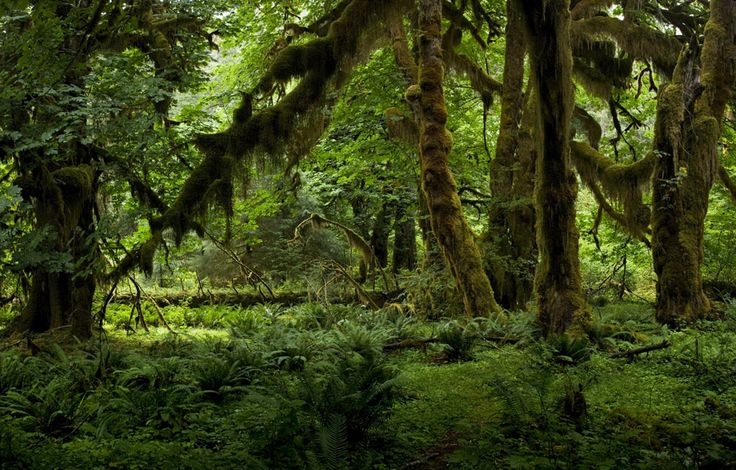
Annie felt guilty for being sad that day. For months, they had dreamt of this place, drained the last of their savings, and plotted every last mile with care. The forest that sprawled before them had already surpassed every hope and expectation—its leafage lusher, its evergreen glow more resplendent, its silence crisper than either had imagined. The late-May sun sifted through parasols of foliage as fir branches fanned skyward in concentric whorls, their lowest needles pricking her arm like a sharp kiss. Mammoth trunks, silvered nearly white, towered into the canopy, and in the deep afternoon shadows beneath them, dew twinkled as though twilight had already fallen. With each step, their soles sank soundlessly into endless cushions of moss. Tender and tremendous, ancient yet full of life, the forest seemed to exist somewhere beyond—borne into the present and worn back into the past by the same ageless winds.
Anil walked slightly ahead, glancing back as if her silence had made a sound. He always seemed to sense the sorrow beneath it, though neither of them could ever plumb its depths. However spectacular the landscape, however close its beauty came to soothing her deepest wounds, some inscrutable sorrow remained buried beyond reach. They wandered through the woods as though returning to a lost childhood, yet even the wildest childlike wonder could never have conjured a world as sublime as the one before them. Within hours, they had given their hearts to it.
The river’s babble gushed into the roar of a waterfall just ahead. They followed the sound to its basin, exchanged a brief glance, then turned together toward the leaping torrents.
“Annie?”
She looked up and, for an instant, felt herself a little girl again, sheltered by his height. He reminded her of the trees—not in force, but in grace, in the strange magic of how something so tall could make her feel so safe.
“You know what I just realized?”
Annie said nothing. She only waited for him to continue.
“I don’t think I knew how much I loved waterfalls until now.” Anil turned back toward the cascade. “The way the water throws itself over the edge again and again—drunk on its own wild rush. It’s incredible, isn’t it?” He glanced at her, grinning. “I think even the ocean will seem dull after this.”
Anil reached for her hand, but she had already beaten him to it, smiling as she braided her fingers through his.
“Oceans, waterfalls—I’d still choose the river any day. That beautiful, unruffled current… if there’s any true harmony in this world, I think it must exist there, in that motion. I could curl up beside its banks, surrender myself to it, and listen to its murmur forever without ever growing tired.”
The word forever suddenly conjured an image she did not want to see: herself crouched beside the same riverbank, listening to the water ripple on, Anil nowhere to be found. Her grip tightened around his hand. Couldn’t she simply remain inside this moment without imagining its end? Couldn’t she gather the fine rays of sunlight, graze her fingers through their warmth, and let them melt into the heat of his palm—even just this once?
Annie was always reaching for some of that warmth, longing to fall into the calm rhythm of Anil’s pulse as her own thrashed and throbbed, to sink into the harmony that seemed to suffuse him so effortlessly. Only later would she understand how hard he always tried to share it with her. She closed her eyes and tried to hold the moment in place, stay there a little longer, but it was already slipping away. Before long, mist pierced the leaves, and every opening revealed a tempest-tossed sky—mounds upon mounds of cloud darkening into a vast nebula of gray. As the daylight sank, Annie felt herself sinking with it, her mind throwing itself again and again over the same edge into darkness.
Anil bent to kiss the crown of her head. Somehow, he always seemed to know when a storm was coming.
“Please, Annie,” he murmured. “Don’t go so far ahead. We’re happy here. Let’s just stay a little longer.”
They ventured deeper into the forest, hands still clasped, talking their way from old wounds to old lovers—his first heartbreak, the boy she once dreamt of marrying—and then, somehow, into language, memory, and all the ineffable spaces in between both. Now and then, the conversation fell quiet—one of them would say something that left the other mesmerized or momentarily speechless, or Annie would have to pause and pick her way across a slick stretch of mud. But the silence never lasted very long. Anil would soon begin humming one of their favorite songs, skipping a few steps ahead until Annie caught the tune and joined him, her lyrics fusing into his melody.
Somewhere between one song and the next, the horizon darkened. Evening thickened into fog, submerging the path ahead as the gloom in Annie’s chest descended with it. As they neared a river they should have crossed hours earlier, the first drop of rain bit her arm like a sting. Annie startled upright, her boot slipping beneath her and pitching her forward toward the mud. She barely caught herself on a low branch. Before she could regain her footing, Anil was beside her, one hand bracing her elbow, the other steady against her back.
“Annie—are you hurt?”
“I’m fine.” She smiled too quickly, though the scrape across her palm had begun to burn.
Anil pulled her upright, but the moment her fingers closed around his, a raindrop struck her cheek. Then another, and another, until the canopy rattled beneath the sudden downpour and Annie’s smile vanished.
“What?” The word came sharper than she intended.
“Nothing. I was just—”
She pulled her hand free. “Why do you always look at me like that?”
“Like what? I was making sure you were okay.”
“Okay?” Her own sharpness startled her. “When am I ever okay?”
“Annie, I didn’t mean—”
“You don’t really want to know. You want me to say I’m fine so you can stop worrying. So we can be okay.” She shook her head. “But I can’t. I can’t even give you that. I only make everything worse. Look—I’m doing it now.”
Frustration sharpened her voice.
“God, Anil, why did you have to ask? We were so happy there in the sunlight, and now it’s raining and everything is ruined…” Her first tear vanished into the rain. “Why is it raining? Why does it always rain here? Why can’t we lie in the sun for more than a few minutes? Why can’t we stay there forever? Why can’t we just be happy? We should be happy—”
Her voice seemed to crumple in her throat. “These are supposed to be our happy memories. This is supposed to be our happy place.”
Anil wiped the rain from his eyes. His mouth opened, then closed. Instead, he moved closer, slowly enough to let her turn away, and rested a hand on her shoulder. She flinched beneath his palm but did not pull back. For the moment, that was enough. Rain poured through the leaves around them, and for a while neither moved. Then, all at once, Annie recoiled.
“Stop—please.” She twisted sharply away, throwing his hand from her shoulder. “Don’t do that.”
“Do what?”
“Don’t touch me like that. Don’t pretend it’s still—” She broke off. “Please. It hurts too much.”
“Annie, I’m not pretending—”
“But you are. We both are.” She shook her head, rain-soaked strands clinging to her cheeks. “We can’t keep coming back here and acting as if nothing has changed.”
“I know things have changed.”
“Then why do you still look at me and see her?” Her voice cracked. “That girl doesn’t exist anymore. She’s gone. I hardly remember who she was to begin with. Some days, I can barely remember the night we met. It’s all fading…”
Anil fell silent. The pain in his eyes seemed to pierce her skin and enter her bloodstream, coursing through her until she could no longer tell whether it belonged to him or to her.
“I remember,” he said at last. He looked past her, into the rain.
“You sounded so worried when you called to tell me you’d missed the train. After we hung up, I kept hearing your voice. For four hours, I stood there holding on to it, replaying it until I almost forgot the cold.”
He paused, lingering in the memory a moment longer.
“It was gray that night too. It was always gray in the city.” He smiled softly. “Then you came around the corner in that long black skirt, billowing in the winter wind, and for a moment, it was all I could see.”
Before Annie could ask him to stop, the rain behind Anil began to glimmer. The storm-dark sky melted into the warm yellow light of the cramped Thai restaurant tucked into a corner storefront on Fourth Street. Eye contact had always been difficult for Annie, but by her second glass of sangria, the evening had somehow skipped ahead in time. Before she could make sense of what she felt, they were already speaking with the entwined tenderness of two people months deep in love.
At the next table, another couple had dawdled over the same half-full pitcher of sangria all night. The woman rose, still laughing, and disappeared down the hallway toward the bathroom. The man watched until she rounded the corner, then turned toward Annie and Anil and leaned in.
“Can I tell you two a secret?” He glanced once more toward the hallway, barely containing his grin.
Annie and Anil exchanged a look, then leaned closer together. The man lowered his voice beneath the clatter of dishes.
“I’m going to propose to her tonight.”
“Tonight?” Annie whispered, smiling.
The man nodded. His grin held, though his fingers trembled beneath the corner of his napkin.
“I’m terrified.”
Anil joined her smile, and together they congratulated him in warm, giddy whispers. When Annie turned back, he was already looking at her. The same gleam shone in their eyes, tinged with something bittersweet.
The memory ended there. Annie could no longer remember the woman returning to the table, whether the man ever found the courage to ask, or what she answered if he did. All that remained was the look she and Anil had shared. As the restaurant’s dim lights trickled back into the rain, Annie searched his face, wondering whether he, too, had just returned from that night.
“I can’t hear any more of it.” Annie’s voice scarcely carried above the rain. “It’s been almost two years, Anil. How can you talk about that night as though nothing came after it?”
“Almost two years?” He waited for her to correct herself. When she didn’t, worry entered his voice.
“Annie, my love, we haven’t even known each other for a year.”
“Please—stop.” The plea came out muffled, scarcely above a whisper. “Why are you pretending not to remember?”
“I’m not pretending.”
“Then why would you say that?”
“Because we met in February. It’s May.”
Anil stepped closer.
“Look around. It’s still spring. The flowers are only just beginning to bloom. See?”
Annie looked above her, beneath her, between the trees. There were no flowers. Only gray. Her knees folded, and she sank into the moss.
“I’m sorry.” She looked from Anil to the trees, then down at the earth beneath her hands, as if apologizing to all three. “I don’t know what’s wrong with me. I—” Her fingers closed around the moss. “I don’t know what I’ve done.”
The sky tore open all at once. Thunder rolled through the canopy, water coursed down the bark, and the forest’s lull contorted into an inhuman scream. Through the clamor, Annie thought she heard her own voice carried on the wind from somewhere beyond sight. Then Anil’s—fainter, farther still. She wheeled toward him, but he had vanished behind the ash spiraling upward from the sodden earth. Annie staggered back against a tree. The voices drew nearer until they seemed to sound from within the wood itself. Rivulets raced down the trunk like waves breaking over driftwood, blurring its grain and bleeding blackness into the night. She wished the water might seep into her memory as well, welling within its rifts until they closed.
“Anil?” Annie called.
She waited.
“Anil—answer me. Where are you?” Her voice broke as she reached blindly through the darkness. “Please—come back. I’m sorry.”
The only body her reach met was that of a tree trunk—its rough bark softening beneath her palm into sea-soaked wood. Light flickered over yellowing strands of moss that now hung from the branches like kelp. A dim horizon inched closer, revealing a forest drowned and desiccated all at once. Annie blinked and found herself seated atop a fallen cedar half-buried in sand. She spun around. There was no forest, no midafternoon—only an empty beach late at night.
A hand brushed the back of her arm. She turned. Anil sat beside her on the same damp log, staring into the distance like the storm had somehow passed through Annie alone.
“Anil…” Annie clutched his sleeve. “I’m sorry about earlier. Everything returned at once, and I couldn’t—” She swallowed, her teeth beginning to chatter. “I watched it all fall apart again.”
Without a word, Anil gathered her against him. He held her there in silence. When he finally spoke, he was looking past her, into the sea.
“There’s something about the ocean at night,” he said. “It frightens me.”
He watched the water closely, searching somewhere beyond the horizon for the words he needed.
“It isn’t like the forest. The forest closes around you. This has no edge, no end.” His eyes moved slowly across the black horizon. “It just keeps opening… opening and opening still.”
Annie lifted her face toward the white iris of the moon. A long while passed before she could bring herself to ask.
“Anil?”
“Yes?”
“Is it only the ocean?”
“What do you mean?”
“The fear.” She hesitated. “Is that all it is?”
Her hand rose to the hollow beneath her ribs.
“Something feels strange. Not exactly wrong, just…” She searched for another word and found none. “Just strange. Like something momentous has happened and we don’t know it yet.” Annie drew a long breath, curling her fingers against her ribs as though she might reach through the bone and find the feeling lodged there.
“I’m starting to feel crazy,” she said. “My stomach keeps sinking, and every time I think it can’t go any lower, it drops again. Like something terrible is about to happen—something I should already know—and every second I don’t, I’m losing another chance to stop it.”
Anil stayed quiet.
“Are we going to be okay?” she asked, the question almost a plea.
He moved closer. “Of course we are.”
Annie looked at him, but the reassurance did not reach her.
“You’re scared. You’ve been scared for a while.” His voice softened. “And being here—the water, the dark, all of this—maybe it’s bringing back things you haven’t let yourself feel.”
“But what if it isn’t only fear?”
Anil hesitated. “I don’t know.” His fingers found hers in the dark. “But even if we lose sight of each other for a while, we’ll find our way back.”
Even Anil seemed taken aback by his own certainty.
“Even when we make each other miserable, we stay. We sit beside each other for hours without saying a word.” He paused. “Annie, I love you. We’ve gone days—weeks—without speaking, and I still catch myself saying it to you in my sleep.”
Anil turned toward her fully.
“When I imagine dying, I never see when or where or how. I don’t see what comes after. I only see pieces of us—blurred, almost too far away to make out. But in every one, we’re both here.” His voice lowered. “We’re together. We’re home.”
Annie could hardly look back at him. For a moment, she wondered whether the weight that had been sinking through her all night was not fear at all, but desire—the terrible weight of wanting something badly enough to become afraid of losing it. She had never wanted anything more than what he had just given her. She had never feared death until she imagined it without him beside her.
“Annie—what’s wrong?” Anil’s voice drew her back. “Why are you shivering?” He gave a puzzled grin. “How are you even cold? It’s almost July.”
“July?” The word felt warmer than the night around them. The air seemed scarcely above freezing. When she reached for the date, she found no recollection of it.
Anil slipped off his jacket and draped it around her shoulders. The next frigid gust bit into her cheeks, and she pulled the jacket tighter. The unease hollowing her stomach rose into her throat and closed around her voice. She could not explain how the moment seemed already to be receding from her, though she was still inside it. Wave after wave broke and re-formed in the darkness, and still not a single word came.
When she looked up again, the storm had torn the sky in two. Wind lashed across the beach, flinging sand and splintered wood as the sea drove itself deeper into the forest’s edge. Annie clung to Anil, his arms the only proof that he remained beside her while the world convulsed around them. When the tempest thinned to a drizzle, she did not let go. Several breaths passed before she realized that both sea and forest had vanished entirely.
In their place, Annie and Anil stood in an alpine meadow floating above veils of cloud, range after range of mountains dissolving into silvery-blue haze. The fury of the sea had dissipated, but the alpine air cut just as sharply. Annie’s dread remained, sharpened by the vertigo of the heights. At the cliff’s edge, Anil stood untroubled, face lifted to the wind, already lost somewhere beyond the horizon.
“This reminds me of your dream,” she called, leaning into the wind as she came to stand beside him.
“My dream?” He turned toward her, one hand raised against the gusts. A curious smile swept across his face. “Which one?”
“The waterfall. The one you’re always talking about.”
His brow furrowed, though the smile remained. “Annie, I honestly have no idea what you mean.”
“Of course you do.” She nudged his arm, still half-convinced he was teasing. “You were beneath a waterfall, climbing through the spray and over all that slick rock until you reached a cliff like this. You stood at the edge and looked out over everything—the falls, the valley, all that endless space.”
Anil followed her gaze toward the panorama below but said nothing.
“Remember?”
He considered it a moment longer. “Suppose you’re right. What happens next?”
“Well, that’s the thing—nothing, really.” She hesitated. “You always said it wasn’t about what happened. It was the feeling.”
The playfulness left her voice.
“Anil, you’ve told me this so many times! How can you not remember?”
“I believe you,” he said, gentler now. “I just can’t find it.”
“None of it?”
He shook his head. “But you can.” His smile softened. “Help me remember.”
Annie took a deep breath and closed her eyes, searching for the cadence of his late-night retellings, each more vivid than the last.
“It was the cold,” she began. “You swore you’d never felt anything like it—sharp, dry, almost piercing. The wind seemed to have no direction. One moment, everything was still; the next, it struck from every side before you knew it was coming.”
She opened her eyes and held his gaze.
“You said that was what you loved most—the fact that you could never brace for it. Something in the cold felt immense—absolute. You couldn’t look away.” Her fingers tightened around his sleeve.
“That was when you began to love the cold—why you’ve been obsessed with it ever since.”
She paused, searching him for some sign of recognition. When none came, she pressed on.
“Like Multnomah that November. Everyone else was shivering, hurrying back to their cars, and you just stood in the freezing spray. Perfectly still.” She almost smiled. “I couldn’t stop watching you. I asked what you were feeling, but you only smiled. It was as if you had slipped into some hidden psychic realm—as though the wind and cold were speaking in a language only you understood.”
He listened without interrupting. “I still can’t place it,” he said at last. “Not one detail.” He turned back toward the horizon. “But listening to you, I can understand why I loved it.”
Another gust swept the hair from his forehead.
“Doesn’t this feel like it? Like the wind has been traveling forever just to reach us, carrying something from somewhere beyond these mountains?”
“Maybe.” Annie looked out over the valley. “It feels impossibly far away and close at once.” Her fingers slackened around his sleeve. “But it was your dream, Anil. How can I be the one remembering it?”
“I still don’t understand.”
“Then stop trying for a moment.” Anil took her hand. “Close your eyes. Really feel it—the bite of the cold, every shiver, every gust that nearly knocks you over.”
She saw herself frolicking through every season, then sitting beside him on the forest floor, rhapsodizing about evergreens and the silken drift of mist while he listened with that same unhurried attention. She watched their love deepen, darken, then slowly recede. Still, they returned again and again, as though the forest alone could resuscitate what they had lost.
When Annie opened her eyes, Anil remained at the precipice. Though he had not moved, he seemed already farther away.
“Well?” She stepped closer, her voice hushed by the wind. “What are you thinking about now?”
He did not answer until she rested her head against his shoulder. Only then did he seem to return to her.
“It’s strange.”
“What is?”
“I still can’t see the dream—not when it happened, not where. Nothing.”
Annie lowered her head, her expression turning serious. “Then why do you believe me?”
“Because something in me recognizes it, even if my memory doesn’t.” He turned toward the valley. “Not the details. Only the feeling. I can’t see it, but I feel it in every gust—in every surge and recoil of the wind. I keep trying to piece the dream together from this place, from today…” He paused. “But perhaps this is how it returns.”
He laughed softly. “Listen to me. I’m beginning to sound like you.”
Annie smiled, then shivered.
“And you?” he asked. “Do you understand it now?”
“I’d like to.” She paused. “I always thought standing here would be enough.” She tightened her grip on his hand and closed her eyes as the last cold gusts of the storm swept across the ridge.
They descended from the ridge through valley and forest, hands still clasped—their only tether from one realm to the next. Anil remained buoyant well into the night. Beside him, Annie felt a solace she had not known in years. Neither knew the night would be his last.
At 5:46 a.m., a doctor entered the waiting room. Annie knew what he had come to say before the first low, careful words left his mouth. She had never known exactly how it would happen, but for years she had imagined this day coming—had tried, in a hundred different ways, to imagine what it would do to her when it did. None of them came close. The scream that tore from her sounded almost inhuman. Afterward, she could not remember the sound of her own voice.
She drove six hours through relentless rain, searching for some sliver of meaning and finding none. Their first night and his final hours replayed as she fought the urge to sink beneath the ocean and never resurface. Instead, she packed what she could carry and boarded the next flight three thousand miles east, returning to a place she had never imagined she would call home again—desperate to banish the memories, silence the flashbacks, and begin again. Within months, she promised herself, she would wake into another life, and this one would seem impossible—a nightmare she once mistook for reality.
For nearly three years, Annie hid from her grief. It terrified her—its sudden ambushes, its merciless dreams, its power to swallow entire hours without warning. She cried herself to sleep each night and woke already afraid of what the day might bring back. No matter how fiercely she tried to forget him—his soft voice, the shelter of his height—the forest kept returning with him. The first year, she buried every memory she could; the second, she built her days around keeping them buried. By the third, the hollow of his absence had widened beyond anything she could contain. At last, in late May, Annie returned to the peninsula alone.
As she steps off the plane, Annie braces for the rage she has spent years expecting to rise within her—but it never comes. When she enters the forest, the warm weave of leaf and earth gathers her in, and for the first time in years, she allows herself to be held.
That night, beneath the pallid wash of moonlight, Annie returns to the beach and makes herself face the sea. The tears come, but this time they do not carry her under. Along the ridge, cold wind scours her face, drying the salt from her cheeks. She draws the cold deep into her lungs until her head swims, and for one bright, breathless moment, life passes through her again.
“Well… what about now?”
Annie does not turn.
“Annie.” The voice comes again, nearer this time. “The cold, the wind—does it feel different?”
Annie closes her eyes. At the next gust, the fine hairs along her arms lift. The wind moves around her, through her, within her, until she can no longer tell where her body ends and the air begins. She feels herself thinning, almost translucent, drawn outward into the night. A wisp of mist threads through her, stitching her to his voice, the stars, the trees and moss, the sea and darkness, until every seam between them disappears.
“The place hasn’t changed,” he says. “The wind is just as cold.”
He waits.
“Do you understand it now?”
An ecstatic smile breaks across her face. Bright and blithe, she turns and gathers him into her arms. No words pass between them. Hand in hand, they descend the slope, gliding along leaf-strewn paths and weaving from tree to tree. Near the forest’s edge, Anil’s silhouette begins to wane, thinning into mist and light until his hand grows weightless in hers. When at last it disappears, Annie does not claw after him. Later that week, Annie returns home only long enough to pack her bags and say goodbye. One final time, she moves three thousand miles across the continent.
In the years that follow, Annie returns to the forest again and again. Her life still tilts between green and gray, riverbed and cataract, hope and sorrow. In sun and rain, warmth and frost, she follows familiar paths through old groves and wild hinterlands, searching until she knows the peninsula in every weather. Days blur into dreams, memories into moments, beginnings into endings, until she can no longer remember what she first hoped to find—or why she began searching. She knows only that somewhere within that impenetrable maze, she found it. In time, Annie settles on a modest plot of land in the heart of the peninsula and, with her own hands, builds their home. To this day, she and Anil wander the surrounding woodlands, waltzing through the wilting gardens of a forest without end.
“Waltz Through Wilting Gardens” PDF Version
My Brother, the Hunter
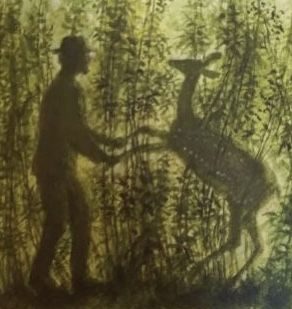
How long have I known him? Mm… Many years now—more than I know how to measure. Count them? No, no… Who could count a thing like that? In the old days, he came at dawn, morning after morning, while the river still held the black of night and the first red of day had only begun to bleed through the leaves. Only then would he appear: pale little thing, bare and bright, impossible to miss among all that green. Now he comes after dusk, if he comes at all—smoke in his hair, slipping through the shadows until the dark nearly swallows him whole. He never looks this way. Thinks no one sees him. He does not know I am still here.
Before him, I had known little but solitude. No warm palm had ever lowered toward my head. No kindness had ever come nosing into my little dark. Well… no matter. I had the leaves, the spiders, the snakes, the warm wind moving through the trees above—more than enough, yes, or so I believed. But the boy was different. I remember that first morning: he crouched beside the river, his head bent so near the water he seemed to be listening for something beneath its skin. Men? Yes, of course I knew men—their heavy boots, the stench of stale smoke, their voices cleaving through the heat. But a boy? No. Never before him. He frightened me at first—that pale, bare chest shining against the river-murk. From within the dark of leaves and roots, I watched him closely, ears raised, legs folded tight beneath me. Frightened? Mm… yes. Yet I did not run. I told myself I stayed only to learn his movements, to know when to flee. No, no… that was a lie. Before he lifted his face, something in the way he bent his whole body toward the river had already held me there—as though he listened with his eyes, his shoulders, even the small bones of his hand pressed into the mud. Just as I had bent toward him. He left that morning without knowing I was there. Yet long before the next dawn, I was back in the same place, waiting for him to return with the first light.
He had a peculiar courage. Jaguar courage? Perhaps… almost. Jaguar watches. Jaguar listens. Lies low and waits. No hurry in him—only hunger held tight beneath his hide until the jungle grants him one clean pounce. The boy could wait like that. But not for prey. No, no… he waited only to listen. My family knew Jaguar too, though neither Jaguar’s courage nor the boy’s seemed to live in us—or so I thought. We were small things, quick-fearing things—made for leaf-shadow and root-dark. Spider or serpent, frail or fierce—it hardly mattered. If another eye so much as turned our way, we were gone. A coward, you say? Hmph. Mother thought so too. “The jungle has no pity for cowards,” she would scoff. But I know better now. Hiding was no cowardice. It required a patience of its own: knowing when to keep still, when to slip away, when to be seen—and when not. The boy had not yet learned that last part. The ferns told on him wherever he passed, trembling long after he had gone. Beetles scuttled aside before his feet, and his bare limbs flashed sharp and loud through the waking green. At first, I took him for clumsy. Then I noticed the care inside each stumble: how he searched the earth before every step, as though some small, secret life were breathing beneath each leaf. Once, a frog crossed his path. He stopped so quickly he nearly toppled backward. Another morning, a tarantula crept the length of his arm. Did he shudder? No, no… not even a twitch. He held himself still until its last leg passed from his skin onto the nearest branch. Clumsy? No, no… careful. Strange boy. Tender boy. He came back quieter each time, learning where to place his feet, which tremor belonged to the wind, which sudden hush meant another creature was near. Some mornings, he came all that way through the snarl of branch and fern only to leave a few breaths later. Other days, he stayed deep into the thick heat of afternoon. But before he left, he always returned to the river. He would sink his palms into its cool dark and sit very still, watching ants thread a slow black path along the bank and dragonflies flicker above the current, listening until the silence seemed to open into a hundred little murmurs.
I had only begun to wonder how I might show myself to him when the forest made the choice for me. One morning before dawn, I lay curled in the root-dark hollow left by some great tree long since fallen. All through the night, metal had ground through wood and trunks had struck the earth, each fall shuddering through the roots beneath me. Daylight entered little by little. Only then did I see what those long hours had done. The canopy had opened onto bare sky. Severed vines hung in the open air; saplings lay crushed into the earth; familiar turns ended in raw clearings; shadows I had known all my life were simply gone. For the first time, I wished the boy would not come. Then a sob rose from somewhere in the broken green. I knew it was his before I saw him. He knelt among the fallen branches, his face buried in his hands. I watched him tremble there, alone beneath all that empty sky, until my body rose without asking me. Did I mean to leave the hollow? Mm… perhaps. I only knew I could not stay hidden while he grieved among all that ruin. By the time fear told me to turn back, I was already crossing the open ground toward him. He did not flee. Did not even flinch. He lifted his face. His hands fell away. Slowly, he opened his arms toward me.
After that, I no longer felt the need to hide. We spoke little at first, my new friend and I, but soon there was no distance left between us. Words? Mm… what use had we for them? He murmured to me, yes, but I understood him better by the easing of his shoulders, the weight of his palm, the slowing of his breath until it matched my own. That was our speech. We listened—to river-murmur, leaf-shiver, insect-wing; to each other breathing inside the green dark. Before long, he came straight to the hollow, and I knew him by his scent, the gleam in his eyes, the warmth rising from his skin. With my head against his chest, I learned the beat of his heart. Brothers, I called us. Did he? Mm… I could not know. Yet when he rested his brow against mine and made that low sound in his throat, I believed he did.
The forest was not enough for them. Soon the machines moved upstream, cutting into the banks and grinding through the shallows where the boy had once sunk his palms and watched silver fish smoke between his fingers. After the next hard rain, the water came down thick with loosened clay, and diesel spread thin colors across its surface. The fish vanished. Fled? Buried themselves deep? Drifted somewhere downstream with their mouths open? We never knew. Still, morning after morning, the boy knelt with his hands sunk in the silt, searching the ruined current for one silver flicker. Some days he wept. Other days he sat dry-eyed until dark. All the while, the machines cut deeper, the clearings widened, and the forest fell away around us. Then the boy began to draw closer to the men. At first, he only watched from the edge of the clearing while they laughed and called him nearer. Then he carried their water. Their rope. Their dented tins of fuel. Small tasks, yes—but he hid them from me, though their smell clung to his hands. One evening, after he had dragged a coil of rope from the road, one of the men pressed a tin cup into his hand. The boy drank. The men laughed. One struck him on the shoulder, and after a moment, the boy laughed too. Soon came the orange cap, bright among the leaves. At first, he left it outside the hollow. Last came the gun, its metal bright against his side. By then, he came later and later—if he came to me at all—his breath sour with liquor and smoke. I kept my distance. The men’s words came with him now, broken and bitter between his teeth. Still, I told myself he was only a boy, frightened into borrowing their hardness. But little by little, that boy receded, until even when his hand returned to its old place between my ears, I could no longer be certain who was touching me.
Since then, I have known him only from afar. I smell him before I see him now—not river water, no, nor leaves crushed beneath his palms, nor the warm musk of the jungle. Machine oil. Diesel. Smoke. The bitter ash of burned green. He appears only near sunset, crossing the clearings that have widened along the road, his hands black with grease. He walks among the men. They slap his shoulder, spit into the road, shout above the engines. Sometimes he laughs with them. Sometimes he says nothing, his head bowed as their laughter breaks around him. Then his scent disappears again, morning after morning, until I begin to think he will not return. Whole weeks pass inside the silence he leaves behind.
It is nearly dusk now. From what little cover remains, I watch him fall behind the others, the rifle slung across his shoulder, until their voices recede and he stands alone among the stumps. He pauses, listening as the last engine fades. His shoulders loosen as they once did beside the river. The longer I watch, the more the man thins and the boy returns: bright and bare at the water’s edge, his hands breaking the dark surface, his whole body bent toward its smallest murmurs. My ears turn toward him. My brother… A low grunt gathers in my throat. I bow my head and hold my breath, but the sound tears loose. I flinch—too late. It has already crossed the clearing. He turns. For one breath, neither of us moves. His eyes find mine and hold, then shift toward the old hollow. The rifle dips. He remembers, I think. Yes… he remembers. Any moment now, he will lower it and cross the clearing. I step from cover and begin picking my way toward him over the fallen branches. His fingers tighten around the stock. His shoulder sets. Crack. Clay kicks up beside my foreleg, and I leap sideways. The bolt snaps back, then forward. Another flash. A hot line opens across my flank, and bark bursts from the trunk behind me. I lunge toward the trees, then turn back. Mistake? Mm… it must be. How could he not recognize me? We are brothers. I search his face for recognition, regret—anything. Nothing. He advances, working the bolt as he comes, the orange cap he once left outside my hollow pulled low over his eyes. How can he move so quickly? Or have I been standing still all this time? I scramble across the torn earth and call to him again, straining to make some sound he might remember, to find some sign in his face of what we once had been. But nothing of my brother looks back. Then he stops. Waits, yes—but not as the boy waited beside the river, nor as Jaguar waits. He lets the metal do his waiting now. Another hunger has him—flash-bright, crack-loud, metal-sharp. He knows. No mistake. The rifle rises again, and at last I understand: my brother is hunting me
I know now there is no more time. Run-wait, wait-run… No. Run. For a moment, my legs lock into place. Move, I tell myself. Move. Crack. Something strikes just behind my foreleg and turns the clearing sideways. At first, there is no pain—only a great shove, then heat opens inside me. Still, my legs carry me. The first strides come fast, but soon my chest begins to tighten. Something warm rises in my throat, and I cannot help but glance back at him once more. I flee that little place we once called home, each step pounding over the forest floor that had held all our mornings. Faster, faster, toward the last dark between the trees, toward—h… hh… toward— My forelegs fold. The dark pitches me into the leaves. My legs thrash once, twice, tearing at empty air. I try to cry out, but only breath escapes—a thin whistle, then a wet hiss. For a while, no footsteps follow. He waits at the edge of the clearing, watching. Blood spreads hot beneath me. I strain to look back, but the clearing wavers, and suddenly I see him as he was beside the river. Bare sky… bare shoulders… The boy’s pale body flashes through my mind. Brother, I try to call. Brother… But only another low grunt comes, then the broken kh—rrr—rr, each sound betraying what I mean to say. His footsteps draw nearer. Step—crush. Step—crush. They grow louder as the river, the insects, the wind begin to fall away. He sees me. Knows me. Still he comes, following the blood with the rifle ready in both hands. I force my head up, but my neck gives and my jaw drops back into the leaves. Another cry breaks from my throat—wet, weak, ragged. He does not flinch. His shadow passes over me. Stop, I try to tell him. This is a mistake. Please… listen. You must know me. You must know my voice. I have known you many years now—more than I know how to measure. Count? No, no… not count. Know. I know you. I know—hsss… mis—tk… hh… kh—rrrr… I…
The young hunter reached the deer before it drew its final breath. He stood over it, the rifle ready in both hands, and watched until its chest fell still. Then he pulled off his orange cap and knelt beside the body, watching the blood blacken the clay and soak into tawny fur. He laid the rifle within reach, drew a folding saw from his belt, and leaned closer. His hand moved toward the familiar place between the ears, then stopped. For a moment, his fingers hovered above the fur, as though those wisps had disturbed something deep inside him. He closed his hand into a fist and struck himself once in the chest—hard, as if to dislodge whatever was caught behind his ribs. Nothing came.
The hunter planted one palm between the deer’s ears and pressed its head into the clay. The first scrape of metal at the base of the antlers made him flinch. The second tightened his jaw. But by the third, the blade had found its rhythm—back and forth, back and forth—biting through fur, hide, and bone until the skull plate gave with a dry crack. He pulled the antlers free. From the distant road, one of the men called his name. He drew the orange cap back over his head and rose, the antlers in one fist. He looked once toward the old hollow, once at the body beneath him, then slung the rifle across his shoulder, turned his back on the river, and walked straight into the unrecoverable dark.
At last, he had become a man.
“My Brother, the Hunter” PDF Version
The Long Way Home
Esmeralda woke with a shiver. Still half asleep, she reached for her mother’s hand and found only the cold sheet, whatever warmth had been there already gone. The thin glow of dawn had begun to spill into the empty shadow beside her. For a moment, she kept her hand there anyway, hoping, in the soft confusion of waking, to feel her mother’s fingers close around her own. But after a few seconds, she understood: her mother had been gone for a long while.
She pulled the blanket up to her cheeks and curled deeper into herself. The clock read 5:48 a.m.—almost an hour before she had to leave for school. Esmeralda squeezed her eyes shut, trying to force herself back into sleep, but her thoughts had already begun to race, and the cold had stiffened her body too tightly for rest. As November wore on, the desert nights had hardened into a dense, unmoving stillness. The dry cold sank low through the apartment, gathering along the walls, the floors, the thin seams of the windows. Yet despite all her daughter’s pleading, Dolores Estrada insisted it was “still not cold enough” to turn on the heat at night.
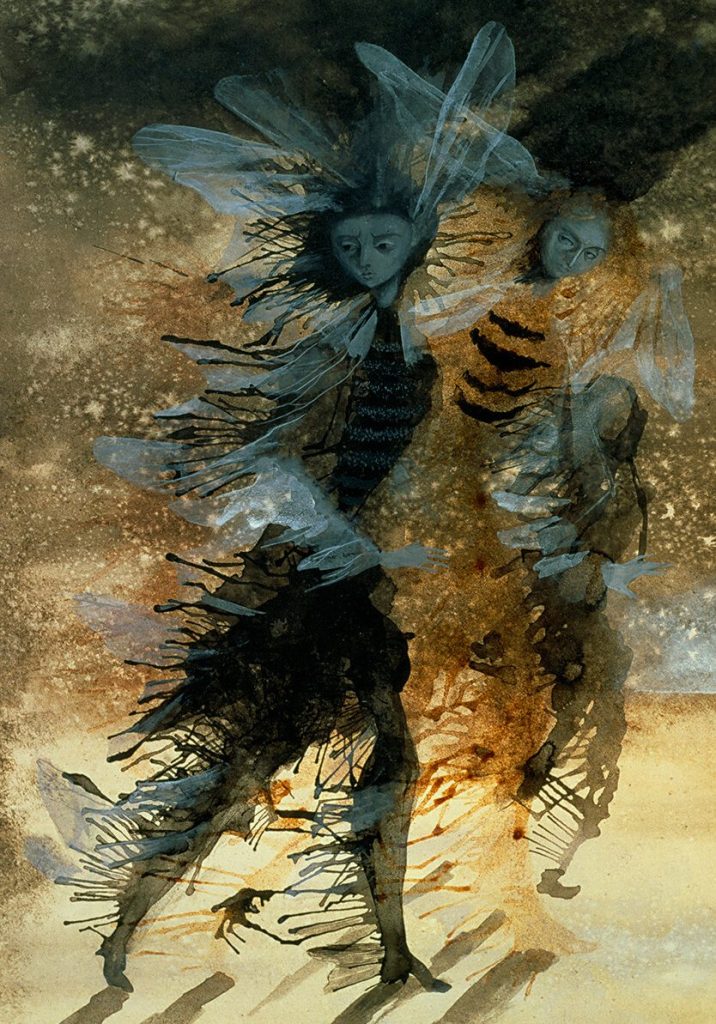
The first shimmer of sunlight brightened against the window above the foot of the bed. Esmeralda forced herself upright and watched her breath fog the glass, then dissolve into the golden light beyond, where the distant mountains dusted the horizon with rose. At times like these, she imagined herself as a small caterpillar, the worn cotton blanket her cocoon, inching toward the day she would finally emerge. She closed her eyes and imagined her wings unfurling, deep emerald glittering with iridescent gold beneath the sun. Then, with a sudden burst of energy, she sprang from bed and fluttered into the kitchen.
The fantasy vanished the moment she saw the crumpled foil on the counter and recognized the shape at once: the same bland ham-and-cheese sandwich for the fourth day in a row. She sighed, remembering the lunches her mother used to pack—scorched chorizo-and-cheese quesadillas, thick slices of mango dusted red with Tajín, sometimes even a wedge of homemade pan dulce or soft cinnamon cookies that left buttery crumbs at the bottom of her backpack. Only then did she notice the small sheet of paper taped to the limp little bundle.
Mija—I left your lunch on the counter. If I’m not back when you get home, lock the door right away. Don’t open it for anyone—nadie más que yo. Cuídate mucho. Te quiero.
Esmeralda read the note once, then again, before finally setting it back down and getting ready for school. As she brushed her teeth, she kept thinking about the sandwich. It wasn’t only lunch that had changed. Almost everything felt different now: fewer fresh groceries, fewer rides to school, fewer laughs. They used to wake together each morning, bundled beneath the same blanket, whispering themselves awake and sometimes giggling over who had snored louder through the night. Then came the SUV.
They first noticed it one morning as they walked toward Dolores’s car, its fresh white paint glaring against the familiar faded sedans and dented trucks crowding the lot. At first, Esmeralda thought nothing of it. But by the fourth day, they were leaving through the back door and walking to Dolores’s car more than a block away. Each morning, Dolores peeked through the blinds to see if it was still there, and each morning, there it was—never in quite the same spot, yet somehow always out of place. After a week, they began parking even farther away, then leaving earlier, until finally Esmeralda was told she would have to take the bus while her mother picked up earlier shifts.
Esmeralda hated the changes, especially the bus—the nearest stop was more than a thirty-minute walk from the apartment. It became bearable only after she realized Lucia walked and rode the same route. Lucia’s mother, Marisol Moreno, had once been Dolores’s closest friend in Tucson. Both women were from Tlacolula, both worked long shifts in a city where most Mexicans seemed to come from somewhere else, and for years the two families had lived almost braided together. Lucia and Esmeralda were born only a year apart, and though Lucia never seemed particularly fond of her when they were small, the girls eventually became friends in the same quiet, inevitable way their mothers had. That is, until the previous Christmas.
Neither girl ever learned what transpired that night. By the time those months of slight jabs and buried resentments finally erupted, the women knew to keep their voices low enough not to be overheard. But when Esmeralda woke on Christmas morning to the sound of her mother quietly sobbing, she understood there was only one woman in the world who could have wounded her that way.
Afterward, the weekend dinners grew rare. The calls became sporadic, then stopped altogether. Months passed without either name being spoken in either household. Yet neither woman could undo what had already taken root between their daughters. The girls still ate lunch together every day at school, and when Esmeralda saw Lucia leaving alone after class one afternoon, she called out before she could stop herself.
“Lucia!”
Lucia kept walking.
“Wait—it’s me!”
At last Lucia turned, squinting through the afternoon light. “Esmeralda? Since when do you take the bus?”
“I don’t. Well—I didn’t.” Esmeralda hitched her backpack higher on her shoulder. “My mom started leaving earlier for work.”
“So now you’re on my route?”
Esmeralda tried not to smile too much. “Okay, that actually makes this way better.”
It got better still when Esmeralda started to turn left, just as her mother had told her to, and Lucia caught her lightly by the arm.
“Not that way,” Lucia said, already smiling. “I take the long way home. It’s much better. You’ll see.”
Lucia led her far behind the complex, through back roads and half-abandoned lots, until the concrete sidewalk broke apart into dusty footpaths stretching wide toward the mountains. Despite her first flicker of fear, Esmeralda let herself be persuaded over the chain-link fence, and before long her courage was rewarded by a vast sea of desert shrubs and pale sand opening endlessly before her.
Their mothers were livid. Both girls were forbidden to take the long way home ever again.
Nearly two months had passed since then, and Esmeralda had been too afraid of being caught and scolded to risk it. But something that morning felt different—perhaps some anger had risen out of the loneliness of her new routine, or perhaps the butterfly within her had awakened, carrying with it the restless instinct of something born to fly. Whatever the reason, when Esmeralda stepped out the front door at 6:43 that morning, she did not turn toward the sidewalk. The nearer she came to the fence, the faster her heart beat, and the instant it appeared at the edge of her vision, she broke into a sprint.
The changes in her life had not stayed inside the apartment. Dolores had become obsessed with routines—more than that, with never breaking them. No more stopping for snacks at corner stores on the way home, no more riding her bike around the complex, and above all, absolutely no going anywhere near the desert roads where the green-and-white trucks sometimes passed through. Dolores could never understand why Esmeralda loved the desert so much. She rarely spoke of it directly, but whenever those roads appeared beside the city, her whole body seemed to tighten. She gripped the steering wheel harder and drove faster.
“Nothing good ever happens behind those roads,” she would say, shaking her head, before warning Esmeralda never to stare too long at whatever lay beyond the fence.
And yet, to Esmeralda, the desert beyond the fence felt infinite. No rattlesnake or coyote had ever filled her with the same dread as a siren tearing through the complex at night. Even at daybreak in late November, with the heat gone and the air turned cold and dry, she loved everything about it—the crisp wind hissing through the low shrubs, the little spirals of dust curling beneath her shoes, the immense wonder opening deep inside her chest. She nearly skipped as she made her way through the thorned brush and prickly cacti, slipping past every spine without catching once. In that moment, she was no longer the Esmeralda who woke to cold sheets and empty shadows. She was Esmeralda—light and effervescent, bright and quick, emerald and gold, a desert mariposa riding high on the wind.
The thrill humming through her chest carried her onward until a blurred silhouette began to gather in the distant haze. She remembered the way Lucia had laughed when they crossed the fence.
“There’s never anybody out here,” she’d said. “Seriously. It’s like our own little kingdom.”
Suddenly, all her mother’s fears came rushing back at once: strange men hiding in parked trucks, children wandering too far and never coming home. A knot twisted in Esmeralda’s stomach when the figure finally looked up, then tightened as she realized it had already begun moving toward her.
Little by little, the silhouette resolved into the shape of a woman dressed in a loose embroidered tunic, its red-and-gold geometric stitching luminous against the pale desert fog. Her long black hair moved almost exactly like her mother’s, catching the first sun in the same dark, rippling sheen.
“I’m sorry,” Esmeralda blurted. “I didn’t mean to stare. I just… I didn’t think anyone else would be out here.”
The woman smiled. “It’s all right. I was only washing fabric.” She gestured toward the shallow wash beside her. “I come here in the mornings. It’s peaceful.”
“What’s your name?”
“Esmeralda.”
“And what brings you out here alone, Esmeralda?”
“I’m going to school,” she said quickly. “Well—not exactly. I mean, I am.” She glanced back toward the fence. “I just wanted to take the prettier way.”
“The prettier way,” the woman repeated, amused. “And you aren’t afraid?”
Esmeralda frowned. “Of what?”
“Of the desert.”
“No,” she said, almost too quickly.
“The snakes?”
Esmeralda let out a small, nervous laugh. “No. I like snakes.” Then, with sudden firmness, “They don’t scare me.”
“Do your parents know you came this way?”
Esmeralda lowered her eyes. “No.” After a pause, she added, “My dad isn’t around.”
The woman’s expression softened, though only slightly. “And your mother?”
“She hates it out here. She thinks it’s dangerous.”
“And what do you think?”
Esmeralda looked across the open land, where the desert shimmered violet and amber beneath the rising sun, sprawling so far it seemed to fall into another world. “I think it’s beautiful.”
The woman held her gaze a moment too long. “Would you like to know my name?” Esmeralda nodded.
“Coatlicue.”
Esmeralda blinked. For a second, she wondered if she had heard correctly. The woman seemed entertained by her confusion.
“You’ve never heard it before?” she asked. “I thought you would have by now.”
Esmeralda shook her head. “No… but it’s pretty.”
A clever smile crossed the woman’s face. “Thank you. Not many people would say that.”
“Where’s it from? What does it mean?”
The question seemed to catch the woman off guard. She studied Esmeralda with new interest.
“You’re sharper than most children.”
Esmeralda straightened. “I’m almost thirteen.”
The woman gave a small nod, though her gaze did not soften. “It comes from somewhere very close,” she said at last, “and somewhere very far away.”
Esmeralda looked puzzled. “How can it be both?”
“Some things take a long time to explain.”
“Can you still tell me?”
“The short version begins many centuries ago, in ancient Mexico.” She tilted her head. “You know Mexico, don’t you?”
Esmeralda’s stomach tightened. “Not really,” she said quickly.
“You’re not Mexican?”
“No.”
The woman hummed, almost disappointed. “That’s too bad. I can only finish the story for someone who is.” She turned slightly, as though preparing to leave.
“Wait—” The word escaped before Esmeralda could stop it. “Okay, fine,” she muttered. “My mom’s from there.” She looked up, suddenly suspicious. “How did you know?”
“I’m from there too,” the woman said. A smile spread across Esmeralda’s face.
“And I’m not from there at all.”
The smile vanished. “What? That doesn’t even make sense.”
The woman laughed softly. “No. I suppose it doesn’t. Not yet.”
“You’re really from Mexico?” Esmeralda asked, brightening again. Only then did she realize how long it had been since she had spoken to anyone besides her mother about Mexico. Her mother’s rules left no room for anyone else—school and straight home, every single day, without stopping anywhere in between.
The woman seemed to notice the sudden sadness passing over her face.
“Do you like stories?” she asked gently.
Esmeralda looked up. “How’d you know?”
“I thought you might.” The woman smiled. “I’d imagine you like history too.”
“It’s my favorite subject,” Esmeralda said, almost beaming now.
“And what about stories hidden inside history?” Esmeralda’s face brightened even more.
“Then you’re in luck,” the woman said. “I happen to know a very old one.” She glanced toward the brightening horizon. “But you should go. You’re going to be late. Your mother will worry herself sick.”
Esmeralda grimaced. “How do you know anything about my mom?”
The woman looked back at her calmly. “I’m a mother too.”
“You are?”
A strange expression crossed her face. “I was,” she corrected quietly, as though the words had slipped out before she meant them to. Then she smiled again, though not quite in the same way. “Go on now, querida. Morning won’t wait forever.”
“Wait.” Esmeralda stepped forward. “Can I come back later?”
“After dark?”
“Well… it gets dark earlier now.”
The woman shook her head at once. “No. Not after dark.”
The certainty in her voice unsettled Esmeralda. After a pause, she asked, “What about tomorrow?”
For a moment, the woman only studied her. Then she smiled. “Tomorrow, then.”
Esmeralda still stood there, caught between the urge to run and the need to know everything.
“I’ll be here,” the woman said. “But go before your teachers notice. We wouldn’t want tomorrow ruined already.”
Reluctantly, Esmeralda turned toward the path.
“Oh—and Esmeralda?”
She looked back.
“You still wanted to know what my name means, didn’t you?” Esmeralda nodded at once.
The woman smiled softly. “She of the serpent skirt.” Then she gestured lightly toward her tunic.
The movement was so sudden that Esmeralda stumbled back, her shoes skidding in the sand. The embroidered cloth had vanished. In its place, serpents writhed around the woman’s waist and legs, their thick bodies twisting over one another in endless coils—slithering upward, collapsing back down, looping and tightening into a skirt of slick scales and hissing tongues. Around the woman’s neck hung a heavy cord strung not with beads, but with severed hands, human hearts, and small skulls bound together. Esmeralda screamed.
That evening, Esmeralda opened the door to find her mother in the kitchen, hunched over a disordered stack of papers, her face strained as though she had spent all afternoon listening for the lock. Esmeralda stepped forward automatically for their usual kiss hello, but when Dolores did not move, something heavy dropped inside her chest.
“You know,” Dolores began slowly, lowering her glasses, “the school called today.” Esmeralda swallowed.
“They said you missed the bus. Then they said you showed up covered in dust.” Her eyes moved over the dirt staining Esmeralda’s shirt and sleeves. “The nurse said you were out of breath, dehydrated… and when they asked where you’d been, you wouldn’t tell them.”
Dolores sighed, more exhausted than angry. “What happened, mija?”
“I got lost.” Esmeralda tried to sound certain, but both of them knew she had never been any good at lying.
“You got lost?” Dolores repeated. “On the same route you’ve taken every morning for weeks?”
Esmeralda gave a small shrug, pretending not to understand why that sounded suspicious.
“Mija, please.” A desperate spark flashed in her mother’s eyes. “I can’t help you if you lie to me. I can’t protect us if—”
Her phone vibrated against the table.
At first Dolores ignored it, her gaze still fixed on Esmeralda. But when it rang again, sharper and more insistent, she snatched it up.
“Hello?” Dolores straightened. “Yes, this is Dolores speaking,” she said carefully, her English slower now, more deliberate, slipping into the strained American accent Esmeralda only ever heard around doctors, teachers, and landlords.
After a moment, Dolores stood abruptly and hurried toward the bathroom, motioning Esmeralda toward the bedroom with the phone pressed tight against her ear.
Exhausted, Esmeralda fell asleep almost as soon as she collapsed onto the bed. Dolores never woke her when she looked that peaceful, and the night passed without another word between them, though they slept holding each other tightly. The next words from her mother came scribbled on a note taped to the foil of yet another ham-and-cheese sandwich:
Mija, we’ll talk tonight. I might be late—there’s something I need to take care of after work. Lock the doors. Don’t answer for anyone. Please, I’m begging you, at least for today: school and straight home. Cuídate. Te quiero demasiado.
Neither the note nor the memory of the serpents kept Esmeralda from the desert the next morning. By the time she reached the wash, guilt had tightened so sharply in her stomach that she almost turned back. Then she saw Coatlicue waiting on the same rock, with the same patient stillness as her mother at the kitchen table.
“You came back,” Coatlicue said with a smile.
For some reason, the sight of her made Esmeralda want to confess everything at once.
“My mother’s really upset with me,” she burst out. “She begged me not to come today. Especially today.”
The tears came before she could stop them. She tried to speak again, but the words caught in her throat and broke into small, helpless sobs that seemed to vanish into the open expanse. Coatlicue drew her into her arms.
“What is it, mija?”
Esmeralda buried her face against her shoulder. “She was so worried last night. I could tell. And she said she had somewhere to go after work.” Her voice broke again. “She never stays out late.”
Coatlicue’s hand tightened against the back of her head. “Did she say where?”
Esmeralda looked up, startled by the change in her voice. “No. Just that she might be late.” A chill moved through her. “How did you know?”
For the first time, even Coatlicue seemed shaken. A faint tremor passed through her body as she held Esmeralda closer.
“Shh,” she murmured. “Todo estará bien. Te lo prometo.”
Esmeralda heard the tremor in her voice, but something in it remained soft and maternal, calming her even as fear gathered between them. After a long silence, Coatlicue drew back just enough to look at her.
“How about that story?” she asked. “It might help for a little while.”
The smile returned to her face, though not quite as brightly as before.
“Do you trust me?”
Esmeralda wasn’t sure she did. Still, after a moment, she gave a small, hesitant nod.
“Good,” Coatlicue said. “Then listen carefully.”
She turned toward the pale seam of the horizon. “Do you know why the Aztecs are called the Aztecs?”
Esmeralda shook her head.
“They are named for the place said to be their first homeland. A place called Aztlán.” Her eyes drifted toward a handful of slender white herons stepping through the shallow marsh nearby. “Aztlán was a land of abundance, hidden beyond deserts and caves, somewhere far north of the valleys we know today. Some say the Aztecs were born there beside six other tribes, all emerging from the same deep cave. They lived among reeds and lakes, where herons stepped through the shallows at dawn and children fell asleep to the singing of insects and the soft tapping of water against canoes.
“Then, one day, a few of them began to hear a voice speaking from the darkness. At first, they did not understand what it was. But soon they knew: it was Huitzilopochtli, the great god of sun, war, and sacrifice, commanding them to leave at once, for their true homeland waited somewhere far, far away.”
Coatlicue turned and found Esmeralda hanging on every word.
“Some laughed. Some thought the voice was only a dream born from hunger or heat. Others were too afraid to leave. But a few listened. They gathered what little they owned and followed the call southward. They crossed deserts where the heat split their lips, slept beside dry riverbeds, woke with dust in their mouths. Children were born along the way knowing only movement—one camp after another, one horizon replacing the last.”
“What were they trying to find?” Coatlicue looked at her, almost surprised.
“A sign,” she said. “An eagle perched on a cactus, a serpent gripped tight in its beak.”
Esmeralda stared at her, then had to fight back a laugh. “Seriously?”
“It’s true.”
“But that doesn’t sound real.”
“Very little does when you hear it too quickly.”
Esmeralda opened her mouth to argue, then stopped. In all the thrill of the story, she hadn’t noticed the eagle circling above them, suspended in the white heat. Each time it tilted against the sun, light flashed beneath its wings, bright and brief as glare off a windshield.
“Those who left Aztlán soon began to lose hope,” Coatlicue said. “Year after year wore them down until, far to the south, they came upon a lake covered in a thin film of dull green light. Reeds crowded the edges so densely they seemed to wall the water in. The water was shallow, the mud unstable, the place all wrong for a city.”
Esmeralda’s hand closed tightly around itself.
“And yet, there in the middle of the lake stood a single cactus. And on that cactus perched an eagle, its wings spread wide, a serpent gripped tight in its beak.”
Esmeralda’s eyes widened.
“It was a terrible place for a city,” Coatlicue continued. “Marshland. Shallow water. Reeds thick along the shore. Nothing firm enough to trust. And yet, they stopped there anyway.”
“How did they survive?”
“They did not wait for the land to become merciful,” Coatlicue said. “When life upon the lake seemed impossible, they did not abandon it. They remade it. They packed mud and reeds into the shallows, raised causeways over the water, and drove stakes so deep into the lakebed that the earth itself was forced to bear the weight of a city.”
She looked over at Esmeralda. “You know, Esmeralda, in that city, you might have worn feathers, tasted chocolate, slept beneath cotton and rabbit fur. You might have known, without anyone telling you, that you came from something vast.”
And just like that, Esmeralda’s imagination burst open. For a moment, the lake city rose around her: turquoise stitched into the hems of her coat, quetzal plumes flashing green-blue prisms in the sun, feather mosaics shimmering at her wrists. She tasted bitter dark cacao melting on her tongue. She saw canoes slipping through the canals, heard drums rolling across the water at night while incense curled through torchlit temples. The vision came so vividly that she could almost see it swirling there in the hot mist.
“Do you have any idea where that place might have been?”
Coatlicue’s voice cut through the reverie. The lake vanished at once, its dark water pulling back into the shriveled desert as though some immense hand had drained it beyond reach. Esmeralda said nothing, but Coatlicue answered anyway.
“Tenochtitlan,” she said. “The city your ancestors built.”
Esmeralda stared at her.
“And Aztlán?” Coatlicue asked. “Their first home. Any guess where that was?”
Esmeralda shook her head.
Coatlicue looked out across the desert. “You’re standing on it, mija. This very desert. This very land. Not only Mexico. Not only some faraway story, but here too—from Aztlán to Tenochtitlan, from Mexico to Tucson.”
Her voice softened. “Do you understand now?”
But before Esmeralda could answer, figures began to emerge through the wavering morning light. At first she thought they were boats—long, hard-edged shapes glazed green-white beneath the sun’s glare. Then the heat shifted, and they cohered one by one, not into boats but trucks, crawling over the gravel with black-tinted windows sealed tight against the desert. Men climbed down in a rush. Their boots struck the sandstone with sharp, metallic scrapes. Esmeralda flinched, heat rising in her chest so fast she nearly fainted.
“¡Escóndete!” Coatlicue snapped, her voice sharpened by a fear Esmeralda knew too well.
Esmeralda dropped behind a creosote bush, curling inward as the dry branches cut across her cheek. Above her, the eagle cried out again—a thin, piercing whistle slicing through the morning stillness like metal dragged across stone. She covered her ears and squeezed her eyes shut. When she opened them a second later, Coatlicue was gone.
The trucks rolled on, grinding through the wash without seeming to notice her. Esmeralda watched the eagle wheel overhead, its shadow sweeping across the hood of the first truck, the pale shape still wavering like a vessel in the heat. For a moment, she kept her eyes fixed on it, as if looking hard enough could push it farther away. Then a hand clamped around her wrist.
“No te muevas,” someone breathed against her ear. “Ni una palabra.”
She turned to find Dolores crouched behind her, her hair fallen loose from its bun and spilling around them like a dark veil. For one stunned second, Dolores only stared at Esmeralda, her face hollow with terror. Then she broke into tears—first a few strangled sounds, then sobs she could not hold back, fear and relief tangling with anger too quickly for her to swallow.
“I told you not to come today,” Dolores cried, pulling Esmeralda as close to her chest as she could.
“I’m sorry, Mamá,” Esmeralda choked. “I’m so sorry… I didn’t—”
Dolores drew back just far enough to see her face. “Shh. It’s okay, mija,” she said, though she was still sobbing. “Just tell me—quickly. Who else knows about this place? Please. You have to tell me the truth.”
Esmeralda shook her head, crying harder. “No one.”
“Mija.” Dolores gripped her shoulders. “Mírame. Don’t hide anything from me. Not now.”
“No one, Mamá. Only Lucia. I swear.”
“Lucia?” Dolores went completely still, her expression frozen in disbelief and a fear too deep for scolding. “Lucia knows?” Esmeralda cried harder.
“I’m sorry, Mamá… Lucia showed it to me. I just wanted to explore. I didn’t think any of this would happen.” Her breath broke, and she said it again through her sobs. “I’m so sorry.”
The wind gathered with sudden force, throwing a violent swirl of sand around them as they curled closer together. For a moment, the dust nearly swallowed them.
“Can we go home? Please?” Esmeralda whispered through her tears, though her mother’s eyes had already given her the answer.
Dolores turned toward the road. The trucks were circling back, their white sides flashing between the shrubs like vessels searching for shore.
“No, mija,” she said. “Not home.”
Esmeralda looked up at her. “Then where?”
Dolores gathered her close again. “Away from here.”
“Where, Mamá?”
For a moment, Dolores did not answer. She kept her eyes fixed on the road, watching the trucks pass in and out of sight between the brush.
“Somewhere safe,” she said at last.
She held Esmeralda against her chest and waited for nightfall, listening until she was certain no tires would return, no doors would open, no voices would cross the desert but their own. By the time the night deepened, Esmeralda had fallen asleep in her mother’s lap for the first time in weeks. Dolores did not sleep. She watched the road and the long tire marks darkening in the cooling dust, her body held so still she seemed emptied of everything except the need to keep her daughter close.
“Shh, mija. I’m here,” Dolores whispered, pressing a kiss into Esmeralda’s hair when she tossed against her chest. “I’m here now.”
By the time Esmeralda woke, the desert had nearly gone dark. For one confused instant, she mistook the last violet haze gathering above her for the first light of dawn. Out of habit, she reached for the cold sheet—but this time her mother’s fingers closed tightly around hers.
Only when the black desert night had fully overtaken the sky did Esmeralda and her mother rise from the sand. The day’s heat had drained away, but neither of them shivered. Hand in hand, they stepped into the dark expanse. Behind them, the road still bore the last scars of the trucks. Before them, the desert opened without promise or mercy. And yet Esmeralda moved through it like a desert mariposa, guiding her mother along the only path left.
Years later, in an apartment on the far edge of Tucson, Dolores would keep a miniature Mexican flag tucked behind the Virgen de Guadalupe shrine above the stove, high enough that no one outside could see it. Only Esmeralda seemed to notice how the kitchen light caught its white center and illuminated the eagle perched upon its cactus, the serpent held tight in its beak—as if even there, after all those years, it still refused to let go.
“The Long Way Home” PDF Version
Atziluth, Tzaphiron, Tassili n’Ajjer
Come, let us build ourselves a city, and a tower with its top in the heavens, and let us make a name for ourselves; otherwise we shall be scattered abroad upon the face of the whole earth.
Genesis 11: 4
Therefore it was called Babel, because there the LORD confused the language of all the earth; and from there the LORD scattered them abroad over the face of all the earth.
Genesis 11: 9
***
1977 — Tassili n’Ajjer, Algeria
As the sharp spears of the Saharan sun pierced through the seams of his rickety, ramshackle yurt for the fifth consecutive morning, Alaric von Vergessen sank deeper into his sweat-stained pillow and let the illusory darkness carry him back to the shadow-casting pines of his beloved Baden-Baden childhood home. For a fleeting moment, he caught a whiff of browning butter mingling with the nutty smoke of rye as it crisped in the oven—each laced with the sharper tang of dew-damp moss drifting through the mullioned windowpanes. The aroma flickered in and out—one moment palpable, the next smothered by a gust of scorched sand and acrid dust.
Despite being the lead archaeologist on the expedition, Alaric was the last to awaken that day—clinging well past sunrise to the scraps of his dream he could still salvage from the night before, secretly yearning to be anywhere but this merciless maze of endless desert dunes. It wasn’t that he had given up—at least not yet—but rather that a realization, as slow and insidious as the heat-thick smog, had begun to settle in: he had, once again, gravely—and now perhaps irrevocably—underestimated the toils of his pursuit.
For as long as he could remember, Alaric had been possessed—perhaps even cursed—by an indomitable ambition, a hunger sharpened with each year of praise from the most eminent archaeologists at Europe’s prestigious institutions. So when, at the robust age of twenty-seven, his research into Neolithic North Africa uncovered tantalizing traces of a long-lost, rumored civilization known as Tzaphiron, and earned him the Gerda Henkel Stiftung grant, Alaric had accepted the 60,000 Deutsche Mark without hesitation, packed his gear in haste, and departed the oak-paneled halls of the German Archaeological Institute in Berlin for the searing heart of the Sahara Desert: Tassili n’Ajjer.
In fact, Alaric had been so exuberant, so pertinaciously convinced that some monumental revelation lay dormant within those oracular cavern walls—just waiting for his hand to brush away the veil of dust—that in his zeal, he had entirely overlooked one simple yet crucial fact: his inability to withstand the heat. A minor discomfort, he had assured himself again and again—a noble sacrifice in the name of knowledge. But by that fifth unrelenting, ruthless sunrise, his characteristically German predilection for overcast skies and pine-shaded fog had already begun to eclipse his resolve. And so, burrowing even deeper into his cushioned cocoon, Alaric surrendered once more to the mirage of memory and let the thick desert fumes evaporate back into the cool green mist of Baden-Baden.
Suddenly, the hum of his mother at the stove dissolved into the hiss of sand as a cry sliced through the fragile membrane of his reverie in rapid Darja Arabic:
“Lqina haja! Lqina haja!”
Alaric groaned, reaching for another ottoman cushion to muffle the intrusion back into illusion. But the shout pressed closer—now in English, a clear sign that the message was meant for him.
“We found something! Professor von Vergessen, we found something! You must come at once!”
Just beyond the hide of his hut, Alaric recognized the voice of Samir Barzakh—whose fierce curiosity had already set him apart from the others dispatched from the Universitaire de Tlemcen. Samir burned with such rare fire that even after the Boumédiène regime’s reforms suppressed indigenous languages, he had taught himself fluent Tamahaq out of sheer resolve. Alaric had been quite impressed—he’d even begun to develop a sort of affinity for Samir. Yet no affinity could temper the irritation that now swelled with each syllable of the young man’s holler.
Grumbling, joints stiff, mind sluggish from the leaden heat, Alaric finally heaved himself upright.
But the moment he stepped beyond the scant shade of his shelter, the sun struck like a molten scythe—singeing his blistered skin and forcing him to squint at a cluster of silhouettes huddled around a single object in the distance. Just beyond, three others trudged forward, hunched beneath the weight of what looked like massive sandstone slabs. As they neared, Samir broke away and approached, cradling something in his hands. When they met face to face, he revealed the source of the commotion: a small, worn leather-bound book—its spine splintered, its cover faded to pale umber.
“We discovered it just this morning,” Samir said, his tone barely containing its exhilaration.
“Near three heavily eroded sandstone slabs, each chiseled with a series of strange symbols none of us could identify. My first guess was some rare variant of archaic Tifinagh—I could’ve sworn I’d seen some before. But Dr. Azouaou was adamant—they don’t stem from any known Afroasiatic script. And with each layer of sediment we cleared, we began to realize just how peculiar—how anomalous—they truly were. Then, just meters away…”
Still powdered with dust and calloused from hours of excavation, Samir extended the book toward Alaric, who was immediately struck by the give of its spine.
“It appears to be someone’s personal journal. Written in the late 1920s. Mostly in French,” Samir continued. “At first glance, you’d assume it was insignificant. But after skimming just a few pages…”
He paused, searching for the right words.
“Well… it may be even stranger than the tablets. Obviously, none of us have had time to read it closely yet, but from just a quick glance…” His gaze lingered on Alaric’s grip, as if momentarily bewitched by its pull.
“All sorts of bizarre ramblings—impossible chronological inconsistencies, abrupt digressions into a multiplicity of languages—some of which seem entirely alien. And near the end…” A mixture of a sigh and an inhale slowed his breath.
“Only a few entries remain in French. After the first handful, the author begins to sketch the same symbols we found etched into the tablets. At first, the task clearly challenged them. You can see the strain in each early line—hesitant, uneven, almost trembling. But then, page by page, something shifts. The sketches improve—gradually at first, then swiftly, assuredly. By the final few, despite their complexity and the difficulty of transcription, each is replicated with perfect precision. They’re rendered with such deliberate care, such unmistakable rhythm, that they almost appear… legible. As if, despite belonging to a language extinct for millennia—if not longer—the author had somehow become fluent.”
Samir steadied his breath, preparing to deliver the final revelation.
“And yet, somehow even more astonishing—” he began, thumbing frantically through the yellowed pages the moment he snatched the journal back from Alaric’s hands. “Countless times, scattered across multiple entries—”
But before he could finish, Alaric had already seen it. How could he not? Half-submerged in a sea of flowing French cursive, coiled amidst a labyrinth of unintelligible scribbles and scrawls, a single word gleamed forth as resplendent as the sun above: Tzaphiron. In an instant, the exhaustion, the inertia, the slow disintegration of his will—all flared into a sudden incandescent blaze. The sunburnt sting on his flesh, the throbbing ache at his temples, the long erosion of days spent chasing chimeric phantoms across the dunes—none of it mattered anymore. A fire he’d thought extinguished now flared anew—brighter, hotter, blinding. With renewed urgency, he seized the journal from Samir and rifled through the pages in a frenzy until finally—he reached the first. His pulse staggered, stalled—then surged. There it was: Ariadne Solène Mornève.
“Do you know whose this is?” he asked, his stare unfixed—as though he were no longer seeing the desert.
A few exchanged puzzled glances. One or two shrugged. But the confusion on every face told him what he needed to know.
“Ariadne Mornève,” he repeated, his voice edged with slight agitation. “The infamous French linguist who vanished in the Sahara in the late 1920s. One of the great mysteries of the twentieth century. You really mean to tell me not a single one of you recognizes her name?”
They continued shaking their heads, confusion deepening into collective bewilderment.
“Actually,” Samir offered, breaking the silence, “now that you say it… the name does sound vaguely familiar—though vaguely is an understatement, and I haven’t the faintest idea why.”
Alaric blinked. “I suppose I’d be more familiar with her than most,” he said. “But to be the only one who knows her name? I don’t see how that’s possible.”
“Hmph—no matter,” he collected himself with a sigh. “Ariadne Mornève was no ordinary scholar. A genius of such staggering magnitude that had fate been slightly kinder, she would have gone down as one of Europe’s greatest minds.”
“She studied under Marcel Cohen—and even Meillet, in his final years at the École Pratique. Her dissertation traced a proto-Afroasiatic tongue in North Africa, dating to 3500 BCE or earlier—long before Egyptian or Sumerian. She christened it Atziluth, after the highest realm in the Kabbalistic Tree of Life—believing it to be the primordial progenitor of all languages.”
Among the furrowed brows and skeptical stares, only Samir’s eyes—aglitter with wonder—stood apart, like a lone cedar hung in the desert drift.
“Her revolutionary comparisons of Libyco-Berber, Proto-Sinaitic, and other ancient Afroasiatic scripts uncovered patterns that appeared to suggest a single, shared ancestral root—one with improbable affinities to language families as far-flung as Uralic, Turkic, even Sino-Tibetan. The claim was bold. Controversial. But it brought her immediate acclaim.”
“And yet,” Alaric continued, “her brilliance began to spiral. Lucidity gave way to obsession, and soon, her research bled into all manner of esoteric delusion.”
“With staunch conviction and no substantiating proof, she began to claim that Atziluth was the long-dismissed Ursprache—the ancestral mother of the human species, the primal father, the accursed tongue God sought to scatter at Babel. She read the Babelian tale not as scriptural allegory, not as divine parable, nor even as literary myth—but as a real, historical event. An irreparable tear in the very fabric of the human psyche. The cataclysmic loss of a syntax that once held the Infinite. A language from an age when the divine was not ineffable, but speakable.”
Alaric’s gaze drifted toward the tablets, still half-mired in sand.
“These speculations were, of course, outright dismissed. Too mystical for the linguists. Too linguistic for the mystics. Denounced as delusional by both. And yet…” He turned back to the group.
“Even now—though sparse and scattered—there are still those who believe Atziluth is no mere myth, but a secret yet solvable riddle—a language encrypted deep within the collective marrow of human consciousness.”
Murmurs rippled through the group, their expressions swinging like pendulums between incredulity and intrigue. Samir, however, remained firm and fixed—not in disbelief, but in quiet, speculative awe.
“But if she had proof,” he asked, “then why did no one take her seriously?”
Before Alaric could answer, another student interjected with a scoff:
“Isn’t it obvious? Monogenesis has been debunked for over a century. The Enlightenment made sure there’s no room left for religious fantasy masquerading as science.”
Samir refused to let the slight dim his fascination. “But if she did have proof,” he pressed, “if she traced Atziluth through real, rational evidence—then it wouldn’t be ‘religious fantasy,’ would it? Wouldn’t it then be science?”
He turned to Alaric. “Didn’t she have that evidence?”
“That depends,” Alaric replied, tilting his head with a faint smirk. “She presented a mountain of material—artifacts, petroglyphs, manuscripts—that she believed confirmed her theory.”
Samir, hearing it as affirmation, allowed himself a slight grin. But Alaric quickly interrupted his satisfaction:
“That’s the strange thing about evidence, isn’t it? Some say her findings were irrefutable. Others insist they weren’t evidence at all. And in the end—can anything ever truly be proven?”
He pressed on, almost without pause. “To her, the signs were so compelling that, nearly a decade after the war, she set off on a solitary expedition into this very desert—Tassili n’Ajjer—convinced the final pieces of her puzzle lay hidden in some undiscovered cavern. Scholars implored her to reconsider. They say her mother wept for days. But Ariadne was unstoppable—impervious and consumed. And sadly, as many predicted, she never returned.”
He let the silence settle for a moment.
“Over the decades, theories have multiplied like mirages,” Alaric said at last. “Some say she collapsed from heatstroke—dehydrated, starved, then swallowed whole by the dunes. Others suspect madness. And then there are those who believe it wasn’t disappearance at all, but a wilful choice—a deliberate surrender to whatever fate the desert had in store for her. A self-orchestrated annihilation, born of mounting melancholia and an ever-deepening solitude.”
“She must have been mad—a young woman alone in the Sahara! What sane person would do such a thing?” The remark came from one of the Germans. Alaric barely registered it.
“In any case, nothing was ever found. No remains. No trace. And whatever she discovered—if she discovered anything at all—has long since been swept away by the gale of time.” He exhaled. “That is, until now.”
Alaric’s thumbs tightened gently around the flaking leather spine.
“Gentlemen,” he said, “I think it would be best if I examined the journal alone—at least for now. I suspect it will require my full attention—and therefore complete silence.”
Without waiting for a reply, Alaric turned and began walking back toward his hut.
“In the meantime,” he called over his shoulder, “begin cataloguing the inscriptions. We’ll reconvene this evening.”
With every step, his thoughts drifted further and further—from the rust-hued auburn wasteland to the dim solitary hush of his yurt, all the way back to the quiet green cradle of Baden-Baden—until, finally, they reached their true destination: squiggles snaking, ink splitting, words coiling down the yellowed paper, sentences unveiling the momentous revelation he had crossed continents and suffered so valiantly to uncover—the titles of his future books, the generous grants and prizes, the accolades, the acclaim, the lecture halls echoing with his name—the brave archaeologist who solved the mystery of Ariadne Mornève, the brilliant scholar who decoded Atziluth, the man who revealed the truth of Tzaphiron: Dr. Alaric von Vergessen.
He drew a deep inhale and steadied his pulse once more.
***
July 16, 1927.
I never succeeded in keeping a journal—a source of deep regret, given my lifelong struggle with memory. Perhaps it is because the present unfurls within me with such tempestuous force that it leaves little room for retrospection. Or perhaps my memory is simply too porous, too permeable—allowing the past to surge in formless torrents rather than collect as distinct drops. Whatever the reason, I have recently come upon something so strange, so singular, so impossibly—yet undeniably—extraordinary that I must record it, faithfully, with care, before it too evaporates into the same fog where so many others have vanished into obscurity.
As improbable as it may seem, I have reason to believe this blossoming discovery traces back to a most peculiar incident from my early childhood—one I long dismissed as inconsequential, but which has now crawled out from its shadowed nook and shimmers with eerie clarity. After nearly consigning it to oblivion, it reemerges not as a lucid window into the past, but as scattered shards of something once whole—puzzle pieces whose original shape I can no longer reassemble.
I fear I am moving too quickly. I’ve begun my tale too far ahead. Allow me to backtrack—to retrace the path more slowly, lest I lose myself once more in the impenetrable labyrinth of my own memory.
July 17, 1927.
It was late May (though, for reasons aforementioned, the precise date eludes me), and I was working well past midnight at the Bibliothèque Mazarine—immersed in research for my forthcoming dissertation on the Berber languages of North Africa.
At the time, I was conducting a philological comparison between Libyco-Berber stelae and Proto-Sinaitic inscriptions excavated from Serabit el-Khadim—a formidable, turquoise-veined mountain that broods over the Sinai Peninsula. Scattered across my desk lay an assortment of reference texts, but the one that held me captive was a copy of Fabre d’Olivet’s La Langue Hébraïque Restituée—an obscure, esoteric volume I had stumbled upon only days prior, buried in the marginalia of a manuscript on the origins of the Phoenician alphabet. I had opened it out of idle curiosity, but within twenty pages found myself utterly transfixed by its central proposition: that each letter of the Hebrew alphabet is not merely a graphic or phonetic signifier, but an immaterial metaphysical force—a primordial essence that not only precedes, but exceeds, articulation itself.
What haunted me most—and continues to gnaw at me even now—was his interpretation of the Hebraic Aleph. The first letter of the Semitic alphabet—a silent consonant, an emblem of unity, the mathematical sign of the Infinite—was, to d’Olivet, not simply a cipher for “oneness,” but oneness itself. Not a placeholder for the divine, but a perforated vessel through which divine luminance seeps. Aleph, he claimed, inscribes the indescribable; it is silent because its very form contours the ineffable.
It was within the mystic hush of that scene—the scent of leather and candlewax hanging thick beneath blackened oak ceilings; the mezzanine of Latin titles and esoteric treatises tucked into shadowed mahogany shelves; the dim flicker of an oil lamp casting halos across the desk—that I first encountered the enigma that now harrows me so. An anomaly, a coincidence, a synchronicity—call it what you will—but it struck with such precise, uncanny clarity that I find myself writing here for the first time in my life, compelled not by habit or fervor, but by urgent necessity.
My body is pleading with my mind to rest—I must wait until morning to continue.
July 18, 1927.
Perhaps it is important you should know: I despise sleep. What a dreadful waste of time! My body—keenly attuned to this disdain—rarely slumbers more than four or five hours. So do forgive me if I write until I quite literally collapse onto the page—and for any errors that may follow.
Now, to continue: amidst the Libyco-Berber symbols strewn across my desk that fateful May night, my gaze fixed upon one in particular—a circle enclosing a single dot. I recognized it at once: the Tifinagh letter Yas, still used today in Tuareg variants of Amazigh. My interest was piqued. Nearly every other character along the evolutionary arc from Proto-Berber to modern Amazigh had undergone some degree of visual or phonetic modification. Yet this single circled-dot had remained unchanged—untouched, as if immune to the churn of linguistic drift, impervious to the fevers of time. How could that be?
Intrigued, I began to trace its lineage. Starting with its present form, I worked backward through 19th-century Tuareg ethnographies and early Amazigh epigraphic reports until I arrived at a surprising realization: in older Tuareg Tifinagh, the letter Yas did not appear as a circled-dot at all, but as a forked, zigzagging trident—decidedly angular, anything but circular. And yet, when I turned back to the Libyco-Berber facsimiles before me, there was no mistaking it. Again, and again, and again—almost everywhere I looked: scattered across sketches of prehistoric rock art, photographed in Neolithic inscriptions, scribbled through ethnographic surveys, stamped in archaeological catalogues—the same unmistakable shape: a circle enclosing a single dot.
I began to wonder: if the modern circled-dot—the Tifinagh Yas—bears no phonetic or semantic link to its ancestral Libyco-Berber counterpart, then how had such a symbol, with seemingly divergent meanings, come to occupy such prominence at both ends of the lineage? Stranger still: how could it appear so prolifically in Libyco-Berber inscriptions from 2500 BCE onward, so insistently in its twentieth-century Tifinagh form, and yet be entirely absent from the epigraphic record before the second millennium? It was as if the symbol had emerged inexplicably—sprung from nothing, passed through some arcane semantic alchemy, and resurfaced centuries later, unchanged in form, without a single variation.
Seeking diachronic analogues, I turned to Sir Alan Gardiner’s index of Egyptian hieroglyphs. To my astonishment, there it was: Gardiner N5—a circled-dot, signifying the solar radiance of Ra—the divine totality of the Sun, incarnate. I widened my search.
In ancient Chinese oracle bone script—again, solar: a circled-dot. In the Gothic alphabet, the letter ƕair: a circled-dot. My pulse thrummed. I pressed further.
In the Ashokan Brahmi script: tha. In Old Cyrillic: a monocular O. And then—clear, aglow, luminous and unmistakable—the ancient Pythagorean emblem for μονάς: the Monad, the Essence, the Absolute, the indivisible unity of Being: a circled-dot.
In Hinduism, the Bindu—the point where cosmic unity fractures into multiplicity; in Gnosticism, the primal emanation of the divine; in Kabbalah, the crown of Keter; in alchemy, the perfect radiance of gold; the sun of the astrologer; the star of the astronomer; the Seed; the Womb; the Egg; the Origin; the Center; the Source; the Ineffable One. The same symbol—across millennia, continents, and cosmologies—without a known origin, without a single source, without explanation: the circled-dot.
I began to wonder—could this omnipresent circled-dot (later revealed to me as the circumpunct, from the Latin circum, “around,” and punctum, “a point”) possess an invisible metaphysical charge akin to what d’Olivet believed resided in Aleph? Aleph descends from a pictogram of an ox-head; the circumpunct first appears carved into the flank of a sheep-goat. Both ancient. Both persistent. Both inexplicably ubiquitous. Might they not be equally primordial?
I recalled rumors I’d recently overheard about a small circle of American linguists who, like d’Olivet, believe in some deeper, hidden power of language. They’ve begun to speculate that language does not merely reflect reality—it actively shapes it. That grammar and utterance are not just mirrors of perception—but the very loom upon which perception is spun. And if that were true, then might not the centered dot, like Aleph, encode something far more elusive? Perhaps not d’Olivet’s “divine totality” in the strictest sense, but what about a cognitive architecture? A mode of thought? An ancestral way of seeing the world? A prehistorical, prelinguistic grammar of reality? A gaze unbound by the spatiotemporal confines of the human eye? For if language indeed sculpts the cosmos, then would not a grammar capable of articulating the Infinite grant one the power to speak eternity? Might not such a tongue—divine, primordial—breach the very breath of God? And if so, would God wish to scatter it?
I became obsessed. I chased its specter across marble floors and forgotten archives, through crumbling codices and abandoned lithographs, within the marginalia of esoteric manuscripts, and along the tangled lexicons of ancient tongues—until, at last, I came upon a sequence of petroglyphs in the Corpus Inscriptionum Semiticarum, sourced from Oued Mertoutek—a desiccated riverbed in the Tamanrasset region of southern Algeria—allegedly dated to 3000 BCE: the oldest known Libyco-Berber inscriptions ever recorded.
I was certain—absolutely certain—that somewhere within those scribbles and scrawls I would find some precursor, some trace—a seed, an ancestor—something, anything, that might anchor the circumpunct within the genealogy of language and release me from this vertiginous dungeon of unknowing.
But there was nothing. No circled-dot. No related shape. No embryonic form. Nothing in 4000 BCE. Nothing in 3500. And then—suddenly, inexplicably—from 3000 BCE onward, it was everywhere. Fully formed. Recurring across sites. Scattered through disparate scripts. No lineage. No mutation. No visible evolution. As if it had written itself into being ex nihilo—a diachronic aberration that should not exist, and yet, somehow, nevertheless, appears omnipresent.
Still disoriented, my gaze fell upon something else: a hybrid sheep-goat etched into one of the rocks, its flank chiseled with a cluster of undeciphered symbols. Among them, one in particular seized me with a strange, almost magnetic force. It was circular—eerily similar to the circumpunct, yet grotesquely deformed. Its lines were mangled; its center anything but a dot. So close—yet so divergent. I froze, transfixed. It bore no resemblance to any Libyco-Berber script I had ever studied. And yet—I was certain I had seen it before.
I strained to recall where. Hours passed. Nothing surfaced. No trace in Cushitic, Egyptian, or Semitic. No affinity with any proto-language family—not Afroasiatic, nor Nilo-Saharan, nor even Niger-Congo. Only one conclusion remained: what I had unearthed in those nocturnal hours was not some remnant of the past, but something else entirely—a language wholly unknown to the chronicles of human history.
Overwhelmed, overexhausted, my body finally gave in. I collapsed onto the brittle golden pages of the Corpus Inscriptionum, slipping into a dreamless, involuntary sleep. Hours later, when the first rustlings of Sorbonne students stirred the silence, I awoke with a sharp inhale and a racing pulse. The realization crashed over me like a flood. I suddenly knew where I had seen that symbol before.
Not in an inscription. Not in any lexicon. Not carved in stone, nor printed on parchment.
I had first encountered the language I now call Atziluth in a dream.
July 20, 1927
I grew up in a quiet, lonesome commune called Germigny-des-Prés. Nestled in the rustic heart of the Loire Valley, the village was almost entirely unremarkable—save for a single relic: the oldest surviving Carolingian church in France. I cared little for its sermons or sacraments, but was enchanted by a singular marvel: an ornate mosaic ceiling depicting the Ark of the Covenant.
After nightfall, I would often slip into the Oratory alone, drawn like a moth to its tesserae of lapis and gold, hypnotized by the immaculate geometry, bewitched by the iridescent emerald and cobalt wings of two cherubim coiling inward in perfectly perplexing symmetry toward the radiant center. But after the letter arrived—informing us that my father had mort pour la France, his heart torn open by a German shell in the trenches near Verdun—my mother’s grief hardened into bitter disdain. And the only thing she seemed to resent more than the French Army was my unwavering devotion to the Oratory. One night, having shrewdly discerned my paralytic fear of Father’s old study, she devised a punishment she knew would put an end to my nightly escapades once and for all.
It was a storm-heavy night in December. I had just returned from one of my clandestine visits to find her waiting—arms crossed, stone-cold—by the door. Without a word, she seized my sleeve, dragged me down the corridor, and thrust me into the study, slamming the door shut behind me.
I screamed. I thrashed. I pleaded. I pounded the maroon walls with my fists—but every cry dissolved into the indifferent silence. After hours of weeping, my body finally surrendered, collapsing onto the mahogany-splintered floor. What followed was neither dream nor nightmare, but a slow slither into a more corporeal abyss.
I awoke in the same cobwebbed study, though something implacable had changed. The air was thicker, heavier—with a sharper tang of mildew and the metallic sting of mold. The silence had deepened: hollower, bleaker, more absolute. The dust that once stifled my cries now clotted in my throat. And this time—I was not alone.
In the farthest corner, half-shrouded in a murk of shadow and debris, crouched a small figure—its head buried in its knees, its shoulders quivering with mute, primal sobs. Though every nerve in my body recoiled, some dreadful, inexorable force compelled me forward. As I neared, the creature stirred, slowly raising its head until—our eyes locked. My breath caught. Staring back at me was a mirror image of my own face.
Her features were mine—but distorted. Her limbs were warped, her posture contorted—like a disfigured, cracked porcelain doll. Viscous strands of hair clung to her temples. A feral gleam burned in her agape, dewy eyes. And worst of all—when she beckoned me forward, I obeyed without hesitation.
I knelt beside her. Our shadows mirrored one another in grotesque symmetry. She leaned in. Her bruised-blue lips parted, but no words escaped—only a low tremor, barely audible, yet so discordant it crawled up my spine. Then, with a sudden, sharp flick of her finger, she pointed into the pitch-black thick, where something slow and sinister had begun to writhe. At first it was indiscernible—but gradually, a proliferation of scribbles and scrawls began to cohere into strange symbols and vague, serpentine shapes.
With each symbol, a terror beyond articulation pierced through my flesh, as though I were being slit from within. I could not move. I could not cry. I was frozen—fused to the floor, to the fog, to my monstrous twin. And the very instant I awoke, the memory had already begun to fade.
Years passed with my mind unperturbed. But somewhere, buried deep in the sediment of my psyche, the symbols endured—waiting, with pernicious persistence, until the night, decades later, when I saw them again: scratched into the belly of a sheep-goat in a sandstone petroglyph—the same monstrous contours, unmistakable, and stranger than ever. The marks of Atziluth.
July 23, 1927
I have spent the past several hours ruminating in the solitude of my study, mired in the deep despondency today’s events have left me in. I had hoped—perhaps naïvely—that my exposition on Atziluth might rouse wonder; or at the very least, spark a twinkle of curiosity. Instead, it was met by all fourteen professors and linguists at the École Pratique with a shallow pantomime of polite nods and tepid disinterest. Even the theological philologist Dr. Éleuthère Béraud dismissed it as a mere “interesting idea” before veering into an irrelevant tangent on Valentinian Gnosticism.
Valentinian Gnosticism—how ludicrous! As if I had conjured Atziluth from mystical hallucination rather than unearthed it through rigorous study and thorough analysis of the sandstone inscriptions at Oued Mertoutek. Even without revealing the more intimate dimensions of my research, there is no other plausible explanation for the recurrence of the circled-dot.
Despite their dismissal, I remain steadfast. I cannot—will not—forsake the one thing that has come to animate my soul.
September 2, 1927
Though my pen has lain dormant for some time, I hope my silence will not be mistaken for any apathy or wavering conviction.
On the contrary—I have spent the past few weeks wholly absorbed in the long and laborious process of refining and submitting my findings. Two weeks ago, my article, “The ‘Atziluth’ Hypothesis: Proto-Afroasiatic Glyphs in the Neolithic Rock Art of the Central Sahara,” was published in Acta Orientalia Academiae Scientiarum.
Today, I stepped briefly away from the usual rigors of my research to record what may prove to be a most momentous development. Yesterday afternoon, I found a letter postmarked from Algeria waiting in my École mailbox. I believe its contents warrant direct transcription:
Dr. Ariadne Solène Mornève,
I have followed your work with interest since encountering your recent article in Acta Orientalia. My name is Dr. Yamina Suhaila Nazeera, and I am a philologist at the Université d’Alger specializing in trans-Saharan orthographies.
For the past three years, I have conducted fieldwork in the remote town of Illizi, at the cusp of the Tassili n’Ajjer. During this time, I’ve encountered numerous sandstone carvings and cavern paintings that bear striking resemblance to what you call ‘Atziluth,’ and what I have provisionally termed ‘Tazarfus.’
Perhaps of particular interest to you: among the Tuareg Imuhagh elders I’ve interviewed, several recount legends of a powerful figure known as Tin Hinan—a woman said to have crossed the dunes on camelback bearing with her a divine tongue. Many of these accounts claim she descended from Amunet, and often invoke Amon—intimately linked to the circled-dot of Ra and, notably, to his sacred animal: the sheep-goat. While some elders warn against seeking the tongue of Tin Hinan, the parallels in our research has rekindled my interest.
If you are willing to travel to Illizi, I would be honored to welcome you on a joint expedition into the Tassili n’Ajjer.
— Dr. Yamina Suhaila Nazeera
November 2, 1927
I have arrived in Illizi.
It is far smaller than I imagined. No paved roads, no electric lamps—only dusted footpaths stitched between huts and mudbrick dwellings, their canvas awnings crackling beneath the late-afternoon heat. To the north, a tangled palm grove fans outward; smooth pebbles gleam among gnarled acacia roots, nourished by hidden springs. To the south, the horizon bleeds into the sand-scoured vastness of the Tassili plateau, where jagged stone silhouettes rise like titans from the desert basin.
Amid this earthen palette of clay, stone, and blood-orange sand, a pale anomaly pierces the periphery: a cluster of lime-washed outposts, concrete stations, and iron gates. One reads Poste des Douanes, another Gendarmerie. Further uphill, a garish fortress of steel grates, olive shutters, and blistered stucco stands above a faded tricolor flag, limp in the heat, casting its striped shadow across a rusted plaque: République Française.
Of course, I knew what I would find. And yet—does foreknowledge ever truly soften the impact? When you’re standing in the thick of it—squinting through the garish glare of iron scaffolds, longing to inhale the desert wind but tasting only asphalt, diesel, smoke—the disquiet clings to the heat, seeps into your lungs, becomes pervasive—infects everything in its path.
That afternoon, I wandered into the northern grove, where I saw a boy—no more than ten or eleven—crouched at the edge of a dry wadi, his bare palms streaked with mud, his feet chalked with dust. He was so absorbed I hesitated to disturb him—but my curiosity always triumphs over restraint.
As I neared, I saw that he was carving into the clay: spirals within spirals, overlapping loops, concentric circles—again and again, without pause or falter. Each stroke was etched with such slow, deliberate focus he seemed spellbound. And even more remarkable—his only tool and paintbrush: a small goat-rib bone.
He never looked up. Not when I greeted him softly with a Tamahaq “Azul.” Not when I knelt beside him in the coarse red-ochre grit. He remained fixed on his project for what may have been hours, though I scarcely noticed the time pass. I had meant to meet Dr. Nazeera before sundown, but I couldn’t bring myself to leave. Even now, I cannot say whether it was his stillness, his focus, or the spell of the shapes that held me there—but something did. I hope to see him again when we return from the plateau.
November 7, 1927
We set out two days ago: Dr. Nazeera, Dr. Harithi, our Tuareg guides Asur and Isamar, and myself.
The heat here does far more than scorch—it seeps inward, presses into the flesh, dragging you into its heavy rhythm, forcing your body to yield to its torrid force, altering your cadence. I don’t mind it. I surrender. I even prefer its rhythm.
At dawn tomorrow, we begin our first excavation.
November 9, 1927
No discoveries yet—but Isamar shared something just as extraordinary.
Last year, after centuries of dismissal as mere folklore, a joint team of French archaeologists uncovered a burial site believed to be the tomb of Tin Hinan—the matriarchal queen Dr. Nazeera mentioned in her letter.
A real tomb. For a real fourth-century Tuareg queen.
November 10, 1927
Still nothing definitive. But during our long treks, Asur and Isamar continue to share some of the most magnificent Amazigh legends. Today: the tale of Tislit, the moon and water, and Aneẓar, the sky.
Cursed to live apart by divine decree, the lovers yearned for one another with such vehemence that their tears spilled outward in torrents, dripping through the stratosphere as rain. Her longing became the rivers; his grief, the storms. Their sorrow seeped into the Sahara, carving subterranean rivers and hidden aquifers beneath the crust of sand.
I should feel worn down—but despite fatigue, I feel quickened, held by a radiant hope. I feel closer to Atziluth with each day.
November 12, 1927
On the southern face of a weatherworn bluff, we uncovered a panel of Proto-Berber inscriptions. Most incisions had eroded into faint scars, but a few remained: archaic forms of Yabh, Yah, Yey, and a skeletal Yaz.
One glyph stood apart: a crescent arch intersected by three vertical bars and a diagonal slash. Dr. Nazeera later identified it as a funerary sigil from the central Ahaggar, used to mark the place where the dead await the return of Ra.
November 13, 1927
Shortly before sundown, we made our most astonishing discovery yet.
As we prepared to reverse course, Asur halted before what first appeared to be an impregnable escarpment. With a swift sweep, he cleared the sedimentary drift, revealing a narrow fissure—nearly imperceptible at first—that opened into a sepulchral concave chamber. There, cloaked in a fine layer of coppery dust, we unearthed three sandstone slabs—their edges worn, yet their smoothed surfaces astonishingly preserved. Each was inscribed with intricate webs of interlocking loops, serrated spirals, and interlaced tangles. Petroglyphs—unlike any I had ever encountered.
Some bore a faint resemblance to Libyco-Berber, though most were alien beyond classification. And then—impossible to mistake: the circled-dot. Not once, but twice. Incised with unmistakable precision into the surfaces of two of the three tablets.
Strangest of all, each composition seemed to spiral inward toward a shared focal point—a central glyph, carved into all three, uncannily similar to the sigil I first saw in the Oued Mertoutek inscriptions.
This central glyph is so anomalous it resists description entirely. It’s as if some not-quite-human hand had attempted to mimic the circumpunct—yet failed catastrophically—birthing instead a mangled, disfigured muddle of warped geometries and inscrutable asymmetries. Stranger still, despite its aberrance, I feel drawn to it with an almost gravitational pull of familiarity—not quite recognition, but something close to recollection.
We made camp just beyond the rock’s bend. Exhausted by the day’s labors, the others fell asleep almost instantly. I did not. I could not. Even now, hours later, my gaze remains fixed upon that central glyph.
November 14, 1927
Nearly twenty-four hours of relentless scrutiny, and not one of us has made any headway. I’ve resisted sleep, but the exhaustion is becoming untenable.
November 15, 1927
Strange—I almost never dream. But last night, something feverish must have overtaken me. I awoke drenched in sweat, with Isamar informing me that I’d been chanting strange syllables throughout the night. Yet my memory eludes me once again. I cannot recall a single sound or image.
Our supplies are thinning. I must begin preparing to return to Paris. The tablets will remain with Dr. Nazeera, who will escort them back to Algiers. I have photographed and sketched everything I could.
November 16, 1927
Sleep evades me. My limbs are heavy with fatigue, but my mind thrums with sharp, hungry anticipation. I’m too alert, too eager—too ravenous. How could I possibly rest now?
One of the glyphs from the second tablet has seized my attention for days. At first, I dismissed it as illegible. But now—the more I look, the more certain I become: I’ve seen this symbol before. The memory hovers just out of reach. This time, the feeling is even more potent than with the central glyph—more arresting than the circled-dot. And yet, no recollection surfaces. The déjà vu is maddening.
My memory is quite the hindrance.
November 17, 1927
This morning, while rummaging through a satchel of old notebooks I’d nearly forgotten I’d packed from Paris, I stumbled upon a marginal gloss I once wrote beside the Nahuatl compound xochicuicatl—“flower” (xochitl) and “song” (cuicatl)—not metaphorically conjoined, but coalesced in a metonymic act: a flower-song. The utterance is not representational or symbolic. It does not describe the cosmos—it enacts it. Nourishes and renews its motion. Performs and sustains its cyclical regeneration. Bear with me.
In Nahua metaphysics, the cosmos is not a fixed entity, but a generative energy in constant motion—teotl—omnipresent and omnipotent, at once divine and immanent, both force and fabric. It pulses through all matter and phenomena in a peculiar rhythmic motion—something between weaving and oscillation: a ceaseless interlacing and intertwining of the antagonistic forces that thumb through the universe—life and death, day and night, fire and water—merging all into a single continuity.
I thought of the circled-dot. I recalled Aleph. And then it struck me.
On the second tablet—there it was: the same crescent-like symbol found in pre-Columbian Nahua codices to signify teotl. Two civilizations, oceans and millennia apart—no contact, no transmission—and yet the glyph is nearly identical.
What am I to make of this, if not a common ancestor? A shared origin? It becomes clearer with each day.
November 19, 1927
Another fever dream last night. This time, I managed to retain fragments—scattered and strange—yet nonetheless intact. I will relay what I am capable of.
Though I once studied Nahuatl morphology with deep and devoted passion, I never quite managed to master the language. Yet somehow, in the dream, I spoke it not just fluently—but effortlessly, with a startling precision, as if it were my native tongue. And more astonishing still—each word spoken in Nahuatl was accompanied by a visceral bodily and psychic sensation: each syllable seemed to shift my body back and forth, swinging in synchrony, both through and within me, like the sweep of a pendulum. Allow me to exert more effort to describe it:
As my limbs swayed like a seesaw caught in invisible tides, my mind flummoxed—seamlessly and simultaneously—between impossible dualities: past and present, flesh and soul, matter and spirit, death and breath—the list could be infinite. I was not just the weaver, nor merely the woven—but the very act of weaving itself. I was string, spindle, and loom; thread, pattern, and quilt; the logic of entanglement and its undoing—the act of interlacing and unraveling—all while continuously winding and unwinding.
Forgive me if this sounds confusing. I know of no word or phrase in any Indo-European tongue capable of conveying the texture of this motion. The sensation itself transcends metaphor.
I write this now while rattling across the Tassili plateau, en route to Djanet, where I am to board the train for Algiers, then Paris. Dust coils behind us as we retrace the path of my arrival. And then—something strange.
As we passed the outskirts of Illizi, I looked up to find the strange edifices—the fortress, the shutters, the barracks, the flag, the plaque marked République Française—had all vanished without a trace. As I stared into the emptied horizon, I noticed a kind of magic, an earthy beauty I felt in my bones, one I had not seen upon arrival.
November 26, 1927
I have been back in Paris for several days now.
Each night, the same dream recurs: I stand before the cavern cleft in Tassili. But this time, when I peer inside, I see not tablets—but the Ark of the Covenant mosaic from Germigny-des-Prés. Yet its medley of blues, greens, and golds is now ash-caked, copper-smeared, and blood-washed. And where the cherubim once coiled in luminous symmetry, two figures—one demonic, the other angelic—have fused into a singular, deformed wraith. Stranger still, despite such perversion, the mandorla still suffuses my soul with the same serene, solemn harmony it did when I was a child. I do not fear these dreams. In truth, I long for them.
My attempts to share my findings here have been met not only with rejection, but with ridicule. I plan to write to Dr. Nazeera. Perhaps her expertise might carry more weight than mine.
December 3, 1927
In the past few days, I have made what I believe are substantial breakthroughs in decoding the first two tablets. While I still cannot determine how the pieces fit together, I’ve begun to isolate and tentatively translate several glyphs.
On Tablet I, the sequence appears to read, in order: human, difference or separation, language, seeking (or perhaps longing), then a symbol uncannily akin to the Semitic Aleph. After that: ancestor, labyrinth, the Tifinagh Yey, then language again, followed by the circled-dot (whose meaning remains elusive in this context). Thereafter: space-time (conjoined in a single glyph), fabric (or to weave), and finally: the arcane, esoteric, unearthly central glyph.
Tablet II begins similarly: human, difference or separation—then diverges into three unknown symbols, which I have provisionally labeled X₁, X₂, and X₃. X₂ appears to carry mathematical valence—some structure of measure or value. Then: the teotl glyph, denoting generative oscillation; a quincunx (whose semantics remain uncertain); the circled-dot again; space-time; fabric (or weaving); and, at last, the elusive central figure.
Tablet III is by far the most enigmatic. The symbols are more abstract, the syntax more opaque—but the core motifs persist: space-time, weaving or fabric, and, of course, the center glyph.
Now, I speculate that one of the figures may signify flow, emergence, or some other form of continuous movement. But in truth, it has become nearly impossible to focus on anything but the central symbol. It recurs with such unnerving insistence, it feels as though the entire syntax coils toward it. At night, it slithers into my dreams; by day, it curls around the edges of my thoughts. I am bewitched—haunted and transfixed.
December 6, 1927.
Today, Dr. Delprat warned me: should I continue with what he so crudely dismissed as “this mystic esoteric nonsense,” I will forfeit my position at the École.
It has now been nearly two weeks without a single word from Dr. Nazeera. I will write to her again this evening. I only wish there were someone—friend or colleague—willing to offer support, to corroborate my claim, or simply to listen. But alas, there never has been, and there most likely never will be.
November 14, 1927.
Last night, I returned to Tassili—though not as myself.
I was Tislit, the moon and water. And Aneẓar, who bore the face of my father, hung suspended in the overcast heavens above, his gaze a melancholic constellation lit with distant sorrow. I cried out for him. My longing tore through the sky. Yet no rivers welled, no springs surged from the sand. Instead, my grief transmuted—bleeding tremendous torrents of gold into the dunes, rising in plumes of dust and sand. Each tear descended into the valley and gave birth to a miraculous serpentine dune. With every collapse, another would form; with every formation, another would fall. Again—and again. And again. The dunes did not rest. They spun, spiraled, dissolved, reassembled. And within this ceaseless cycle, the motions began to blur—growing too fluid, too continuous to perceive—until, at last, they became imperceptible. All I could glimpse across the desert terrain was a proliferating procession of innumerable, miraculously symmetric, impossibly geometric, circular, recursive spirals. The sand. The loops. The procession. The exquisite completeness of their circular form. The spellbinding alchemy of the spectacle. Birth through decay. Wholeness through collapse. Continuity through ruin. It clicked. When I awoke—breathless, brined in sweat—I knew exactly what I had seen.
I have deciphered two more glyphs: X₁: love; X₃: death.
December 7, 1927
Ever since I named Dr. Nazeera as the leader of our expedition into Tassili, disturbing rumors have begun to circulate around the École.
More than one colleague insists there is no record of any Dr. Yamina Suhaila Nazeera—not at the Université d’Alger, nor in any faculty directory, archive, or bibliographic index. I’ve searched myself. Nothing. And now the letter she sent me is gone. Misplaced? Lost? Vanished?
They’ll say I’ve lost my mind. I must write to her again.
December 11, 1927
The center glyph—why does it remain so impenetrable? Why must it devour me?
Human. Language. Love. Death. Thread. Thread—what thread? What binds them into a single weave?
I keep pleading for someone—anyone—to help carry the weight of this unraveling—this entangled disentanglement. I once cherished solitude, but a deeper loneliness has begun to gnaw at my ribs like a hunger without end.
December 12, 1927
I wonder if my tears will become rivers or dunes.
December 14, 1927
Lately, I’ve been thinking—obsessively, excruciatingly—about what makes a word mean anything at all.
If meaning arises only through difference, then isn’t the very architecture of this world a catacomb of separation? How cruel—to dwell in a kingdom whose very grammar is severance. How lonely—this lonely, lonely world.
December, 2197 BCE.
Therefore it was called Babel, because there the Lord confused the language of all the earth!
December 16, 1927
Terminated from the university.
No matter. So be it. Let them scoff. When Atziluth emerges—when it proves itself as primordial as it is real—they will hang their heads like fools.
December 17, 1927
Another dream. Another glyph.
Infinity—that must be it! Surely the abstruse mathematical X₂ denotes the boundless.
Marvelous, isn’t it? That as early as 3500 BCE, the human mind had already begun to trace the shape of the Infinite.
December 18, 1927
No—not the Infinite. Zero.
I now suspect the mathematical X₂ marks absence: the void, the silence, the vacancy, nothingness, and so forth.
You might call me inconsistent. Allow me to explain.
This afternoon, beneath an unnaturally blazing winter sun, I wandered through the Jardin des Plantes and saw a young boy—perhaps ten or eleven—tracing the glyph into a patch of wet soil with nothing but a goat’s rib bone. I meant to thank him. But by the time I reached the spot, he was already gone. How exquisitely strange.
December 21, 1927
I have been having the most marvelously peculiar dreams. They grow stranger with each passing day. But forgive me—I can no longer describe them. The language in which I began this journal is no longer the realm I inhabit.
December 22, 1927
A letter arrived from Mother—her first and only since I left the Loire. I know she did not write from love, but from shame. Word must have reached Germigny-des-Prés: the fall of Ariadne Mornève. The expelled prodigy. The girl who squandered her brilliance on desert delusions.
Madness, they say. Ha—how absurd. Little do they know, I am more lucid than ever. I am so close to Atziluth, I can nearly touch it.
Still, I believe I will return. I wish to behold the Ark once more.
December 23, 1927
I have returned to Germigny-des-Prés.
Hardly a moment passed before Mother asked about my expulsion from the École. Of course, what had finally moved her was not the many months of silence—nor the unspoken estrangement that has come to define our relationship—but the faint whisper of scandal. Not the years of distance. Not the absence of love. Only the rumors.
My loneliness once thickened around me when I first glimpsed the marks of Atziluth. But lately, as I’ve begun to trace its syntax, I feel something different—no longer estrangement, but a pull. Something drawing me outward—toward the world, perhaps even through it. As if I am being unspooled—not snapped, not severed—but carefully unwound. Once again, the words escape me. I can scarcely begin to describe it.
Tomorrow, I will rise before dawn to visit the Oratory while Mother still sleeps. I must be gone before her morning grievances begin to take shape.
Undated.
I open my eyes to a muddled murk the color of desiccated blood—maroon, dense, darkening by the second. As if the smog itself were imploding, sinking into a far more inscrutable dark. Not the vacant dark of a starless night, nor the coffin-sealed black of a funeral home. No—this is something else entirely. Older. Hungrier. A darkness not made for the human eye. No edge, no air, no sound. A black without boundary—though not without depth. Perhaps nearer to the mute void of dreamless sleep, or the silent chasm at the bottom of the sea. Something in me loosens. Untethers. A dread begins to crawl beneath my flesh. Then deeper—into bone; terror into marrow. My stomach convulses. My limbs unfasten. I sink—mind and body—helplessly into some unfathomable abyss. The nausea is excruciating. My breath slows. Weakens. I feel myself dimming. Then—something stirs. There is another nearby. I am not alone. I begin to sob—violent, guttural, feral tears. With each one, a pressure mounts inside me. As if every grief I’ve ever carried—every death, exile, shame—collapses inward, all at once. The sorrow floods my limbs, presses against my skull, lacerates my tears, poisons them into something venomous. They burn like acid as they streak down my cheeks. And yet—how strange. The venom begins to change. Each drop no longer wounds, but quickens. As if something long-dead inside me now twitches back to life. And oh… dear God. I cannot see it—but I feel it. It is near. Closer now… watching… hesitating. Then— A flicker. A silhouette. I lift my head. My breath catches. We lock eyes. I freeze. I can hardly believe—oh God… oh dear God… how can it be? It is me. My own face. My own eyes—yet younger, gentler, untouched. And her gaze… oh, dear God—her gaze locks me in place. Not with fear, but with pity. The quiet, terrible pity the innocent offer the damned. What have I become? Have I truly gone mad? Can she see it? Can she tell? I long to reach her with terrible desperation. The urge is unbearable. I move toward her—she recoils. I whisper—she retreats. Her eyes widen. Not in fear, but in revulsion. Is this what I’ve become? So desecrated that even my own reflection recoils? Then—another shift. The weight begins to lift. Not upward, but inward. Into the space between us. The silence thickens. The darkness folds like a veil. A gossamer cocoon. A warmth enters. Slow. Subtle. It touches her. It touches me. It moves through us—into us. Breath by breath. Pore by pore. We are made porous. Her light seeps into me. My shadow spills into her. I look into the dark light, and the luminous dark gazes back. It glows from within. I blink—nearly blinded. Golden tesserae shimmer across the sand. The dunes ripple. Collapse. Ripple again. From the shade of an overgrown oasis, the Ark of the Covenant gleams—emerald and bronze—its surface scattering mirrored chimeras into impossible geometries. It has never appeared so beautiful. So real. The cherubim lean inward. Symbols slither through the air—serpentine, silver. Glyphs spiral in mirrored winds. Coiling inward. Uncoiling outward. Once more. Again, and again, and again. Diffusing. Dissolving. Unity into multiplicity. Multiplicity into void. The sun collapses. The moon swells. He offers his light— She returns it in rebirth. The sky churns. A tower crumbles—brick by luminous brick. I long to save it. I plead. No—wait— I pray. But the prayer unravels me. Thread by thread. My limbs dissolve. I burn. The longing thickens. The marvel ripens. The dark deepens. The light becomes unbearable. And then— My loneliness softens. Not vanquished, but transfigured. The emerald kingdom knots into one. The twilight realm rejoins it. I wait—silent and porous. Devoured, but no longer afraid. Tick by tick. Alone—but no longer lonely. Why was I ever afraid? The separation has gone away. And now… It is coming. Yes—tick, tick, tick… Brighter. Darker. The sun. The moon. Yes—I knew this day would come! Finally, it is here. I am not afraid. Yes… Irrefutable. Ineffable. Unfathomable. I knew it all along. Yes—the marks of Atziluth…
At last—it has emerged!
***
The sun had already begun its descent, casting long, skeletal shadows across the dunes. But dusk brought him no clarity. He did, in some part of himself, long to make sense of it all—but hadn’t the faintest idea where to begin. After nearly an hour circling the same opaque passages, parsing symbols like a weary pilgrim lost in a maze of unsolvable riddles, Alaric finally let out a sharp exhale and closed the fragile spine with a sigh and a measured, deliberate shut.
“Samir,” he called, standing upright, brushing grit from his hands.
When Samir approached, Alaric continued. “I’ve given it my most concentrated effort. Yes, a few fragments appear translatable. But the rest?”
He gestured toward the open page as if the disarray might speak for itself.
“Obfuscation. Nonsense. A chaos of symbols. The ravings of a brilliant but tormented mind. A chronicle of her descent into madness.”
He paused, wiping his brow.
“It makes me quite ill, if I’m being honest. Tell the others to bring one of the tablets—I’d like to begin a clean transcription. As for the journal, you’re welcome to it. Though I suspect it to be a complete waste of time.”
The students from Tlemcen—well-acquainted by now with Alaric’s shifting moods—carried the sandstone into his yurt. Samir, meanwhile, had already drifted several paces away, the journal clutched tightly in his hands—his eyes, once again, aglow with that quiet, hungry wonder.
Shortly before the expedition’s end, just days before their departure, Samir Barzakh vanished without a trace. No one could say when. Some claimed it happened at night; others, during a solitary afternoon walk. But most agreed on one thing: in those final weeks, something in him had begun to shift. He grew more withdrawn. He would disappear into the canyons alone, whispering phrases no one recognized, filling his notebooks with strange symbols he refused to explain. He left no note. No footprints. The only thing he took with him was the single complete copy of Ariadne’s journal. All that remained were the meager, partial fragments Alaric had lazily transcribed.
In the years that followed, Dr. von Vergessen returned again and again to the theory of Tzaphiron—reshaping, revising, elaborating one speculative hypothesis after another. Although he initially drew a small circle of scholars intrigued by the promise of decipherment, the spark was short-lived. Interest waned. Funding dissolved. And so, at fifty-five, Alaric took early retirement and returned with his wife, Marlene, to Baden-Baden—back to the pines, the bread ovens, the shadowy fog. He spent his remaining years reading Hölderlin, composing the occasional essay, and consuming generous amounts of homemade dark rye.
Within decades, the journals had fallen out of circulation. Tzaphiron remained undiscovered; Atziluth, untranslated. Both trapped in that same liminal oblivion where myth and memory blur.
***
The pages in this manuscript were recovered from the private library of Dr. León Nahum Teozintli Mendoza, a Mexican historian whose lifelong obsession with Ariadne Solène Mornève and Alaric von Vergessen led him to acquire a near-complete corpus of Mornève’s unpublished writings—including the partial Vergessen transcriptions—at an esoteric antiquarian auction sometime in the early twenty-first century. His intent had been to compile a definitive chronicle of their interwoven trajectories, a manuscript he intended to title: Atziluth, Tzaphiron, Tassili n’Ajjer.
Dr. Teozintli Mendoza died under sudden and uncertain circumstances before the manuscript could be completed. The surviving folios were later deposited in the Bibliotheca Alexandrina in Alexandria, Egypt, where they now lie sealed in a cabinet on the eleventh floor—marked only with the catalog number: heurēma 131-A. According to the archivist’s log, it has been nearly two centuries since the cabinet was last opened.
And yet, astonishingly, to this day, there are still the occasional few—linguists, occultists, archaeologists, wanderers, mystics—who swear they’ve seen those symbols before, somewhere implacable: in petroglyphs, in trance-states, in hypnosis, in religious ceremonies, in ritual acts, in dreams. A small handful have even ventured into the bleeding, sanguine labyrinth of the Tassili n’Ajjer plateau. Most return empty-handed. Others are swallowed whole by the drudges and dangers of the dunes. The tale is almost always dismissed as mere legend or myth.
And yet—one final enigma continues to leave many wondering.
During a recent restoration of the ninth-century oratory at Germigny-des-Prés, a group of conservators uncovered a series of inscriptions hidden behind the Ark of the Covenant mosaic. Etched into the substrate beneath the gold and lapis tesserae, the lead epigrapher claimed the hand was unmistakable: Ariadne Solène Mornève. December 1927. Nearly six months after her supposed disappearance.
Consensus remains divided. Some dismiss the carvings as an elaborate hoax; others insist they constitute the long-sought final entry of Mornève’s journal. Yet those who have seen them firsthand speak with unwavering certitude: the same intertwining spirals, the same serpentine geometries, the same impossible symmetries. The specters of a language that once bore the divine and mounted the Infinite, yet now lingers like a wraith in the flesh of mortals—haunting its dearest prey, the lonely soul—and taunting countless others with impossible dreams of ineffable unity. Waiting, hidden, in almost every moment, for the chance to sprawl through pages and crawl forth once more: the marks of Atziluth.
“Atziluth, Tzaphiron, Tassili n’Ajjer” PDF Version
The Virgin Ceiba
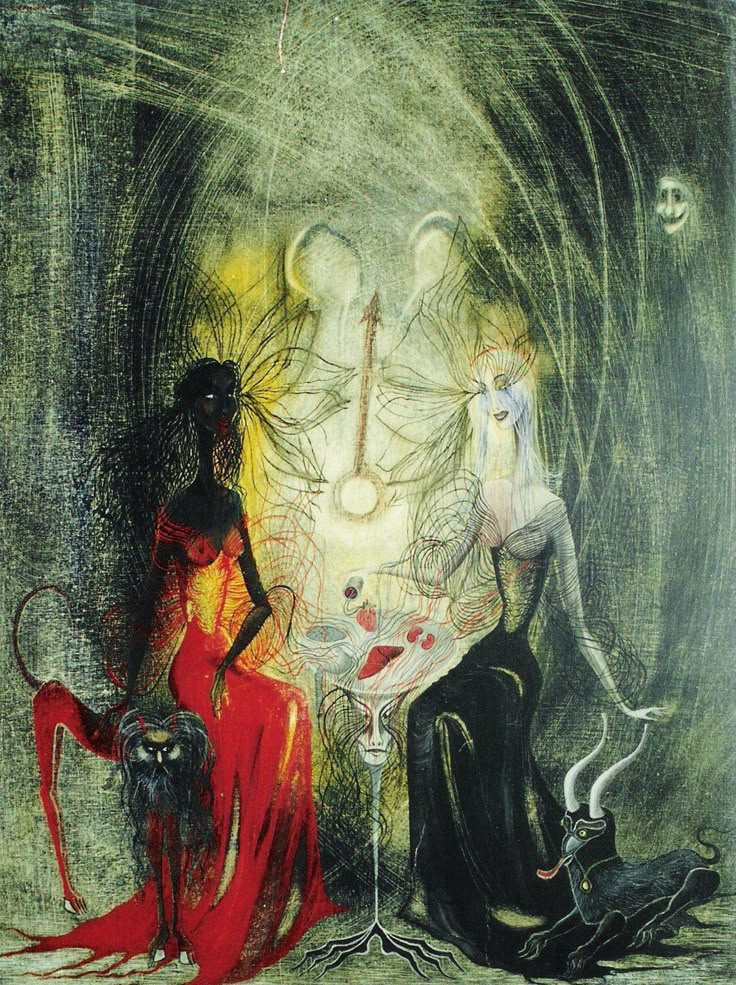
At the ripe age of thirteen, Anacleta de la Cueva first felt that indelible spark of destiny kindle within her soul. She cupped it close in her small hands, letting its pale glow illuminate the dark corners of her path. Soon she walked with lifted shoulders, gliding through the halls of her home with newfound poise. She would skip and chatter to her parents, her dolls, even to the ants on the floor, always proclaiming she was meant for something more. Yet for all her confidence, she never seemed boastful. Even months later, when she received her first vision and that ember burst into flame, Anacleta remained steady in her humility. From that night on, she carried in her heart a certainty few ever glimpse: though the road ahead lay hidden, she knew it would end in the arms of God.
The Virgin Mary first came to her not through sight but through sensation. Still too young to name it, Anacleta had already felt a strange, implacable loneliness seep into her once-blithe blood. Each night she knelt by her bed and whispered pleas into the cold, begging the Lord to cast out whatever pest had nested in her thoughts. She had once been so carefree, wholly content with the love of her father, mother, and guardian above. Now, scarcely an adolescent, she wept herself swollen over a void she could not trace. Convinced no other cause could explain so strange a malady, Anacleta believed herself poisoned.
At first the infection worsened slowly, day by day, until one pale December night her ache swelled with sudden force, rising like smoke to lodge in her throat. Desperation tightened around her limbs, binding her still, until tears blurred her sight and she could no longer tell where sorrow ended and suffocation began. Then, gasping through the frost, she felt it: a faint breath of warmth scrape her skin. She froze. On such a frigid night, the heat itself felt uncanny. Yet the graze bore a tenderness too otherworldly to mistake. Evanescent as it was, Anacleta read it at once as a sign from God, an answer to her endless prayers, so full it left her convinced she had been healed.
In the months that followed, her solitude thinned into a sadness she could bear. Convinced some celestial ear had heard her plea that night, Anacleta drifted through her days, buoyant as a petal on water, trusting the cure was already at work. Some days pressed heavier than others, but never as dark as before, for now she prayed with the secret assurance that someone above had listened.
Yet one quiet night in February, just as she had begun to settle into that tenuous calm, her mother appeared at the doorway with the words no child should ever hear: her father had died in the night, taken without warning by the plague. A gale slammed into her chest. Moments later it ripped through her veins, ravenous to burrow deeper. The venom she had once believed divinely cleansed had returned—keener than ever.
Until then, Anacleta had known little of grief. She had never imagined it could strike so quickly, or why it seemed to aggravate the toxin already coursing through her bloodstream. From that moment on, alongside her strange malaise came a second torment: the specter of her father. Her nights grew sleepless, her hope withered, her light wilted. Still, she clung to her faith, meeting her sorrow the only way she knew. Night after night she knelt in prayer until she collapsed on the floor, when her mother would tiptoe in, stealthy, worried, to lift her back to bed.
For weeks the silence held indifferent. Then one night, her cry seemed to pierce the heavens. At last her prayers were answered, not with a fleeting touch this time, but with a true, ardent kiss. Startled yet enraptured, Anacleta wept as a figure took shape in the fog drifting through the open window. She rubbed her eyes in disbelief. Crowned in stars, robed in specks of cerulean and sapphire, stood the High Lady, her face aglow with moonlight.
“My daughter, do not be afraid,” she said at last.
Anacleta told herself it must be an illusion. Yet the words fell soft against her cheek, like snow that would not melt.
“Tonight’s moon rises only to greet tomorrow’s sun, and the storm flooding your soul is but a divine deluge, sent to clear the path ahead.”
No doubt remained in her mind: an arm’s length away, on the other side of her bed, it was the Virgin Mary who spoke.
“Endure, my child,” she said with a kind smile. “The Lord placed that ache in your heart only to hollow a chamber within, for there He will enter, and there He will dwell.”
At her final word, the Virgin dissolved into mist. Exhausted from shock, Anacleta curled on the floor and sank at once into deep sleep. All night the spectacle replayed in her dreams, each time confirming what she already knew: the Virgin had come, her kiss was real, her words were true.
She held these tenets with the same intensity with which she had once clung to her pebble of destiny. But unlike that fleeting kismet, Anacleta guarded her private moment with the divine like a sacrament, terrified that even speaking of it might fracture its sanctity. Yet the opposite proved true. Her Grace returned night after night, in dreams, in prayer, in the flicker of candlelight, in the whispers of the wind, each time her aureole brighter, her caress softer, her clutch more complete.
As their bond deepened, the Holy Mother revealed her true desire: not silence, but praise, for Anacleta to become her lips on earth, gathering her words and carrying them into the world like a feathered courier. At first the request filled her with dread. Even in her innocence, she had sensed the Church’s narrowing regard, the eagerness of friars to brand mystics as witches and seers as deceivers. Shrewd as she was, she learned to veil her revelations in modesty and cloak her prophecies in restraint. Yet with each visitation, her love for the Virgin grew until it became too powerful to resist. She confided first in her mother, then in the Franciscan at Vinuesa, and by week’s end even the Guardian of the Royal Convent in Atienza had heard of the girl whose passage into womanhood was marked by miracle.
Luckily for Anacleta, the very woes that had once driven her near to damnation had also tempered her spirit, sensitive, pure, and diffident enough to shield her from suspicion. Month by month her love swelled, her fervor widened, her piety strengthened, until at last, shortly after her fourteenth birthday, the long-awaited moment arrived. Yielding to the urgings of her mothers—both earthly and divine—Anacleta shackled her soul, cast the chains heavenward, and took the final step of her exodus with joy. From the ivory peaks of the Picos de Urbión she descended into the Gothic abbeys and narrow alleys of Salamanca, where she granted the Queen of Heaven her wish and entered the Convent of Santa Clara.
As a young novice, Anacleta learned to mend habits, recite psalms in Latin, and obey without question. Above all, she mastered the art of alchemizing suffering into devotion. Any desire for rosy dresses or her mother’s lullabies was soon conquered by the convent’s revelation: pain was beautiful.
Yet Anacleta’s faith did not rest on sisters or scripture alone. She tended it as a farmer tends his fields, certain the harvest would come. Just as rain promises fertile soil, she took the faint trace of rose in copal smoke as a pledge that her servitude was not only seen, but soon to be acknowledged. And sure enough, Her Holiness returned again and again, at times radiant in lapis and gold, at others gleaming in the pearl of a rosary bead, most often as nothing more than sensation: a sharp flush in her cheeks, an irresistible urge to weep. However she appeared, the outcome was always the same: her presence emptied Anacleta’s fear and filled her with a wholeness so complete that agony and adoration became one.
Before long she began to seek sorrow willingly, opening herself to its void, hoping to catch His light in her fissures. And so, after a single year of confessions and fasts, she made the choice without hesitation. Kneeling before the altar, Anacleta took the veil and swore her vows of chastity and submission—reborn as Sor Anacleta de la Luz Carmesí, bride of Christ.
Word of Anacleta’s rare piety and mystical gifts spread through Castile almost as soon as she was professed. Weeks later, when a letter arrived from the Archbishop of Mexico requesting Spanish-born nuns for the expanding missions, it was no surprise the Abbess named her first. Many thought her too young, too newly avowed, but her ardor pulsed too brightly to be overlooked. And so, in May 1561, scarcely fifteen and younger than most ever sent abroad, Anacleta left her nest once more, bound for the tropical wilds of Cuetzalan in the Sierra Norte de Puebla, New Spain.
Her first days in the New World differed little from those in the Old. She rose before dawn, recited the Hours, folded linen, and took her meals in silence. The beaterio of Santa Rosalía de las Lluvias housed nine sisters: two elder Castilian nuns, three mestiza beatas, two newly baptized native servants, and one infirm elder, Sor Gregoria del Rosario. The Castilians, long settled in the colony, showed little interest in Anacleta, likely deeming her too young and untested. The beatas were polite but distant, offering only a cordial nod. The servants were just as reserved, speaking to her solely of chores.
At first the isolation did not trouble her. It even offered small consolations, moments of peace she needed to endure such a strange, secluded place. When sent for beans or squash, Anacleta would tarry, slowing her steps to savor the bristles of stalks against her fingertips as she meandered the rows of maize. Yet her deepest solace lay just beyond, where the golden field opened into unknown wilderness. From the meadow’s edge she fixed her stare on foliage rising in lustrous tiers of green. Some force always seemed to beckon her inward, but the threat of vipers and pumas always held her back. Instead, she strained her eyes until she could imagine the jungle enfolding her into a chrysalis of leaves. Even then, she would return to the beaterio gates with that wild vision pounding in her mind, its allure tugging her closer still.
So consuming were these savanna daydreams that nearly two months passed before Anacleta realized her visits from the Holy Mother had ceased altogether. For a time, the forest’s spell had renewed her almost as fully as the Virgin once had. But a glance alone could not sustain her soul forever. The long days without a single word from Mother, Son, or Spirit finally shattered upon her, splintering the illusion. She stopped walking the fields, forbade herself to dream of the jungle, and turned instead to the only weapon she knew against despair. Night after night she crawled across the chapel floor, groveling at Christ’s feet, searching for the flaw that had driven Him away. But the silence held, and with each day another thread came loose, unraveling her bit by bit.
At last her old malady returned—faster, hotter, hurling her into a grave fever. Unable to discern the cause, Mother Superior declared it the phthisic plague: the same that had taken her father. With no doctor nearby and no remedy at hand, she laid Sor Anacleta in an empty infirmary bed beside the fading Sor Gregoria and placed her care in the hands of one of the young beatas: Leonor Xóchitl de la Cruz.
To Anacleta, the arrangement felt like a cruel jest. Only weeks before she had been Christ’s bride, the Virgin’s chosen child, the Church’s exemplar of devotion. Now she lay reduced to a madwoman, left to decay beside an old, forgotten nun already at death’s door. She imagined her caretaker’s resentment at being pulled from holy duties to tend an invalid and bore the thought like a second illness. Yet if Leonor had in fact harbored any bitterness, she never showed it. Each morning without fault she entered the infirmary with a sponge and clay basin, patient as she bathed Anacleta, gentle as she drew a comb through her tangled curls, careful never to pull a single strand. Still she spoke little, and Anacleta kept silent in return, first from shame, then from fear that Leonor disliked her voice or her company altogether. But as the days wore on, Leonor’s compassion proved steadfast and genuine, melting Anacleta’s trepidation and sowing in its place a longing for connection. After nearly two weeks of silence, Anacleta resolved at last to speak.
“Does it feel swollen to you?” she asked one afternoon as Leonor pressed a warm cloth to her chest, trying to ease the rasp in her lungs.
Leonor looked back, puzzled.
“My throat—does it feel swollen?”
Leonor touched her neck lightly, then drew her hand away. “No, Sister.”
“Does my voice sound strange? Ill?”
“I do not know, Sister.”
Anacleta paused, searching for what else to say. “Do I seem so sick to you?” When no reply came, she hurried on. “Forgive me, Sister—I hope I’m not troubling you. I can’t seem to read my own symptoms. I think the fever has driven me a bit mad.” She hesitated, then spoke more softly, “It’s so lonely in here, left with nothing but my thoughts. You’ve been so kind to me… I only wish I could know more about you.”
She took Leonor’s silence as permission to go on. “How long have you been in the beaterio?”
“I’m not sure,” Leonor said after a pause. “I haven’t kept count.” But as soon as she caught the desperation in Anacleta’s eyes, her shoulders eased. “No more than a few years. Two, maybe three.”
“How did you come to Santa Rosalía?” Anacleta asked, lowering her stare as though afraid to push too far. Still, she could not help herself. Something in Leonor’s muted gray-blue eyes transfixed her, like seawater under a storm-heavy sky. Their depths seemed endless, darkening to indigo in shadow, silvering to pearl in light, flowing with hidden currents of intimacy and infinity.
Leonor noticed the stare. Unbeknownst to Anacleta, she too was ensnared by the flecks of gold and amber in Anacleta’s eyes. Their pupils widened, locked, until Leonor at last broke the silence.
“If you truly wish to know, I’ll tell you. But I should warn you—my story is far from calm, far from ordinary.” She hesitated. “And I’m not sure you should hear such darkness while you’re burning with fever.”
“I don’t mind, Sister. You might be surprised at the shadows in my own past. I won’t be frightened, I only want to know you. And for that, I need to hear your story.”
Leonor lowered her eyes to the basin, as if to anchor herself before she began. “My mother and I came from a small village just south of here—Xiloxochico. My father was Castilian. I never knew his name. But my mother’s was Citlali—‘star’ in Nahuatl, a name that suited her. She was full of life, tireless, tenacious, but with an old soul. More than a healer, she was a singer. She healed through her songs. My grandmother had taught her the sacred art of in xochitl in cuicatl—”
“In xochitl in cuicatl?” Anacleta gently interrupted.
Leonor smiled, bittersweet, slightly sad. “Forgive me, I forget you don’t speak Nahuatl. You really should learn. Most of the sisters know at least some. I could teach you, if you’d like.” Her timidity faded as she went on. “In xochitl in cuicatl—‘the flower, the song’—is our word for poetry. Where I come from, poetry isn’t just words on a page. A flower is never only a flower, and a song is never only one voice. Flowers hold the deepest powers of nature. Each one is a key that unlocks a song, and every song brings us closer to truth. That is why flower and song can’t be separated: the flower gives birth to the song, and the song gives birth to the flower. Through the flower we chant to God, and through the chant, God sings back.”
She glanced at Anacleta, worried she had said too much and lost her. Yet far from lost, Anacleta hadn’t looked away once. She listened intently, her ears clinging to each word as firmly as her stare clung to the obsidian strands slipping from beneath Leonor’s veil. It wasn’t only the words that held her. It was Leonor’s voice itself, steady yet tremulous, soothing yet unsettling, like the pull she sometimes felt staring into the jungle from the edge of the corn field.
“I’m telling you this,” Leonor went on, heartened by Anacleta’s gaze, “because it was through in xochitl in cuicatl that my mother drew her strength. Each flower-song gave her wisdom, as a bee gathers honey, carrying it back to heal the living. She guided women through birth, reverted curses, mended grief.”
Her tone darkened, her features grew solemn.
“I was thirteen, only just entered into womanhood, when the Franciscans of San Miguel began descending into the lowlands,” she said after a long pause. “They ravaged village after village, tribe after tribe. Ancient or new, strong or weak, it did not matter. Word soon reached them of shamans, singers, flower-songs… of women like my mother. And their thirst for blood only grew. Healers became witches, singers idolaters, flower-songs the Devil’s work.”
“My mother was no fool. From the moment they set foot in Xiloxochico, she knew her days were numbered. Yet she neither fled nor hid. She clung to her calling, fiercer than ever. Her songs grew louder, her remedies more wondrous. Until one afternoon a friar caught her serenading a grieving widow. He seized her, spat curses, and gave her a choice: renounce everything—her songs, her tongue, her healing, her ancestors—and bury herself alive in a cloister, or die.”
Anacleta drew a worried breath, afraid to hear what came next.
“My mother did not surrender. Days later they returned with soldiers. I crouched behind the thorns of a mesquite bush, as paralyzed by fear as I was powerless to act. My hiding place didn’t last long. Before I could even grieve, they cut my hair, bound my wrists, and left me at the gates of Santa Rosalía. It has been my world ever since.”
She hesitated, her eyes flicking toward Anacleta as if bracing for admiration to curdle into judgment. But Anacleta’s expression only softened, her gaze turning warmer, almost loving. Even so, fear and habit pushed the next words from Leonor’s lips.
“It’s alright, Sister. I do miss my mother. But she was… cursed by pagan ways, lost in idolatry. Her death freed me. In the order I found my true calling; in her death, I found salvation in Christ. I was nothing but a sinner, a monster. Now I am His servant. For that, I am grateful.”
Anacleta was at a loss for words. She could hardly believe the disgust with which Leonor spoke of herself. Was it a performance, this self-hatred, or had they truly convinced this tender, beautiful girl that she was a monster? Either way, Anacleta’s heart broke. She longed to comfort her, though she knew no words could mend such wounds. All she could offer was to hold Leonor, to draw her into the tenderness the Virgin had once shown her. She was no Blessed Mother, but in her hold there was true affection, true care. And so she clasped Leonor’s hand, pulled her close, and held her until the midnight bells tolled their separation.
With Leonor back in her chamber, Anacleta was left alone, another night without sleep or solace. Lying awake, her every thought circled Leonor, heaving her into a maelstrom of yearning and heartache. Then, without warning, a warmth brushed her skin. Before she could grasp it, it burst into a blizzard of heat, wrapping her in its mantle. She did not hesitate, nor doubt, she knew at once. Her pupils widened, first with relief, then with joy. A bright, uncontainable smile bloomed across her face. The Virgin had returned.
She shut her eyes to let the Spirit enter. But when she opened them, there was no Mary. No glimmer. No golden kiss. Instead, a searing flash, then thunder. A mighty gust of love tore through her marrow like a comet, sweeping her into a starlit womb. The Presence was heavy, immense, enclosing her in a vortex before hurling her onto the black volcanic grit of a primordial desert. From the corner of her eye she saw it: a colossal tree, its branches sprawling impossibly wide in every direction. No one came, no voice spoke, yet Anacleta knew who dwelt within the trunk. She fell to her knees, arms outstretched, bracing for His embrace, when a knock at her door wrenched her from the brink of consummation.
Any trace of anger vanished when she turned the knob to find Leonor in the blush of dawn, a basin of water in her hands. She entered quietly, pulled up a stool, dipped the cloth, and pressed it to Anacleta’s cheek. At once its warmth sobered her, lulling her back from the terrible grandeur she had just witnessed.
Anacleta weighed her choices with each twist of the cloth. It wasn’t distrust that kept her silent, if anything, the opposite. To an outside eye, they might have seemed like opposites: Anacleta of the Old World, Leonor of the New—dark waves against fair curls, one gaze tempest-tossed, the other rosy like firelight. Yet beneath those differences lay a familiarity neither could explain nor deny—as if they had known each other long before Santa Rosalía, twin souls once bound and now torn apart. The very thought of losing Leonor, even of frightening her away, sent shudders down Anacleta’s spine. But when the cloth returned to her chest, pressed so lovingly into her skin, she knew she could no longer keep her secret.
“I have something I must tell you,” Anacleta confessed at last. “But you mustn’t think I’ve gone mad.”
Leonor’s face softened. “Sister, I would never have shared my own story if I feared judgment between us. Please—tell me what weighs on you.”
Anacleta let out a troubled sigh. “Before I left Salamanca, my Mother Superior made me promise to keep silent about certain… matters. She warned the line between mysticism and madness had grown dangerously thin, especially here in the Indies. So I obeyed. I held my tongue. I spoke of it to no one. But with you…” She drew a breath, steadying the knot in her chest. “Forgive me for hiding this part of myself.”
Her voice hardened. “Since I came of age, I have been visited by the Holy Spirit. In the stillness of dawn and dusk, He sent me His messenger: the Virgin Mary. Sometimes she spoke, other times she was silent, but always she came to anoint me with a kiss, to remind me that my suffering had meaning.”
Her pupils brightened with a sudden glee. “Oh, Sister—what visions they were! In every doubt, in every fear, there she was, wrapping me in her seraphic wings, soothing my sorrows, lifting my faith. I came to love her more than life itself. So when I was called to this land, I seized the chance to give my life to the Lord, for He had already saved mine a hundred times.”
The blush in her cheeks turned pale, the bustle draining from her voice. “And then, when I arrived…” She stuttered, as if on the verge of tears. “She stopped coming. No warning, no reason. At first I tried to go on as if nothing had changed. I wanted to see her again so badly I mistook the rustle of leaves for the sweep of her cloak. But deep down I knew. She was gone. And I could not bear it. I believe it was grief itself that made me ill.”
Leonor reached for her hands, her face tight with worry.
“Dear Sister—what concern I see in your eyes!” Anacleta cried, gripping back. “Please, let me finish before you make yourself sick with fear. I don’t know what summoned it, but yesterday, just before you came to my door…” Her voice quickened. “The Spirit returned. Only this time—” She clutched Leonor’s fingers tighter, as if to still their tremble. “It was not the Virgin. It was Him—the Lord Himself!”
“Oh, Leonor!” She erupted, alight with elation. “I can hardly speak of what He awakened in me—the terror, the rapture! His voice… my God, beyond words, sublime! And His touch—” She faltered, searching for words that would not come, then pressed on. “I’m afraid this is where you’ll think me mad…if you don’t already.”
Leonor shook her head softly, her thumb tracing the back of Anacleta’s fingers.
“I was with Him,” Anacleta said, her voice fluttering. “Not in heaven, not in the deserts of Jerusalem, but here—in the valley of Mexico. I beheld Him in all His glory when all of a sudden—” Her words erupted into a cry. “I longed for Him—not only as spirit, not only as savior, but as a lover! Don’t you see, Leonor? Why else would He rouse such gnawing in me, even when I was a child? He wants to unite with me—not only in paradise, not only after death, but here—in this soil, in this body, in this flesh!”
Her breath hitched, flaming with a delirious certainty. “I am not meant only to be His bride—I am destined to bear His child!”
Leonor gasped. “Oh, Sister, please—don’t speak such things! You frighten me…”
“You don’t believe me?” Anacleta’s voice quivered. “Why would I invent such a thing?”
“Of course I believe you,” Leonor quickly affirmed. “I swear it. But if the others hear, they won’t see devotion. They’ll see delusion—madness! You could be cast out, exiled… or worse.” Her voice cracked. “I can’t even bear to think of it.”
From that night on, Leonor scarcely left Anacleta’s side. With each day, their bond tightened, like a serpent’s slow coil around the throat. In the afternoons, as she braided Anacleta’s hair, she would sing the few hymns she still remembered from her mother. At night, reading from the Psalms or the Canticles of Solomon, Anacleta would break in with her own confessions—memories of longing and solitude, nightmares and dreams, visions and apparitions.
When her temperature soared and shivers wracked her frame past midnight, Leonor whispered the names of flowers in Nahuatl to distract her from the pain. But nothing could silence her screams. Night after night they rose until at last they pierced the thin infirmary walls, waking the entire beaterio in fright. Sisters would rush in, crosses clutched, to find Anacleta convulsing, babbling in tongues, weeping without end. Leonor would press her palm to Anacleta’s mouth, muffling each cry of ecstasy or howl of pain. And when the storm finally subsided, she would lie beside her, take her hand, and whisper:
“Tell me… what did you see?”
“In the sky,” Anacleta murmured one night, “a claw ripped straight through the stars. I was lying naked on a stone altar when a sudden twitch began to—”
“Anacleta!” Leonor cut her off, her body rigid with fear. “You mustn’t speak of this to anyone but me. Do you understand? Promise me!”
“I won’t tell them,” Anacleta promised, again and again. But the visions only grew stranger, each one harder to contain. Soon Virgin’s name vanished from her tongue altogether, her every word bending toward that haunting tree. As her body weakened, its image ripened. By day she swore vines crept around her ankles; by night her moans turned raw, almost bestial, forcing Leonor to keep vigil at her side, smothering each sound before it could escape into the corridor.
“I can feel Him, Sister,” Anacleta gasped one night, waking in sweat. “He wants me… He needs me—”
“Anacleta, please,” Leonor pleaded, glancing toward the door. “Enough!”
But Anacleta pressed on, as if powerless to stop herself. “Leonor, don’t you see? I’ve pieced it together. I see it now, clear as day—I know what He asks of me.” Her words tumbled out, giddy with conviction. “He has bound us together—entwined our destinies as one. I cannot obey Him without you.”
Leonor blinked, shaken. “I don’t understand. I thought… I thought your destiny was to bear His child.”
“It is!” Anacleta cried. “But first—I must conceive.”
Leonor pulled back slightly, her face caught between confusion and care. “But if the child is Christ, the conception would be immaculate… How could I—how could anyone—be part of it?”
“I do not know how it happened in Nazareth,” Anacleta said, “but I know how He wills it here, in the jungles of Mexico. At first I thought it would happen entirely within the dream. But when I reached for His embrace… I felt thorns against my skin. And when you knocked, breaking the spell—it came to me.” Her eyes shone. “His arms are not arms at all, but branches. He means to hold me not as a man, but as a tree! Why else would He come night after night in the same form—the same leaves, the same trunk? It is no coincidence—it is His command!”
Leonor frowned. “I am more confused than ever. What tree are you speaking of?”
“Think of it as Sinai, as Nazareth, a place of meeting. The Lord has chosen it as the ground where He will join me in the flesh. Moses had his mountain; I have this tree. As he heard God in thunder and stone, so shall I hear Him in the trunk of this living giant. Through the tree He will touch my womb, and through my womb, He will speak again.”
“Anacleta… do you really believe this tree exists outside your visions?”
“I am certain of it.”
“But how could you ever find it? A single tree in all this wilderness?”
“I know its face better than my own,” Anacleta answered in haste. “It comes to me each night, without pause, without reprieve.” Her gaze fell, fixed on something only she could see. “I know the moss on its pearl-gray bark, smooth in places, jagged at the base. I know the shadows in its creases, the bend of every branch. Even now I see it, its buttress roots fanning out, shimmering as if lit from within, its fibers catching daylight like strands of sun—”
“What kind of roots?” Leonor cut in, her voice suddenly urgent.
“Buttressed. Broad. Spread wide across the forest floor.”
“And the fibers?”
“They hang in wisps from the branches, like cotton, like—”
“Anacleta!” Leonor gasped. “I cannot explain it, but—I think I’ve seen that tree.”
“What?” Anacleta blinked, searching her face for answers. “Leonor, please… you mustn’t say such things just to comfort me.”
“I cannot be certain,” Leonor admitted. “It was long ago, and I was only a child. But hearing you now, it comes back to me.
“I must have been six, maybe seven. It was May, at the end of the dry season. Our village was celebrating Huey Tozoztli, the feast of fertility, rain, and maize. The elders led us children to sacred places—trees, caves, mountains—to give thanks to the gods of the earth. That year my mother and aunt brought me to make my first offering to Tlaloc, lord of rain, and Chicomecóatl, goddess of maize. I chose mine with care: a few dried cacao beans, a red feather, a chipped jade bead from my grandfather’s altar. My mother always said a first offering bound you to the land for life.
“We walked for hours through the hills and thornwoods until late in the afternoon we reached a wide cenote where—” She paused, her glance far off. “There it was. Taller than anything I’d ever seen, its roots spread over the ground like rays of sun. My tía called it a pochotl. I think the Spanish call it a ceiba, but—”
“Leonor!” Anacleta cried. “It’s the same tree—I know it! Don’t you see? Our Lord, our Christ, our very world—it needs us. You must help me find it!”
“Find it?” Leonor’s forehead tightened. “Anacleta, please… they’re already speaking of sending you away.”
“You might as well say you don’t believe me.” The brightness dimmed from Anacleta’s voice, leaving only hurt.
Whether Anacleta had been chosen to bear a new Christ or was only lost in fevered dreams, Leonor could not say for certain. She knew only this: God—or something just as mighty—had descended upon Anacleta with a hunger beyond lust, and whatever form He took—Virgin, seraph, vision, or tree—Anacleta burned for Him all the same. Yet something stranger, perhaps stronger, had taken root elsewhere. Not in the mountains of Spain or the lowlands of Mexico, but in the instant Anacleta met the silver gleam of Leonor’s eyes and saw her own amber mirrored there. In that moment, she was marked forever. No touch in heaven, earth, or hell could pierce her solitude as Leonor’s did.
And for Leonor, a single glance into Anacleta’s desperate, doe-like eyes was enough to make her yield. That night, at Anacleta’s behest, Leonor snuck from her chamber and tiptoed through the halls of the beaterio to the front door, where she whispered to the gatekeeper that the friars had granted them leave to seek a healer in the southern villages. At dawn, as the gate creaked open, Leonor obeyed Anacleta’s wish, and Anacleta followed her lead, guided only by the faintest pull—south, into the jungle.
They reached Xiloxochico within hours. Leonor had not returned since her mother’s death, yet the land seemed to greet her. Ravines and moss-dark cliffs, clouds snagged on their slopes—all welcomed her home. Orchids released their fragrance, as if rewarding her for remembering their secret language. For a moment, it was as if no time had passed. Yet she soon saw the stone cross hammered into the old temple ruins, and sorrow and shame rushed in at once. Before they could take hold, Anacleta had already reached for her hand.
“Do you remember which way from here?” she asked with a sweet smile, her caress easing Leonor at once. Neither could say when it began, but even the smallest gesture between them carried a magnetism—wordless, irresistible. They turned southeast into the lowlands, descending into a forest that thickened with each step. Down moss-slick switchbacks and through ankle-deep mud, their clasp never once let go. What Leonor had once crossed with her tía in a single day now took several. But by the fourth morning, the ground had grown so damp and loamy that she knew they were close.
At last the trail opened into a round hollow, volcanic walls draped in vines and moss, dew dripping into a still jade-green pool. Anacleta stumbled, nearly falling into the slippery soil. Clutching a branch, she gasped, “Leonor—look! Just as I dreamed!” Suddenly ablaze, she rushed forward—bareheaded, breathless, chasing the musk of earth and the metallic tang of water as if under a spell. Leonor called after her, but Anacleta had already vanished into the cleft ahead.
Roots sprawled like wings across the jungle floor, veined with moss and lichen that glazed the bark in shimmering sage and clouded green. The trunk, massive as a mammoth, rose like a leviathan from the sea before bursting into an emerald cascade above the canopy. Impossible to miss, impossible to mistake—the ceiba stood before them in its full majesty.
Leonor stepped into the clearing just as Anacleta’s awestruck face broke into tears. “I’m frightened, Leonor. Frightened and—” She stopped short, her voice catching as she stared at the white blossoms pushing out of the trunk. “My God… do you see them? Can you believe such beauty?” Her lips trembled—half awe, half fear. “Help me, Sister. I know what I must do—I just don’t know how.”
She lifted her tear-bright eyes. Leonor caught her wrist, pressed her palm to the wood, and guided it slowly down the trunk until the rough bark gave way to moss—warm, damp, alive beneath her touch.
She pressed Anacleta’s hand harder into the spine of the ceiba, her voice quickening. “Do you feel it, Sister? Nothing else is like this. Shh—listen. There… beneath the bark. That faint tremor—it’s His heartbeat. Close your eyes. Yield to it. Let Him move through you.”
Anacleta obeyed, lashes fluttering shut. A bead of dew slid over her knuckles as Leonor leaned against her, pressing her frail frame to the barked column. Wedged between Leonor’s curves and the giant’s ridges, her skin scraped along the grooves, shallow scratches marking where bark cut into soft flesh. Leonor pressed her palm deeper, fixing her in place—chest to trunk, ear to wood—until a pulse, steady and immense, thudded through the heartwood. The ceiba seemed to draw her in, folding her into its bends, until they were no longer two nor three but one: one spirit, one flesh, one soul. Then, with an abrupt twitch, the antlers of the tree heaved skyward, pods splitting open, releasing clouds of snowy floss that drifted down across the forest floor. At last Anacleta tore herself free to find Leonor waiting at her side. She collapsed into her arms, and together they leaned against the ceiba, holding fast as the hours slipped by.
At dawn, at Anacleta’s urging, they set out for the beaterio, vowing to guard the night as secret and sacred. On the road they spoke little—not from fear or shame, but because both knew they had crossed into a place words could not follow, an obscurer realm, verdant and deep, where language could not reach. All was calm until midway through the journey, when a sudden throb seized Anacleta’s belly, folding her forward with a soft cry. A pressure gathered low beneath her navel. She had sensed it coming for weeks, yet when the blood came—thin, dark, sliding down her thighs—it carried a chill no anticipation could ease. By nightfall, Leonor understood: there was no turning back. Anacleta was with child.
They returned to the beaterio to find Mother Superior and the friars waiting, arms crossed, vision narrowed, faces set in contempt. Fortunately, Leonor had rehearsed their story on the road: they had gone in search of a curandera said to cure afflictions of the mind, only to lose their way en route to Atotocoyan. Told plainly, without flourish, it was convincing enough to spare them harsher punishment.
For a few nights, life seemed to resume as before—two figures curled beneath a thin wool blanket, whispering in the dark how they might one day reveal their miracle to the world. But quiet soon gave way to chaos. Anacleta’s body betrayed them: fever, cramps, nausea, hunger, bleeding—what should have taken months erupted in mere days. Each night it grew harder to disguise the changes beneath her habit.
One evening the fetus kicked so violently that Anacleta escaped from Vespers, stumbling into a hidden side chapel. She fell to her knees before the crucifix, but the words stumbled. “Our Father, who art in heaven…” She stopped. The next line would not come. Father. Spirit. Son. Each name felt strange on her tongue. Yet her lips kept moving. Unbeknownst to her, the prayer no longer levitated toward a distant sky. It circled the air like a whirlwind, sank into the earth, and spread through the cosmos—toward the ceiba, toward Leonor.
Just as the realization struck, so did the next blow from within. Pain ripped through her, folding her inward as if she herself were the child. A cry tore loose from her throat, echoing down the corridors before she could smother it. When the sisters and friars arrived, they found her collapsed and unconscious at Christ’s feet.
After endless hours, Anacleta at last opened her eyes. The glare was brutal—white, harsh, bare—yet not so blinding that she failed to see she was back in the infirmary. As her vision cleared, a swarm of figures emerged into focus: Mother Superior, the nuns, the friars, all arranged in a semicircle. Their stare was flat, their faces stripped of concern. Her stomach sank, and with it a deeper horror: her womb felt hollow. Panic surged. She darted her gaze until it caught on a wooden tray before the two Castilian nuns. Upon it, laid on fine white lace, rested a dark, almond-shaped shell wrapped in pale gossamer strands of silk.
Relief swept through her. Tears welled in her eyes. “Oh—praise the heavens, praise the Lord!” Anacleta cried, nearly shaking with joy, blind to the looks of horror around her. “Mother, Sister, Brother—look! A miracle—Christ has returned!”
“She’s lost her senses!” one Castilian gasped. “Mother, what are we to do?”
“Child,” Mother Superior snapped sharply, “you cannot call this—this thing from your womb—our Christ.”
“Pay her no mind,” a friar barked. “She cloaks her sins behind this creature. She has dragged the devil into Cuetzalan. Fallen, deceived, blasphemous—do you understand the weight of your crimes? The shame you’ve brought upon yourself, your sisters, this holy house?”
Anacleta’s thoughts lurched and spun. Could they truly not see? Her glance scampered around the room, searching for Leonor hidden in the shadows, the Virgin flickering in the halo of a candle, for any sign she was not alone. But nothing came. A tear slid down her cheek. She had to confess.
“Yes, I have given birth,” she said at last. “That much is true. But what I’ve brought forth is not what you believe—”
“Not what I believe?” the friar roared. “You bore not a child of God but a monstrosity—something no woman, no mortal, should ever bear! There can be no absolution—”
“Father, I swear, I have not known a man,” Anacleta cried. “My sin is no greater than that of the Blessed Virgin. He came to me—here, in this very convent. For years His Spirit spoke through the Virgin, and then one night He came to me Himself. My suffering, my solitude—they were never punishments. They were His hand, shaping me for the destiny He had prepared in secret.”
She lifted her head, voice quaking with fear yet firm with faith. “I am Sor Anacleta de la Luz Carmesí—Wife of God, Mother of Christ!”
A gasp rippled through the room. Shock widened every eye. Yet Anacleta pressed on, her words falling faster, her zeal now unbound.
“He led me into the jungle to stand before Him, face to face. And there, He entered me, as the Spirit once entered Mary—though not as a dove, not as an angel, but as a tree. As sap, as leaf, as flower, He wrapped me in root and trunk and branch. And the fire He kindled within me—oh, Brothers, Sisters, the fire! I was made whole in a way I had never imagined. More alive, more radiant than I had ever been—even in the womb itself!”
“Blasphemy!” the friar roared. “You call God your lover? You claim this seed to be His Son? Madness—or worse, possession!” He turned sharply to Mother Superior. “Neither the girl nor this… thing can remain here. They will bring disgrace—and His wrath—upon us all.”
Anacleta and her child were locked in separate cells, far from the beaterio, farther still from Leonor. In the days that followed, Mother Superior, the friars, and the Council of Elders argued over her fate: confinement or exorcism? Penance or banishment? On the fourth day, the bishop delivered his verdict. Appalled by her testimony yet fearing scandal more than sin, he chose silence over trial. The council concurred. By episcopal decree, Anacleta and Leonor—condemned as her keeper and conspirator—were excommunicated. By dusk, they were denied communion, stripped of their habits, severed from the Body of Christ. Mother Superior’s command was final: they would leave Santa Rosalía at dawn.
When the sun rose to herald their departure, Anacleta, Leonor, and the child stepped through the cloister gates with nothing but a scrap of bread, a flask of water, and their cloaks. No breviary, no habit, not a single rosary bead was permitted. Their steps were heavy, their heads bowed in grief, yet neither looked back once. As soon as they crossed the threshold, Anacleta, cradling the child in one arm, reached with the other for Leonor’s hand. Together they walked beneath the searing orange blaze of the Mexican sun—east toward Xiloxochico, then south into the marshlands, where, in the valley of a hidden cenote, an ancient ceiba awaited their return.
The journey took only two days. They prowled like feral cats through dusk and shadow, vaulting rivulets and skirting mud as if the swamplands had always been their true home. Hollow with hunger, shriveled by heat, they nearly collapsed when at last they reached the base of the ceiba. Without a word, they began their task, layering ferns and palms into a cool, mossy bed. Anacleta laid her newborn gently upon it, then sank into Leonor’s arms with a weary sigh. As dusk darkened into night, the tree gathered mother, lover, and child into its core, holding them close as all three sank into a deep, hibernal sleep.
When they woke beneath the cenote’s dark shade, they could not tell whether hours, weeks, or years had passed. The seedling had somehow grown into a towering tree of its own. Beneath its olive wreath of leaves, Anacleta and Leonor wed themselves to the ceiba and, in the years that followed, bore dozens of its children—tiny miracles unseen in a world blind to its own light. Each sylvan child returned its mothers’ love with gifts: spoons carved from wood, quilts spun from cotton floss, sweet tea steeped from bark, simple yet precious, for they gave the sisters what they desired most: the means to remain together forever at the ceiba’s side.
What had once reached Anacleta only in ephemeral flashes now sprang steady from the soil beneath her feet: the ominous whistle of birds, the rumble of thunder warning from afar, the soft give of the earth hinting at hidden water beneath. In that wordless dominion, the wilderness forced her to listen, as if demanding she learn to speak its tongue. Leonor became her sorcerer, Anacleta her sage, the forest their shaman—lover, teacher, healer, each role transfigured through the other.
Over time, they came to understand what the outside world had long forgotten: warmth stiffens without the sun, grandeur shrinks beneath a sky without mountains, and the sublime terror of the deep dissolves without the sea. Apart from the forest’s web, the threads that bind each creature begin to unravel. Sheltered from the turning of the seasons, time stretches into a single, lifeless line. When storms no longer strike terror and the haunt no longer determines fate, the power of God seems to wither, His many faces fading into obscurity. For if He cannot be found in the petal of a marigold, He will not appear in the soil beneath it. The wooded trail twists into a foreign maze, condemning the seeker to pursue a sun long eclipsed, a hope long forgotten. Yet beyond this barren expanse lies another realm: a lush hinterland where the sun burns as brightly as before, ruling a land where every creature must learn its rhythms, move with its rise and fall. In this emerald empire, where the jungle reigns absolute, God runs naked and free, racing through vine and feather, in fur and wing. Only here, in the jungle’s dark depths, does magic still ride the wind. Only in a secret world where jaguars speak and women give birth to trees could Anacleta at last complete her journey. Leonor gave Anacleta the jungle, and Anacleta showed Leonor how to run through it unbound. In that exchange they discovered a different kind of love—feral, fearless, free. With that love—love like puma, like jaguar, like ceiba—they plunged deeper into the forest, further into its bottomless heart. For beneath its leafy mantle, solitude was nothing but a myth, rustling from somewhere far beyond the trees.
Many years later, or perhaps only hours, for they had long slipped free from the serpent-loop of time, the sisters lay beneath the ceiba. One pressed her cheek to its trunk, the other to her sister’s breast. Through the viridian prism of leaves, shards of turquoise and gilded silver sparkled into the star-strewn sky. They giggled softly, eyes glistening in the moonlight, so coy and whimsical they felt like little girls again, playing the oldest game of all. With their ears against the ceiba’s torso, they listened closely for its pulse, savoring each thrum, thrum, thrum as though it were a sip of fine wine. “Listen,” Leonor beamed with glee, her smile shining in the dark. Anacleta lifted the pair of drums they had carved from deerskin and wood and struck its hide with a steady, cyclic rhythm. The jungle roused awake at once. With every flash of color and beat of drum, spiders and howlers rose as if reaching skyward to shimmer in unison with soil and stars. Their chant cut through the canopy, summoning the night itself to rejoin. When at last it obeyed, when souls wove into voices and kisses seeded into songs, the hymn did not ascend into the heavens but sank deep into the earth. To Mother Superior, the friars, the other Castilian nuns, the heretical sisters had died within a week of exile. Minds bound in dogma could never fathom a mystery as sacred as the ceiba. Yet in one sense they were not mistaken: the moment Anacleta and Leonor pressed their palms into the ceiba’s trunk, they relinquished their souls to the music that secretly resounded in its hollows. Laments of lust, odes of sorrow, ballads of love and death—each a mere murmur swallowed into the jungle’s indomitable bellow.
Anacleta lifted her arms into the moist midnight air, not to break free but to bind herself more tightly within Leonor’s embrace. She knew then what she had always known—as child, as mystic, as madwoman—that her end lay in the arms of God. Exalted, overcome, she rose and readied herself to waltz with the woods and the heavens, surrendering at last to the call of the wild. She spun and glided, aglitter like a firefly, while Leonor beat the drum onward, carrying their chorus further into night. Cradled in the ceiba’s bosom, cocooned in each other’s love, they chanted louder, longer, deeper into the endless dark. Their hearts beat as one, pulsing in a song beyond all measure, jingling past the chimes of time. Long after the earth has turned to dust, after forests have burned and seas have withered away, the music of the wild will still thrum: a dirge and a lament, a beat and a chant, bearing the lunar-honeyed song of Anacleta and Leonor forever into the beyond.
“The Virgin Ceiba” PDF Version
Amora

Amora Rosalquía was born cradled in a bed of wild passionflowers, whose frilled violet petals, drunk with the ecstasy of blooming life, exhaled a fragrance so potent it was said to have roused the soul of the Rosalquía home from centuries of slumber. At the fall of her first tear, the motes of dust suspended in the humid air lit like fireflies, stirring the ancient tendons of the tezontle-stone walls, who trembled awake at once to shield her newborn gaze from the molten glow. The emerald bougainvillea vines—whose roots had entwined with Rosalquía blood since the first dawn of Santa Rosa—sprawled through the cracked adobe in a fevered bloom, unfurling like the vexed wings of a mother quetzal to weave a fierce green cocoon around her purple-plumed cradle.
Amora spent most of her childhood alone—a solitude that, though sharp at times, drew her toward places other girls never thought to look. Day after day, she wandered vine-draped alcoves and ochre corridors, parting leaves like velvet drapery, trailing her fingers along the ridges of volcanic stone, as if each fissure held some secret spell. She whispered dreams into the walls, convinced the spirits of her ancestors slept within—dormant, yet listening. As she ripened into adolescence, the house began to murmur back. At times, she felt its mossy breath whistling through shadow and bloom, a hush drifting across her skin. With every graze and shiver, she grew more intimate with its stones, sensing their longing to wrap her in old Rosalquía magic, to unveil the mysteries curled inside their bones. What began as a lonely girl’s strange imagination bloomed into the labyrinth that would one day become Amora Rosalquía’s mind.
Her mother bestowed upon her a beauty as elusive as dusk: a shadowed warmth in the coils of her obsidian hair, a moonlit glow beneath the olive sheen of her skin—as if sun and moon had seared her in a single fevered kiss. From her father, she inherited an intensity that throbbed through her veins like the jungle’s drumbeat—both intoxicating and fearsome to behold. Yet it was neither beauty nor spirit that made Amora so singular. What others mistook for childish fancy soon revealed itself as something far rarer. A fire had been stitched into her soul—so luminous, so strange, so wild—the villagers of Santa Rosa swore it could have been lit only by the gods. Amora Rosalquía bore the gift of a true storyteller.
From the moment her gift came to light, Amora was no longer seen as merely a girl. She became the blessed daughter of Santa Rosa—a living talisman of its jungle breath and volcanic blood. Her skin shimmered with the jade of the canopies. Her eyes twinkled with the turquoise-lit veins of the cenotes. Her blood thrummed with the primordial pulse of the mountains. It was glaring and undeniable: the molten heart of the land had poured its fire straight into her soul.
Even Amora stood in awe of what blazed within her. She painted the faintest hues and sculpted the subtlest textures of her every sensation: the smoky nectar of passionflowers warming in her throat, the sultry musk of vines clinging to her skin, the golden-green light fractured through the canopy in prisms. Her father’s palace rose from the soil and glared through the overgrown foliage like a half-sunken jewel—strung with jade, rimmed in obsidian, tiled in turquoise. But it wasn’t her honey-umbered home that set her imagination alight. It was the land itself—the tangled marshes, mist-laced mangroves, moss-matted roots, and jaguars that prowled through rustling foliage like spectral beasts—that kindled her flame and breathed life into her stories. She spun the myths of Santa Rosa into song: brave warriors who slit the bellies of pumas with obsidian blades, fearless women who toiled and burned beneath the unrelenting sun, gods and goddesses whose laughter once mingled with the hummingbirds at dawn—each woven into a melody so vivid and sharp it swelled warm tears from even the coldest eyes.
Word of her gift spread like wildfire. Whispers of a celestial beauty whose voice could hush the wind and beckon the stars reached faraway lands, luring strangers to brave jungles for just one glimpse of her tale-telling magic. Her visions stretched far beyond the present—backward into the primeval womb that bore the cosmos, and forward into the tragedy already etched into her fate. From her very first breath, Amora had known: they would come for her land.
The visions struck with monstrous clarity: a procession of pale riders silhouetted against a bleeding horizon, their horses tearing through palms like vipers, hooves churning her beloved savanna into a maelstrom of dust and decay. Spears glinted like shards of light. Arrows shredded the blackened sky. Swords cleaved the thick tropic swelter—and with each stroke, the steel sliced not only heat and flesh, but some deeper sinew of her soul.
Her parents called the village doctor, unable to understand why their daughter’s gaze kept locking to the clay floor. But Amora wasn’t staring into nothing. She was watching the future unravel in merciless detail: banners dancing triumphantly against a vermilion sky, their blood-bright pigments mocking the devastation below. Forests stripped to bone. Huts collapsing into smoke. Villagers fleeing the chains of slavery—their cries swallowed by a sky gone carnivorous, arrows striking them down mid-scream.
She wanted to scream when the bougainvillea vines were hacked and hewn, torn mercilessly asunder. She longed to disappear when the passionflowers she once adored so fiercely bled their wine-dark hearts into desiccated soil. She ached to recoil as their ambrosial fragrance curdled into the metallic stench of death. But her body would not move. She stood frozen—impotent as a ghost in purgatory. Condemned to witness. Unable to act.
Amora understood then: they would come not as men, but as a ravenous gale—driven not by conquest, nor glory, nor even gold, but by a blind and bottomless hunger to consume all that pulsed. She knew what it meant for Santa Rosa. And still, through every vision, through each fevered nightmare, she remained a silent witness. Powerless before the cavernous chasm of fate. Cursed to bear a prophecy that no spell, no prayer—not even her sacred gift of words—could undo.
The air—once sweet with banana leaves and heliconias—curled into smoke and soot. The hearthstones that had once kindled her family’s warmth now blazed red-hot as funeral pyres. No prophecy, no vision, no warning could have shielded her from the piercing shriek of her own heart as it shattered, shard by shard, into the blood-drenched soil.
The vulturous gaze of her captors devoured her long before their hands ever reached her—but that did nothing to dull the pain. They took her first for her beauty, seizing her as one might seize land: defenseless, ripe to ravage, theirs to plunder. Bruises bloomed beneath their grip like poisonous blossoms. Each mark leached the light from her olive skin, leaving her blank—a canvas to bear the scars of their conquest. By nightfall, she lay hollowed and hopeless. Yet, quivering between surrender and survival, when the shadow of death leaned in to press its fatal kiss, Amora summoned the strength to draw one final breath. Not to beg—but to speak.
At first, her voice was no more than a patter of rain. But with each word, it swelled—gathering force, pouring forth in torrents that ensnared her captors in a spell for which they had no armor. Every syllable pulled them deeper into a world beyond their reach, submerging them in a thirst they had never known—and would never quench. By the time her final word fell, they had already chosen to spare her life—but only to bind her anew.
They sealed her inside the decomposing husk of what had once been her home. Now desecrated, it stood like a corpse. The windows gaped. Damp clung to the walls. The air reeked of mildew and smoke. The golden dust had congealed in her throat. With each passing day, Amora faded. Only in the pallid twilight—when dragged out to perform for eyes that no longer lusted for her flesh but for the marrow of her mind—were her shackles loosened. Night after night, they devoured her stories. They feasted on every syllable, ravenous for something they could not name—yet still forced her to feed.
Before captivity, no prayer had ever been holier to Amora than writing. It was not merely her companion or joy. It was her tether to memory, her compass through time. Her sanctuary. Her spell. So when she woke to find herself stripped—not only of her mother’s cacao-stained journal, not only of ink or parchment, but of the illusion that words might still offer comfort—a scream tore loose from her ribs. So raw it scraped her throat. So seismic it seemed to rattle the bones of the cellar. For a moment, she believed it might summon the stone walls—that they might stir to protect her once more. But she no longer knew their language. The tezontle had gone silent—vanished with the final bougainvillea vine. With the last passionflower. With the slaughter of the Rosalquía name.
Each night, she pressed her tear-damp cheek to the mildewed floor. The void gnawed at her—piece by piece—devouring rest, devouring memory, devouring even the outline of hope. Until only the ache remained. The dull, deep, bottomless ache of desolation.
One night, worn to the marrow by the toll of storytelling, Amora’s body finally surrendered to sleep. As her breath slowed, her spirit slipped through the veil of the waking world and sank into the grieving womb of Santa Rosa. The bougainvillea vines reached for her at once. Their moss-damp tendrils wrapped with such tenderness that her body seemed to dissolve into the loamy warmth of the soil. Before she could even register that she was dreaming, she was already wandering through fields of hibiscus.
As if afraid the dream might vanish—or worse, betray her secret joy—Amora began whispering into the violet petals. She confessed everything: the march of steel-hearted soldiers, the pillaged treasures, the chains that bound every woman, the silence that smothered every man who dared to resist. And then—suddenly—she remembered what she could do in this world.
She murmured farewell to the passionflowers and began to ascend a narrow spiral of stone and moonlight. At last, she stood once more in her childhood room. There, untouched upon her desk, lay her old cacao-leather journal.
With an urgency that bordered on rapture, she seized it. Ink spilled like blood across the page. Every broken song, every desolate prayer, every scattered memory poured forth. She conjured her captors in trembling, fractured cursive: fingers never far from the triggers of their pistols, belts always bristling with bullets, eyes gleaming with a hunger no flesh could satisfy. And yet—even then, as she etched their cruelty—she couldn’t help but imagine them, just for a moment, as young boys: voices still soft, faces still gentle, not yet bruised by the brutality they’d been taught to wield by the very hands meant to cradle them. The vision did not last. She awoke with a violent jolt to the crack of gunfire.
Crack. Crack. Crack.
Each shot tore her from her sanctuary. Each bullet flung her back into the fetid dark. Before she could even parse dream from waking, she was already beneath the cruel moonlight—forced once more to endure their rage.
The days blurred. Hope thinned. Their jagged laughter carved new wounds into her flesh—one rasp at a time. And yet—even shackled, even hollowed, even battered and broken—they could not cage the part of her that fled where her flesh could not follow.
In stolen scraps of sleep, she was unbound—tethered not to the men who broke her, but to memory, to soil, to song, to a world where she had once been whole. Night after night, she shut her eyes with desperate urgency, and the moment they obeyed, she returned. Barefoot through sun-drenched gardens, she inhaled cinnamon, exhaled vanilla and cloves, breathed in the scorched perfume of peppers and caramelized plantains rising from her mother’s hearth. Again and again, she anchored herself to the one truth that remained: she did not belong to her captors, but to the land that had first cradled her tears.
But the gunshots always came.
Crack. Crack. Crack.
By dawn, the soldiers were already firing into straw targets—and Amora was wrenched back into the damp dark of her cell.
As the years dragged their rusted chains across her flesh and the fog of captivity settled deeper into her marrow, Amora’s beauty began to unspool—not like a petal wilting beneath moonlight, but like a vine left to rot in the loneliest dark. Her azure eyes, once alight with hidden worlds, dimmed into dusk. Her lips, once hibiscus-soft and cherry-sweet, darkened into a bruised, bluish carmine—the hue of old blood. Her hair, once silken obsidian, thinned into brittle, gray-streaked strands. But worst of all was the starvation of her imagination. Once her lifeblood—wild and unbound—it had dwindled into a dying trickle. Her memories scattered like ash in fog. She was stranded. Lost. Estranged. Even from herself. Even from her dreams.
She knew all too well what this meant. Night after night, she scoured the wreckage of her mind, desperate for a single ember—one last story, one flicker of fire to keep the slaughter at bay. The instant her eyelids fell, she clawed inward with bloodied fingers—only to find vacancy. Blankness. Silence. And the silence shrieked louder than any scream.
Then they came. Not for her body—its sanctity had long been stripped—but for her voice. They arrived with rifles and brittle grins. They unbound her wrists and dragged her into the sickly twilight, cloaking desperation in cruelty. They jabbed her ribs with sticks. Flung stones at her shins. Nudged her with their boots. Sometimes even let out a kick—never to break, only to bruise.
“Come on, sweetheart,” one crooned, voice slick with mockery. “Just one little story, and we’ll let you go.”
They cackled. Roared. But their laughter rang hollow—off-key, off-balance.
“Speak, you wicked wretch!” barked another. His chuckle cracked. Beneath it: a tremor of fear.
Still, she said nothing. Her voice had vanished. Her stories—once armor, compass, world—had crumbled into dust. There were no words left to give.
“What in the devil’s name is wrong with her?” one spat, slamming his gourd of malt against the pyre’s frame.
“She’s no angel,” hissed another. “Enchantress? Ha. Just a shriveled hag.”
“A lying serpent,” growled the third. “A devil who spun dust into dreams. Who tricked us with her filthy, twisting tongue. Who made fools of us all.”
Amora stood still in the eye of their fury. Lips sealed.
For the first time in years, they removed the iron from her wrists—only to lash her to the splintered crosshatch of a pyre. The air reeked of resin, sweat, and rot. They hauled her uphill in a riot of boots and curses, smoke and spittle spewing from their mouths like venom.
“¡Bruja malvada! ¡Ramera de la selva!” they shrieked and howled. But their roars were jagged with dread.
At the summit, they doused her in gasoline. It slid down her spine in cold, stinging rivulets. Soaked her scalp with the promise of flame. Pooled at her feet with the certainty of pain. But before she could shed a single tear, it had already begun.
The fire leapt like a starving serpent, tongues licking her skin, heat curling around her limbs in ferocious spirals. And yet, as the flames pressed close, something deeper had already begun to stir.
Suddenly, memory ignited in her blood—hot, immense, whole. Every tale she had ever told flared through her veins, faster, brighter, fiercer than the fire consuming her flesh. Her lips, cracked and quivering, curled into the faintest smile.
In the heart of the pyre, Amora stood still. Not screaming. Not afraid. The flames, wild and rising, radiant as she once was, rose not to destroy her—but to unbind her. Her smile widened. It cut through the smoke. It stilled the tremble in her bones. At last, she remembered.
The fire, no longer her executioner, enveloped her in an incandescent cocoon. Pain softened into heat. Heat into clarity. Agony into strength. Smoke spiraled around her—not to smother, but to summon. To beckon her home. And in the scorched hush of charred hibiscus and mineral warmth, she rose. Her spirit—burning, unbound, feral—began its final ascent.
The hum of hibiscus shimmered through the haze. Petals fluttered—dark, delicate, and trembling. Guided by the crackle of burning wood and the hush of keening stone, Amora stepped through the spiraling fumes and climbed back to where she had always belonged.
At the summit, the door of her childhood room swung open.
There—steadfast, waiting—her journal lay open on the desk. She seized it without hesitation. Her fingers knew the rhythm by heart. Ink spilled across the cracked cacao-leather surface. With each word, she dropped deeper—sank once more into the cradle of her home. And then, like a passionflower breaking through frost, something began to bloom. What if she wrote a different story?
She summoned the bougainvillea to rise. She willed their tendrils to stretch backward and sprawl forward through centuries. She conjured the day of conquest—not to recount it, but to rewrite it. Turned anguish into defiance. Shrieks into hymns. She did not summon the vanquished, but a legion of warriors—bright, brave, fearless as flame. She recast the invaders as cowards. Her words became sword and shield, ember and seed, blade and root. From the cinders, she forged a fire no darkness could extinguish. And so she wrote:
Amora Rosalquía was born cradled in a bed of wild passionflowers, whose frilled violet petals stirred the slumbering stones of the Rosalquía home—who rose, blades of volcanic fire drawn as armor, to defend the sacred land from any who dared defile it.
With words spun into spells, Amora cloaked her village in living armor. When the day of conquest came, the bougainvillea rose in revolt—smothering screams, devouring bones like serpents starved for centuries. Santa Rosa lived on. And Amora sang, tale after tale, her voice growing as wild and eternal as the wind that thrums through the jungle.
As her pen stilled, the smoke curled skyward like a wayward spirit. Through the thinning fume, she glimpsed a pale procession of riders—their spineless silhouettes dissolving into the ash-thick dusk.
That night, beneath an indigo sky heavy with stars bent close to listen, Amora waltzed barefoot through the dust-softened pathways of Santa Rosa. Her skin fragrant with ash and hibiscus. Her heart blazing with triumph. It was her greatest story yet—one that drew pilgrims, wanderers, and dreamers from faraway lands. But Amora knew the deeper truth: she had not merely survived to tell the tale. Only she knew what she had truly done.
A few miles beyond the Rosalquía palace, a splintered pyre stood half-swallowed by soil. Its blackened beams brittle with age, its purpose long lost and forgotten—entombed within the thin marrow of silence and time.
In Santa Rosa, the bougainvillea still climb. Their ancient ascent unbroken, they cascade in torrents of crimson and jade, threading vines through the veins of the present—weaving root into memory, bloom into blood. Centuries later, the villagers still speak of a girl who conquered death, not with blade or fire, but with her ink and her dreams. Her story endures, bound in a weathered cacao-leather journal inscribed with a single name: Amora.
Hand to hand, heart to heart, it is read, remembered, and cherished anew.
And if you stand very still on the quietest of nights—when the cicadas fall silent, when the mist curls close to your skin, when bougainvillea presses against the windowpanes, and the first passionflower cracks its crimson bloom—some swear you can still hear her voice. Willowing through the dark. Whirling in the smoke. Cackling in secret flame. Stitching wind to vine, vine to song, song to blood. Since time immemorial, like the vexed wings of a mother quetzal, whispering her story into the breath of Santa Rosa—forevermore.
Crack. Crack. Crack.
The gunfire echoed with the crackle of the last flame, flickered with a glint of obsidian silk, then vanished into ash.

