My Brother, the Hunter
How long have I known him? Mm… Many years now—more than I know how to measure. Count them? No, no… Who could count a thing like that? In the old days, he came at dawn, morning after morning, while the river still held the black of night and the first red of day had only begun to bleed through the leaves. Only then would he appear: pale little thing, bare and bright, impossible to miss among all that green. Now he comes after dusk, if he comes at all—smoke in his hair, slipping through the shadows until the dark nearly swallows him whole. He never looks this way. Thinks no one sees him. He does not know I am still here.
Before him, I had known little but solitude. No warm palm had ever lowered toward my head. No kindness had ever come nosing into my little dark. Well… no matter. I had the leaves, the spiders, the snakes, the warm wind moving through the trees above—more than enough, yes, or so I believed. But the boy was different. I remember that first morning: he crouched beside the river, his head bent so near the water he seemed to be listening for something beneath its skin. Men? Yes, of course I knew men—their heavy boots, the stench of stale smoke, their voices cleaving through the heat. But a boy? No. Never before him. He frightened me at first—that pale, bare chest shining against the river-murk. From within the dark of leaves and roots, I watched him closely, ears raised, legs folded tight beneath me. Frightened? Mm… yes. Yet I did not run. I told myself I stayed only to learn his movements, to know when to flee. No, no… that was a lie. Before he lifted his face, something in the way he bent his whole body toward the river had already held me there—as though he listened with his eyes, his shoulders, even the small bones of his hand pressed into the mud. Just as I had bent toward him. He left that morning without knowing I was there. Yet long before the next dawn, I was back in the same place, waiting for him to return with the first light.
He had a peculiar courage. Jaguar courage? Perhaps… almost. Jaguar watches. Jaguar listens. Lies low and waits. No hurry in him—only hunger held tight beneath his hide until the jungle grants him one clean pounce. The boy could wait like that. But not for prey. No, no… he waited only to listen. My family knew Jaguar too, though neither Jaguar’s courage nor the boy’s seemed to live in us—or so I thought. We were small things, quick-fearing things—made for leaf-shadow and root-dark. Spider or serpent, frail or fierce—it hardly mattered. If another eye so much as turned our way, we were gone. A coward, you say? Hmph. Mother thought so too. “The jungle has no pity for cowards,” she would scoff. But I know better now. Hiding was no cowardice. It required a patience of its own: knowing when to keep still, when to slip away, when to be seen—and when not. The boy had not yet learned that last part. The ferns told on him wherever he passed, trembling long after he had gone. Beetles scuttled aside before his feet, and his bare limbs flashed sharp and loud through the waking green. At first, I took him for clumsy. Then I noticed the care inside each stumble: how he searched the earth before every step, as though some small, secret life were breathing beneath each leaf. Once, a frog crossed his path. He stopped so quickly he nearly toppled backward. Another morning, a tarantula crept the length of his arm. Did he shudder? No, no… not even a twitch. He held himself still until its last leg passed from his skin onto the nearest branch. Clumsy? No, no… careful. Strange boy. Tender boy. He came back quieter each time, learning where to place his feet, which tremor belonged to the wind, which sudden hush meant another creature was near. Some mornings, he came all that way through the snarl of branch and fern only to leave a few breaths later. Other days, he stayed deep into the thick heat of afternoon. But before he left, he always returned to the river. He would sink his palms into its cool dark and sit very still, watching ants thread a slow black path along the bank and dragonflies flicker above the current, listening until the silence seemed to open into a hundred little murmurs.
I had only begun to wonder how I might show myself to him when the forest made the choice for me. One morning before dawn, I lay curled in the root-dark hollow left by some great tree long since fallen. All through the night, metal had ground through wood and trunks had struck the earth, each fall shuddering through the roots beneath me. Daylight entered little by little. Only then did I see what those long hours had done. The canopy had opened onto bare sky. Severed vines hung in the open air; saplings lay crushed into the earth; familiar turns ended in raw clearings; shadows I had known all my life were simply gone. For the first time, I wished the boy would not come. Then a sob rose from somewhere in the broken green. I knew it was his before I saw him. He knelt among the fallen branches, his face buried in his hands. I watched him tremble there, alone beneath all that empty sky, until my body rose without asking me. Did I mean to leave the hollow? Mm… perhaps. I only knew I could not stay hidden while he grieved among all that ruin. By the time fear told me to turn back, I was already crossing the open ground toward him. He did not flee. Did not even flinch. He lifted his face. His hands fell away. Slowly, he opened his arms toward me.
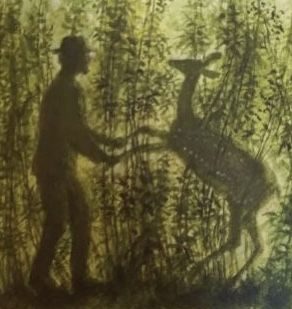
After that, I no longer felt the need to hide. We spoke little at first, my new friend and I, but soon there was no distance left between us. Words? Mm… what use had we for them? He murmured to me, yes, but I understood him better by the easing of his shoulders, the weight of his palm, the slowing of his breath until it matched my own. That was our speech. We listened—to river-murmur, leaf-shiver, insect-wing; to each other breathing inside the green dark. Before long, he came straight to the hollow, and I knew him by his scent, the gleam in his eyes, the warmth rising from his skin. With my head against his chest, I learned the beat of his heart. Brothers, I called us. Did he? Mm… I could not know. Yet when he rested his brow against mine and made that low sound in his throat, I believed he did.
The forest was not enough for them. Soon the machines moved upstream, cutting into the banks and grinding through the shallows where the boy had once sunk his palms and watched silver fish smoke between his fingers. After the next hard rain, the water came down thick with loosened clay, and diesel spread thin colors across its surface. The fish vanished. Fled? Buried themselves deep? Drifted somewhere downstream with their mouths open? We never knew. Still, morning after morning, the boy knelt with his hands sunk in the silt, searching the ruined current for one silver flicker. Some days he wept. Other days he sat dry-eyed until dark. All the while, the machines cut deeper, the clearings widened, and the forest fell away around us. Then the boy began to draw closer to the men. At first, he only watched from the edge of the clearing while they laughed and called him nearer. Then he carried their water. Their rope. Their dented tins of fuel. Small tasks, yes—but he hid them from me, though their smell clung to his hands. One evening, after he had dragged a coil of rope from the road, one of the men pressed a tin cup into his hand. The boy drank. The men laughed. One struck him on the shoulder, and after a moment, the boy laughed too. Soon came the orange cap, bright among the leaves. At first, he left it outside the hollow. Last came the gun, its metal bright against his side. By then, he came later and later—if he came to me at all—his breath sour with liquor and smoke. I kept my distance. The men’s words came with him now, broken and bitter between his teeth. Still, I told myself he was only a boy, frightened into borrowing their hardness. But little by little, that boy receded, until even when his hand returned to its old place between my ears, I could no longer be certain who was touching me.
Since then, I have known him only from afar. I smell him before I see him now—not river water, no, nor leaves crushed beneath his palms, nor the warm musk of the jungle. Machine oil. Diesel. Smoke. The bitter ash of burned green. He appears only near sunset, crossing the clearings that have widened along the road, his hands black with grease. He walks among the men. They slap his shoulder, spit into the road, shout above the engines. Sometimes he laughs with them. Sometimes he says nothing, his head bowed as their laughter breaks around him. Then his scent disappears again, morning after morning, until I begin to think he will not return. Whole weeks pass inside the silence he leaves behind.
It is nearly dusk now. From what little cover remains, I watch him fall behind the others, the rifle slung across his shoulder, until their voices recede and he stands alone among the stumps. He pauses, listening as the last engine fades. His shoulders loosen as they once did beside the river. The longer I watch, the more the man thins and the boy returns: bright and bare at the water’s edge, his hands breaking the dark surface, his whole body bent toward its smallest murmurs. My ears turn toward him. My brother… A low grunt gathers in my throat. I bow my head and hold my breath, but the sound tears loose. I flinch—too late. It has already crossed the clearing. He turns. For one breath, neither of us moves. His eyes find mine and hold, then shift toward the old hollow. The rifle dips. He remembers, I think. Yes… he remembers. Any moment now, he will lower it and cross the clearing. I step from cover and begin picking my way toward him over the fallen branches. His fingers tighten around the stock. His shoulder sets. Crack. Clay kicks up beside my foreleg, and I leap sideways. The bolt snaps back, then forward. Another flash. A hot line opens across my flank, and bark bursts from the trunk behind me. I lunge toward the trees, then turn back. Mistake? Mm… it must be. How could he not recognize me? We are brothers. I search his face for recognition, regret—anything. Nothing. He advances, working the bolt as he comes, the orange cap he once left outside my hollow pulled low over his eyes. How can he move so quickly? Or have I been standing still all this time? I scramble across the torn earth and call to him again, straining to make some sound he might remember, to find some sign in his face of what we once had been. But nothing of my brother looks back. Then he stops. Waits, yes—but not as the boy waited beside the river, nor as Jaguar waits. He lets the metal do his waiting now. Another hunger has him—flash-bright, crack-loud, metal-sharp. He knows. No mistake. The rifle rises again, and at last I understand: my brother is hunting me
I know now there is no more time. Run-wait, wait-run… No. Run. For a moment, my legs lock into place. Move, I tell myself. Move. Crack. Something strikes just behind my foreleg and turns the clearing sideways. At first, there is no pain—only a great shove, then heat opens inside me. Still, my legs carry me. The first strides come fast, but soon my chest begins to tighten. Something warm rises in my throat, and I cannot help but glance back at him once more. I flee that little place we once called home, each step pounding over the forest floor that had held all our mornings. Faster, faster, toward the last dark between the trees, toward—h… hh… toward— My forelegs fold. The dark pitches me into the leaves. My legs thrash once, twice, tearing at empty air. I try to cry out, but only breath escapes—a thin whistle, then a wet hiss. For a while, no footsteps follow. He waits at the edge of the clearing, watching. Blood spreads hot beneath me. I strain to look back, but the clearing wavers, and suddenly I see him as he was beside the river. Bare sky… bare shoulders… The boy’s pale body flashes through my mind. Brother, I try to call. Brother… But only another low grunt comes, then the broken kh—rrr—rr, each sound betraying what I mean to say. His footsteps draw nearer. Step—crush. Step—crush. They grow louder as the river, the insects, the wind begin to fall away. He sees me. Knows me. Still he comes, following the blood with the rifle ready in both hands. I force my head up, but my neck gives and my jaw drops back into the leaves. Another cry breaks from my throat—wet, weak, ragged. He does not flinch. His shadow passes over me. Stop, I try to tell him. This is a mistake. Please… listen. You must know me. You must know my voice. I have known you many years now—more than I know how to measure. Count? No, no… not count. Know. I know you. I know—hsss… mis—tk… hh… kh—rrrr… I…
The young hunter reached the deer before it drew its final breath. He stood over it, the rifle ready in both hands, and watched until its chest fell still. Then he pulled off his orange cap and knelt beside the body, watching the blood blacken the clay and soak into tawny fur. He laid the rifle within reach, drew a folding saw from his belt, and leaned closer. His hand moved toward the familiar place between the ears, then stopped. For a moment, his fingers hovered above the fur, as though those wisps had disturbed something deep inside him. He closed his hand into a fist and struck himself once in the chest—hard, as if to dislodge whatever was caught behind his ribs. Nothing came.
The hunter planted one palm between the deer’s ears and pressed its head into the clay. The first scrape of metal at the base of the antlers made him flinch. The second tightened his jaw. But by the third, the blade had found its rhythm—back and forth, back and forth—biting through fur, hide, and bone until the skull plate gave with a dry crack. He pulled the antlers free. From the distant road, one of the men called his name. He drew the orange cap back over his head and rose, the antlers in one fist. He looked once toward the old hollow, once at the body beneath him, then slung the rifle across his shoulder, turned his back on the river, and walked straight into the unrecoverable dark.
At last, he had become a man.
 Ava Linda Feliz-Sutter
Leave a comment