
“The Dance of Love and Death”: The Inseparability of the Erotic and the Macabre in Carlos Fuentes
by
Ava Linda Feliz-Sutter
A Thesis
Submitted for the Merrill Scholarship
November 2021
ABSTRACT
Anglophone literary criticism has long approached Latin American literature through a predominantly postcolonial lens, privileging historical and sociopolitical interpretation while only intermittently according it the philosophical seriousness routinely granted to European literary traditions. This critical tendency often risks reducing Latin American literary production to the aftereffects of colonial history, thereby obscuring its sustained engagement with metaphysical, existential, and ontological inquiry. Yet the defining characteristics of Latin American literature—its formal experimentation and its seamless interweaving of the fantastic and the real—call for a more capacious critical framework. By foregrounding philosophical and psychoanalytic approaches, this thesis reclaims Carlos Fuentes as a thinker whose work rigorously interrogates the fundamental conditions of human existence, despite his relative marginalization as a philosophical interlocutor within Anglophone criticism. It argues for the necessity of reading Latin American literature not only as historically situated, but as philosophically and psychoanalytically generative in its own right.
This study contends that Fuentes’s oeuvre is structured by an intimate and persistent interrelation between the erotic and the macabre—an enduring preoccupation with sex and death that culminates in their convergence as inseparable, transcendental forces. In Fuentes’s narratives, sex and death are not merely juxtaposed but revealed as dual expressions of the same ontological impulse. The macabre functions as the shadow of the erotic, suggesting that desire is inextricable from mortality, while eroticism itself bears the imprint of destruction, pain, and excess. This dynamic closely parallels the Freudian relation between Eros and Thanatos, wherein the life drive and the death drive collide, converge, and at times coalesce. For Fuentes, death is erotic, and sex is irreducibly marked by the logic of finitude.
Through close readings of The Death of Artemio Cruz, Aura, and Inez, this thesis demonstrates how Fuentes reconceptualizes love as an act of metaphysical self-abnegation and transcendence. Erotic union mirrors death: to lose oneself in another through love parallels the dissolution of the self in mortality. By reconfiguring sex and death as philosophical and cosmological phenomena rather than merely thematic motifs, this study repositions Fuentes as a thinker of the human condition. It argues that within his literary universe, love and death are not opposites but interdependent, seductive, and often unsettling forces locked in an ongoing relation—each ceaselessly entwined with the other to form a single continuum of transcendence. Through the interpenetration of the erotic and the macabre, Fuentes ultimately suggests that to love is already to die, and that dying itself constitutes an erotic, transcendent act.
Keywords: eroticism; the macabre; postcolonial literary criticism; Freudian psychoanalysis; Eros; Thanatos; transcendence; metamorphosis; spirituality; cosmology; sexuality; mortality; love.
Short Titles
Artemio Cruz: Carlos Fuentes, The Death of Artemio Cruz, trans. Alfred MacAdam (New York: Farrar, Straus and Giroux, 2009).
Chapter I. Introduction
“Uncontrolled passions are like poison. Dormant, they are vices, they feed the soul, and the soul, deceived, or believing it is being nourished, is in fact being poisoned by its own unknown and unruly passion.”
— Carlos Fuentes, Inez
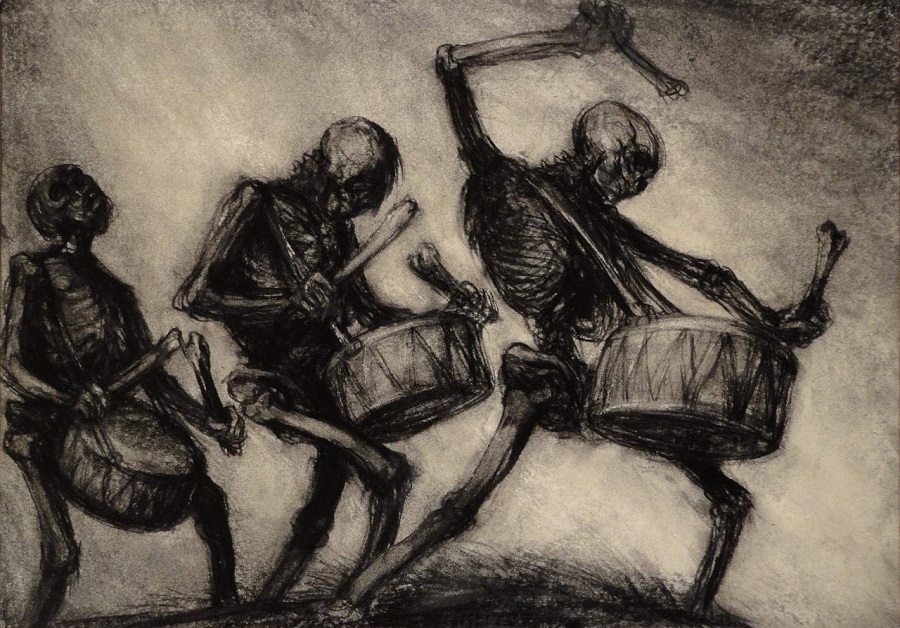
“Skeletal cadavers stacked up by the hundreds, starved, lewd, skin, bone, indecent baldness, obscene wounds, shameful sexes, embrace of intolerable eroticism, as if even death desire endured: I love you, I love you, I love you….”
— Carlos Fuentes, Inez (2000)
“Cry out as if you were going to die loving the very thing that kills you!”
— Carlos Fuentes, Inez (2000)
In the 1960s and 1970s, Latin American literature ascended into international prominence for the first time. Inspired by European Modernism and the surreal, intellectual stories of Jorge Luis Borges, literature from this period—characterized by experimental narrative techniques and lyrical prose—rose sharply in both critical acclaim and global popularity. This emergence is commonly referred to as the Latin American Boom Movement. Alongside formal experimentation, Boom literature frequently uses fiction as a means of articulating political, social, and economic critique. Mexican writer Carlos Fuentes stands as one of the movement’s leading figures, most often recognized for employing literature as a vehicle for political and social commentary. Like other Boom novelists, Fuentes is revered for his experimentation with time and tense and for the creation of enigmatically complex fictional worlds. During the Boom, he and his contemporaries frequently fused dissimilar concepts—such as the merging of fiction and reality in the works of Gabriel García Márquez, or Fuentes’s own sustained exploration of hybrid identity. When one analyzes the intricate structures and techniques of Boom novels, political and social commentary on Latin America undeniably emerges. As a result, English-language literary criticism on Fuentes and other Latin American writers has tended to dwell heavily on geography and history, often “survey[ing] the literary production chronologically—‘novel of the Colonial period,’ ‘novel of the Period of Independence,’ ‘novel of the Mexican Revolution,’ etc.—supplementing historical considerations with biographical notes on the writers of each of the periods” (Flores 111). This critical tendency has contributed to an approach in which philosophical inquiry is frequently sidelined.
Carlos Fuentes is undeniably a political novelist who confronts the conditions afflicting Mexico; his works offer sustained insight into poverty, violence, class inequality, and the instability of national identity. His fiction often portrays “Mexico [in] the 1950s—in search of its identity between history and myth, [and] between memory and a modernity patterned on that of the First World” (Florence 712). Given the inherently political orientation of the Boom Movement, Latin American writers such as Fuentes are routinely read through a Postcolonial framework—one that examines the enduring effects of European colonial rule on Latin America and other postcolonial regions. In practice, this has led critics to prioritize the alignment of literary themes with colonial history and contemporary socio-political conditions. When Fuentes’s literature is analyzed exclusively as political, critics tend to subsume his symbolism and metaphors within a Postcolonial paradigm that privileges themes such as hybridity, autonomy, class struggle, and dual identity. This repeated emphasis on political critique risks neglecting other central dimensions of his work and, paradoxically, reinforces the “othering” of Latin American literature. I therefore propose that a comprehensive analysis of Latin American texts must acknowledge historical consciousness without reducing literature to politics alone, thereby allowing philosophical inquiry to emerge. By considering certain Boom novels as works of philosophical fiction, Latin American literature need not remain perpetually tethered to colonial frameworks; its intellectual production need not be defined in relation to Europe or the West.
The majority of English-language criticism on Carlos Fuentes approaches his novels through this Postcolonial lens, frequently describing him as “inseparable from Mexico and its endlessly rethought identity” (Florence 711). His characters are often read as metaphors for twentieth-century Mexico, evoking themes rooted in European rule, such as the tension between “history and myth” or the pursuit of a “modernity patterned on that of the First World” (Olivier 711). The Death of Artemio Cruz (1962) exemplifies this tendency, as it reflects the loss of revolutionary idealism in twentieth-century Mexico. Artemio Cruz, a former revolutionary soldier who succumbs to political and economic corruption, ultimately becomes the very figure he once opposed. Now a wealthy hacienda owner on his deathbed, Artemio embodies the transition from revolutionary idealism to moral decay following the Mexican Revolution of 1910.1 He thus represents the cyclical failure of successive revolutions and the erosion of optimism in modern Mexico (Castañeda 143). Aura, published the same year, addresses Mexico’s struggle with dual identity, particularly the tension between Indigenous and Spanish legacies. In Inez (Instinto de Inez, 2000), Fuentes examines love and memory against the backdrop of twentieth-century war and violence, while simultaneously narrating a primordial love story set at the threshold of emerging dictatorship.
The Death of Artemio Cruz, Aura, and Inez undoubtedly contain explicit political themes. Yet beneath their socio-political critique, all three texts are profoundly philosophical. As Gloria Durán observes in Modern Language Review, “few literary critics would deny that Carlos Fuentes is a novelist with an almost obsessive attraction to philosophical themes. In one work after another, his characters delve into the nature of history, of tragedy, of free will, and of fate. Yet few critics have taken him seriously as a philosopher” (349). Even when non-political themes are acknowledged, English-language criticism rarely foregrounds them or treats Fuentes as a philosophical thinker in his own right. He is instead classified as a Latin American “political novelist,” and his “repeated attempts to elaborate philosophical ideas are ignored by critics or subordinated to the now popular analyses of his archetypal characters” (Durán 349). Artemio Cruz, for instance, is consistently reduced to a symbol of Mexican identity rather than examined as a figure expressive of the human condition. The dominance of political interpretation within the critical field has thus rendered psychological and philosophical readings of Fuentes’s characters comparatively rare.
In addition to being a philosopher, Carlos Fuentes is arguably “the most Gothic of all major Latin American writers” (Gutiérrez Mouat 297). He combines traditional Gothic elements with formal experimentation, producing a distinctive and nuanced mode of what has been termed “Latin American Gothic” (297). Yet, much like the philosophical dimensions of his work, Fuentes’s Gothic domains frequently remain unexplored. As Gutiérrez Mouat observes, “if this is not a widely acknowledged truism it is because of the marginal status of the Gothic genre in Latin American literary studies. The vast bibliography on the works of the Mexican author, for example, contains only a handful of articles specifically targeting the Gothic strain in Fuentes’s fiction” (297). I suggest that Fuentes’s Gothic and horror elements are overlooked for the same reason his philosophical inquiries are often neglected: political interpretations tend to eclipse more multidimensional readings. As Gutiérrez Mouat aptly notes, “the Gothic in Fuentes is [a] dark mirror, buried deep within the larger work” (298). Even when scholars do address these Gothic elements, they frequently interpret them through a political lens, once again diminishing the complexity of Fuentes’s literary project and overlooking the philosophical concepts he advances. Wendy Faris, for instance, writes in Carlos Fuentes: Literature and Life that “Fuentes’s Gothic rehearses a twisted reading of the great Mexican theme of solitude,” a formulation that risks reducing the intricacy of Fuentes’s Gothic imagination in much the same way critics often reduce his characters to political symbols (165). I therefore contend that Fuentes’s Gothic elements and philosophical dimensions should be approached as a labyrinth: his themes are profoundly intricate and resist reduction to a unidimensional political message. While I concur that these dimensions are “inseparable in Fuentes’s fiction from historical consciousness,” any sustained effort to extract meaning from his literature must also take Fuentes seriously as a philosopher (Gutiérrez Mouat 304). When The Death of Artemio Cruz, Aura, and Inez are examined with philosophical inquiry foregrounded rather than subordinated to politics, a wide constellation of themes emerges—many of which remain largely unexplored in the critical field.
Throughout his work, Fuentes dissects human sexual love in an effort to comprehend the impenetrable complexity of erotic emotion.2 Like his Gothic elements, the erotic dimensions of his fiction—and his sustained inquiry into human psychology—are repeatedly obscured by politicized readings. In an article on eroticism in Fuentes’s literature, Wendy Faris argues that the erotic “joins the experimental writer to the political man in a kind of sexual Zapatism, a desire for the return to paradise in the new world,” thereby situating his exploration of love and sexuality within a colonial framework (63). When Fuentes’s philosophical inquiry into eroticism is dismissed in this way, his ideas are prevented from entering a broader intellectual context; they are confined to Latin American politics rather than recognized as part of a philosophical and artistic examination of existence, emotion, and human behavior.
Throughout her analysis, Faris maintains that Fuentes’s erotic scenes “evoke the erotic potential of the new world, free from paternal cultural pressure” (65). In her reading of Aura, she claims that Felipe functions as “the pilgrim in ‘the new world’ receiv[ing] directions for its exploration from the lips of a goddess-like woman as [he makes love with Aura],” reaffirming a critical tendency to treat Fuentes’s characters as archetypal political symbols (67). Faris further asserts that “Consuelo and Felipe’s transformation at the end of Aura [acts] as Fuentes’ desire to turn the inhabitants of civilization and its discontents into dwellers in paradise; in more Mexican terms, to replay and thus to heal the original chingadura, the violation of the conquest” (74). While this reading offers valuable insight, I argue that Consuelo and Felipe’s transformation exceeds a strictly postcolonial allegory and instead gestures toward a more primordial theory governing human existence—one that remains underdeveloped in criticism precisely because of the prevailing inclination to consign Fuentes’s themes to an exclusively political register.
By relegating Gothic techniques and eroticism to historical and political interpretation, English-language criticism often treats the Gothic and the erotic as separate, unrelated modes, thereby obscuring their convergence. Fuentes, however, persistently links eroticism to Gothic and macabre elements, suggesting that sexual love is simultaneously macabre and transcendental, much like death itself.3 In this context, the macabre functions as a manifestation of death in its various forms—pain, destruction, horror—rather than as mere aesthetic ornamentation.
To understand the interrelation between the erotic and the macabre, it is necessary to engage a critical framework that accounts for the intrinsic connection between sex and death. I propose that the recurring overlap of these forces in Fuentes’s literature resonates strongly with Freudian psychoanalytic theory and is best approached through that lens. Sigmund Freud famously posits that human behavior is governed by two primary instincts: Eros, the pleasure or life drive, and Thanatos, the death drive. Fuentes’s characters are propelled by these omnipresent impulses, which repeatedly converge within the narrative. Both Fuentes and Freud thus suggest that Eros and Thanatos are so fundamental to human nature that the psyche becomes a site of perpetual conflict between love and death—a conflict that ultimately culminates in fusion rather than resolution.
A recent interview with Fuentes further confirms his “longtime fascination with the contest between sin and pleasure as a motivating force behind his writing,” with sin aligning closely with the theoretical framework of the death drive (Faris 63).4 Although English-language criticism occasionally acknowledges the connection between sex and death in Fuentes’s work, it rarely explores this intertwinement in depth or treats it as a sustained philosophical inquiry into human desire and mortality. There is comparatively little scholarship that approaches Fuentes through a psychoanalytic lens or that explicitly connects his treatment of sex and death to Freud’s concepts of Eros and Thanatos. Inez, in particular, remains largely unexamined in English criticism, despite being the novel in which Fuentes most fully elaborates and insinuates the convergence of erotic desire and mortality. Through an interwoven narrative framework that fuses the erotic with the macabre, Fuentes ultimately posits that the sex drive and the death drive are inextricable. Within the dense philosophical terrain of his fiction, the tension between erotic longing and destructive impulse becomes so intense that the two forces inevitably overlap and coalesce.
Chapter II. Erotic Transcendence: Union, Excess, and the Loss of the Self
For Fuentes, an erotic experience is inherently transcendental. The Death of Artemio Cruz opens with Artemio grappling with his imminent death, using memory and consciousness to escape the physical and psychological torment of dying. Within these memories emerges Regina, the most prominent “object” of Artemio’s sexual desire and the woman who dominates his psyche long after her death. Artemio suffers the anguish of dying alone: Regina is gone, and his wife and child despise him. As Britt-Marie Schiller observes, “the dying Artemio cannot control the memories that beset him on his deathbed,” and thus he turns to nostalgia and erotic desire to evade the isolating awareness of mortality (95). Immediately before Artemio retreats into memory, he reflects:
You will desire: how you would like your desire and the object desired to be the same thing; how you will dream about instant gratification, about the total identification of desire and what is desired…you will remember, because that way you will make the desired thing yours: back, back, in nostalgia, you will make yours whatever you desire: not forward, back. Memory is satisfied desire. Survive through memory before it’s too late. Before chaos keeps you from remembering. (Fuentes 29)
As Artemio dies, he seeks refuge from existential despair by returning to his most formative memories—those of love and war. In this oscillation between eros and violence, Fuentes suggests that Artemio is fundamentally driven by erotic desire and destruction. If Artemio survives through memory, and if his most vivid memories are erotic, then his survival is mediated through eroticism itself. The love between Artemio and Regina is therefore transcendental: it allows Artemio, however briefly, to surpass the boundaries of time and death. Their lovemaking assumes a “telluric significance,” and at times “achieves a kind of cosmic eroticism” (Faris 62). For these lovers, time ceases to function conventionally; their love cannot “be measured as any time is measured” (Fuentes 63). Just as erotic love enables Artemio to transcend time, sexual union also allows the younger Artemio and Regina to transcend the brutality of war. They confront violence and the proximity of death only to momentarily rise beyond it. As Faris writes:
In the brief embraces of Artemio Cruz and his young lover Regina between battles during the revolution in The Death of Artemio Cruz we recognize the strong bodily union, the rejuvenating force, the wordlessness, the room with special light that expands outward towards the world, [and] the nearness of death. (Faris 64)
By juxtaposing the imminence of death with the spirituality of eroticism, Fuentes suggests that Artemio and Regina use sexual love as a shield against war, time, and mortality. The room in which they make love is imbued with a “special light that expands outward towards the world,” signaling the ethereal and limitless nature of their intimacy (Faris 64). Their love thus becomes cosmic, violating temporal laws and bodily limits through an erotic union that exceeds the self. Through Fuentes’s emotionally charged and mystical depictions of sexual union, “we experience [the erotic] as moments that attempt to go beyond ordinary sexuality, beyond a system, beyond coherent discourse” (Faris 70). Erotic love is rendered as a spiritual experience, emphasizing its transcendental character.
Teresa Longo elaborates on this dynamic by interpreting Artemio and Regina as symbolic opposites: “when Artemio (fire) and Regina (water) make love, a synthesis of the opposites takes place on multiple levels. The opposites, man and woman, unite literally while the opposites, fire and water, unite symbolically. The synthesis reflects the ancient Mexican belief in the union of opposites as the life-force which regenerates the universe” (61). By framing their intimacy as a fusion of elemental forces, Longo allows the lovers’ sexual union to be read as metaphysical. Fuentes thus evokes a primordial longing to transgress boundaries and become one. From mystical intimacy to cosmic embrace, Artemio and Regina embody the desire to merge completely. This longing is articulated in Artemio’s own thoughts:
This body was not his: Regina had acquired another possession: she had demanded it with each caress. It wasn’t his. It was more hers. He had to save it for her. They no longer lived alone and isolated; the walls of separation had fallen; now they were two in one, forever. The Revolution would end; towns and lives would end, but this would never end. It was now their life, the life of both of them. (Fuentes 78)
Here, the erotic emerges as the impulse to dissolve boundaries and become “one,” generating an entity greater than the self. Through recurring motifs—“cosmic union, compelling natural images, encompassing sensual pleasure, conflation of selves, unity with the universe, the proximity of death, [and] intimations of eternity”—Fuentes repeatedly signals the transcendental nature of eroticism (Faris 68). The love between Artemio and Regina is all-encompassing, suggesting that eroticism cannot be confined to physical sexuality alone. Rather, sexual love exists within Eros: the human longing to exceed oneself through fusion and unity, most immediately realized through erotic union. While reproduction is the biological outcome of sex, Fuentes suggests that even when reproduction is absent, lovers achieve a form of transcendence through “cosmic union” and the “conflation of selves,” entering a realm beyond temporal constraint (Faris 68). Through this portrayal, Fuentes ultimately presents the erotic as infinite, spiritual, and fundamentally transcendental.
Similarly to Regina and Artemio, the sexual love between Felipe and Aura/Señora Consuelo in Aura shatters traditional notions of time and reality, manifesting in a supernatural “union which transfigures Felipe and Consuelo/Aura” (Faris 65). As Faris explains, “in Aura, the duality of past and present is abolished in an eternal time of love, but the two sexes remain separate, though joined in an embrace,” indicating that Fuentes once again portrays a love that transcends universal axioms such as time when lovers unite in a cosmic erotic embrace (67). Like Artemio, Felipe is intrinsically driven by his sexual desires. Aura begins with the expression, “the gods are like men: they are born, and they die on a woman’s breast,” immediately establishing the amorous essence of the novella and insinuating the cyclical, psychological ubiquity of eroticism. Moreover, there is an overarching presence of perversity that accompanies Fuentes’s erotic domains. Faris, citing Gloria Durán, claims that “Fuentes always falls back into ‘the snare of sex,’” and that “perhaps that is why there is an air of abnormality in Fuentes’ erotic scenes, an aura of guilt or depravity” (Durán 246; Faris 68). For Fuentes, “love is abnormal”; throughout his work, “his stories are filled with incestuous unions or the desire for them” (Hall 246).
I predicate these abnormal, perverse depictions of eroticism on the human lust for destruction—the desire to revert to an inanimate state. When this inherent destructive impulse, theorized by Freud as the death drive, encounters the erotic impulse, the two forces clash. The aims of the human sex drive and death drive appear incompatible: sex seeks union and creation, whereas death can be understood as severance. Nevertheless, the universe itself seems composed of opposites perpetually attracting, colliding, and merging.
In particle physics, quantum entanglement describes a phenomenon in which two particles collide and become inextricably linked. Following entanglement, the particles begin to “act together like a single object whose identity lies not with the individual components but in a higher plane,” ultimately becoming “something larger than itself” (Clavin; Michalakis). When one considers the constituent elements of existence, it becomes evident that particles embody the unification of opposites. I therefore surmise that the fundamental driving forces of nature—sex and death—are likewise inextricably bound. From this perspective, the perversity of eroticism in Fuentes’s literature can be understood as a manifestation of a cosmic unification of opposites. The entanglement of sex and death intensifies the cosmic nature of Fuentes’s eroticism, allowing him to explore spiritual and ontological realms through a sustained inquiry into the philosophy of sex and death.
Although sexual love in Fuentes is repeatedly portrayed as destructive—sex is perverse—the erotic nevertheless remains an enchanting, ethereal union. Fuentes suggests that the erotic instinct eternally drives human beings, even when eroticism is inseparable from death. Sex drives Felipe, though it terrifies him as well. When Felipe realizes he is trapped in an occult, macabre situation, he refuses to leave because he believes that “Aura is waiting for [him] to release her from the chains in which the perverse, insane old lady, for some unknown reason, has bound her” (Fuentes 78). While he claims to want to protect Aura from Señora Consuelo—who wields a “secret power over her niece, [keeping her] in [the] dark house against her will”—Felipe is equally motivated by the desire to satisfy his own sexual longing by “saving” Aura for himself (Fuentes 62). Fully aware of his sin and gradual corruption, he nevertheless disregards the looming danger because his lust ensnares him. If anything, the sinful nature of Aura/Señora Consuelo only heightens his desire. Felipe’s lust carries him along an erotic passage from “innocence to life, from light to darkness, [and] from life to death” (Cull 19). The erotic thus consumes Felipe and governs him, suggesting that human beings are ultimately driven by their sexual desires.
The darkness surrounding eroticism in The Death of Artemio Cruz and Aura becomes even more pervasive in Inez, a work of philosophical fiction characterized by its erotic intensity. Inez further explores sexual abnormality through a permeating erotic presence. Like The Death of Artemio Cruz, the novel opens with a ninety-three-year-old man approaching death and reflecting on his life, his most preeminent memory being of a woman he loved. The novel’s two parallel love stories—the relationship between the conductor Gabriel Atlan-Ferrera and his protégé Inez Prada, and the primitive incestuous tale of Ah-nel and Nel-el—are symbolically linked through a mystical crystal seal. This seal recurs throughout both narratives, binding them together. As Atlan-Ferrera examines the seal at the beginning of the novel, he confesses that his greatest temptation is to “love the crystal seal so much that he would destroy it forever with the power of his fist”; his sexual passion is so extreme that it immediately manifests in destructive urges (Fuentes 9). Reflecting on his past, Atlan-Ferrera articulates his longing:
Have the crystal seal in his hand so that he could hold it and squeeze it until he destroyed it; hold it the way he wanted to hold her, tighter, tighter, until she choked, communicating a fiery urgency making her feel that in love—his for hers, hers for him, theirs for each other—there was latent violence, a destructive danger, that was the final homage of passion to beauty. To love Inez, to love her death. (Fuentes 10)
Atlan-Ferrera’s simultaneous desire to love and destroy reveals eroticism as inherently destructive. His destructive impulses recur throughout the novel and ultimately culminate in his own self-destruction. Despite being desperately in love with Inez, he abandons and neglects her, pushing her further away until the damage is irrevocable. The lovers yearn for one another yet never consummate their desire for total union because of these destructive tendencies, resulting in a lifetime of torment and regret. When Atlan-Ferrera and Inez reunite after years of separation, he tells her, “You, only you, are the cause for all my tears, for my disillusion and despair” (Fuentes 73). Through this evocation of emotional anguish, Fuentes suggests that erotic desire is a destructive force comparable to the death drive. Pain, perversity, and destruction trail eroticism like a shadow, manifesting themselves in sexual forms. A macabre essence is thus superimposed upon the erotic. Love, in Fuentes’s fiction, becomes a form of destruction.
Chapter III. “Death Desire Endured”: Gothic Horror and the Persistence of Thanatos
To accentuate the darker dimensions of eroticism in his novels, Fuentes employs Gothic elements and horror to allusively reveal the persistent presence of death within a macabre framework. In The Death of Artemio Cruz, Artemio repeatedly describes Regina as a ghostly, translucent figure, perpetually near death. During their lovemaking, he refers to her embrace as “an embrace of dust” (Fuentes 62), prefiguring her inevitable disappearance. When Regina dies, Fuentes places dramatic emphasis on the gruesome details of her hanging and on Artemio’s subsequent psychological torment. Artemio’s discovery of Regina’s body is rendered in stark, horrific terms:
The finger of young Lieutenant Aparicio pointed to the clump of trees near the ravine. The crude henequen ropes still drew blood from the necks; but the open eyes, purple tongues, and limp bodies barely swaying in the wind blowing down from the mountains proved they were dead. The eyes of the onlookers—some lost, some enraged, most with a sweet expression of disbelief, filled with quiet pain—focused on the muddy huaraches, a child’s bare feet, a woman’s black slippers. He dismounted. He came closer. He clutched Regina’s starched skirt with a broken, choked sound: it was the first time he’d cried since becoming a man. (Fuentes 86)
This grotesque depiction, coupled with Artemio’s anguish, evokes an overwhelming sense of macabre horror. The novel’s vivid imagery—the “crude henequen ropes still draw[ing] blood,” the “purple tongues,” and the “limp bodies”—awakens a visceral fear tied directly to mortality (Fuentes 86). Regina’s death appears as a flashback, a memory Artemio repeatedly revisits in an attempt to evade his present reality and momentarily transcend his own impending death. The Death of Artemio Cruz is structured around the physical and psychological agony of dying: at its core stands an old man desperately attempting to forestall death by reconstructing his life through memory. From the loss of his lover and son to his own demise, Artemio remains unable to escape mortality. Like erotic desire, death permeates Fuentes’s fiction as an inescapable force.
The macabre in Aura emerges through religion, sexual perversity, and the horror of aging. Like Artemio, Señora Consuelo seeks to evade death by retreating into memory. Through occult practices, she attempts to recreate a younger version of herself, refusing to confront aging and her proximity to death by transcending reality through erotic recollection. She generates dual figures of herself and her deceased husband, General Llorente: Consuelo becomes Aura, and Llorente is reincarnated through Felipe, though Felipe remains unaware of this transformation. Unable to face mortality, Consuelo—like Artemio—reverts to erotic memory as a means of survival. Both The Death of Artemio Cruz and Aura are thus premised on a fundamentally human fear of death.
Aura fully embodies the Gothic and macabre dimensions of Fuentes’s work. Its Gothic elements intensify the novel’s disturbing atmosphere and heighten its pervasive sexual perversity. Felipe Montero arrives at Señora Consuelo’s shadowy, unilluminated house after responding to her newspaper advertisement seeking a historian to transcribe her late husband’s memoirs. The house itself establishes a classic Gothic setting: “the room feels damp and cold. The four walls are paneled in dark wood, carved in Gothic style, with fretwork arches and large rosettes,” producing an oppressive, eerie environment that aligns with the novel’s macabre tone (Fuentes 25).56
The portrayal of religion as simultaneously Gothic and erotic is central to the novel’s atmosphere of erotic horror. In a critical scene, Felipe encounters Señora Consuelo performing an occult, sensual ritual while kneeling before religious iconography:
The only happy figures in that iconography of sorrow and wrath, happy because they’re jabbing their pitchforks into the flesh of the damned, pouring cauldrons of boiling water on them, violating the women, getting drunk, enjoying all the liberties forbidden to saints. You approach that image: Señora Consuelo, kneeling, threatens them with her firsts. She beats her breast until she collapses in front of the images and candles in a spasm of coughing. (Fuentes 53)
This nightmarish rendering of Christian symbolism, combined with the explicitly sensual act of Consuelo beating her breast, produces a disturbing entanglement of horror, sexuality, and religion. Religion emerges here as both erotic and macabre. Christian iconography centers on suffering and death, and religious discourse has long been bound to taboo, sin, and corporeal transgression.7 As a system concerned with mortality and the afterlife, religion itself becomes a macabre structure. The association between religion and eroticism is further reinforced through Consuelo’s posture—kneeling, exposed, and convulsing—suggesting an eroticized submission.
This fusion culminates in the sexual union between Felipe and Aura, where Aura’s body is explicitly likened to Christ:
Then you fall on Aura’s naked body, you fall on her naked arms, which are stretched out from one side of the bed to the other like the arms of the crucifix hanging on the wall, the black Christ with that scarlet silk wrapped around his thighs, his spread knees, his wounded side, his crown of thorns set on a tangled black wig with silver spangles. Aura opens up like an altar. (Fuentes 88)
By repeatedly merging horror with religious symbolism, Fuentes entwines eroticism, faith, and death. In the sexual act between Felipe and Aura, this convergence is embodied through Aura herself. Through the fusion of religion, eroticism, and the macabre, Fuentes suggests that these domains are not merely adjacent but fundamentally interconnected.
Inez similarly explores death symbolically through multiple registers. The novel opens with an expansive proclamation by Gabriel Atlan-Ferrara—“we shall have nothing to say in regard to our own death”—before transitioning into his philosophical monologue on morality (Fuentes 1). When contemplating the destruction of the crystal seal, Atlan-Ferrara murmurs, “dream, prediction, nightmare, diverted desire, unutterable love: they would die together with the talisman and its owner,” suggesting that the seal encapsulates desire, death, and erotic love simultaneously. Like The Death of Artemio Cruz, Inez probes the destructive and painful dimensions of love. Atlan-Ferrara describes his lips as “the lips of an executioner and of a lover, which promise sensuality, but only in exchange for punishment, and pain only as the price of pleasure,” explicitly recognizing within his passion a compulsion toward suffering (Fuentes 34). When pain is understood as a symptom of death and destruction, sex and death become intertwined through the fusion of pleasure and pain.
Comparable to the Gothic setting of Aura, Inez employs elements of horror to establish a macabre atmosphere, framing its meditation on love within a narrative of terror. The relationship between Gabriel Atlan-Ferrara and Inez unfolds against his staging of Berlioz’s opera The Damnation of Faust, which functions allegorically throughout the novel. Atlan-Ferrara repeatedly refers to Inez as “his Marguerite,” aligning her not only with the operatic role she performs but with the tragic figure herself. Their narratives mirror one another, and Atlan-Ferrara comes to regard Inez as both his destruction and the source of his suffering, reinforcing the notion that love operates as a destructive force.
Faust itself is a narrative suspended between temptation and redemption. In the opera, Méphistophélès reveals to Faust a vision of Marguerite, provoking immediate infatuation and obsession with her innocence. When Faust and Marguerite are finally united, they profess their love without hesitation. Yet Méphistophélès deceives Faust into believing that Marguerite has been dishonored, prompting Faust to abandon her. Marguerite is ultimately imprisoned and condemned to death for a crime she did not commit. When Faust attempts to rescue her, Méphistophélès agrees on the condition that Faust surrender his soul. Faust complies, only to realize too late that he has been led into Hell, eternally condemned to torment and separation from Marguerite.
Atlan-Ferrara’s suffering closely parallels that of Faust. Just as Faust’s abandonment of Marguerite leads to his destruction, Atlan-Ferrara repeatedly abandons Inez, never fully devoting himself to her. In destroying their love, he condemns himself to a life of longing and isolation. The finitude of Atlan-Ferrara and Inez’s relationship thus mirrors the tragic structure of Faust, a canonical representation of the perpetual dance between love and death.
The opera’s horrifically elaborate imagery also functions as an element of horror in its own right, arousing fear and repulsion. As in The Death of Artemio Cruz, horror merges seamlessly with the erotic narrative. While conducting the opera, Atlan-Ferrara proclaims:
Cry out, cry out with terror, howl like a hurricane, moan like the deepest forest, let rocks crash down and torrents roar, cry out with fear because in this instant you see black horses racing through the skies, bells fall silent, the sun is obscured, dogs are baying, the devil has taken over the world, skeletons have come out of their tombs to hail the passing of the inky steeds of damnation. It’s raining blood from the heavens. (Fuentes 47)
The invocation of religion—particularly the Devil and Hell—further saturates the novel with macabre symbolism and allusions to death. The relentless terror generated by Faust permeates the narrative and unmistakably shapes the affair between Atlan-Ferrara and his protégé.
Atlan-Ferrara obsessively channels his fanaticism through Faust, using it to explore lust, pain, and death as a means of confronting his own sexuality and self-destruction. In attempting to artistically render the realms of love and death through increasingly extreme imagery, he resolves to:
Project the film of the discovery of mass graves in the death camps; the terrible, apocalyptic evocation of Berlioz would become visible, skeletal cadavers stacked up by the hundreds, starved, lewd, skin, bone, indecent baldness, obscene wounds, shameful sexes, embrace of intolerable eroticism as if even death desire endured: I love you, I love you, I love you… (Fuentes 65)
Atlan-Ferrara seeks to evoke the gruesome yet paradoxically beautiful union of sex and death in the most viscerally unsettling manner possible. From images of “raining blood from the heavens” to “skeletons [coming] out of their tombs,” Fuentes repeatedly conjures death through stark, apocalyptic symbols (Fuentes 47). Gradually, the language shifts from the purely morbid to the enigmatically erotic: “skeletal cadavers” give way to “embrace of intolerable eroticism,” revealing a transformation in which love becomes death through the superimposition of the macabre upon the erotic (Fuentes 65). By juxtaposing mass graves with “shameful sexes” and the repeated invocation of “I love you,” Atlan-Ferrara attempts to embody the inseparability of sex and death through art (Fuentes 65). For Fuentes, love entails the dissolution of distinct identity. As Artemio and Regina fall in love, they gradually become one another, imperceptibly relinquishing individuality. Through this longing for complete union, Fuentes suggests that love both begins and ends in death, a truth metaphorically rendered through the fusion of the erotic and the macabre. Love may be transcendental, but it is ultimately fleeting—death, inevitably, endures.
The parallel love story in Inez is a tale about the first lovers in human history. Through the primitive nature of the story, Fuentes conjures the precariousness of being in love. Language is only beginning to form in this narrative, forcing the lovers to communicate through sounds rather than words. The first sounds they speak to one another are “eh-dé” and “eh mé,” which Fuentes translates as “aidez, aimez, help, love,” evoking danger and vulnerability (Fuentes 38). Like Artemio and Regina, the sexual love between Ah-nel and Neh-el exists in close proximity to death, a condition emphasized by the pervasive danger that structures this parallel half of the novel. While Atlan-Ferrera moves closer to death through psychological destruction, Ah-nel and Neh-el approach death through physical threat, both trajectories echoing the inherent risk of love.
Throughout the story, Ah-nel and Neh-el are fascinated by watching deer mate, even as they themselves are targeted by predators. The fragility and defenselessness of the deer symbolize lovers’ susceptibility to death. As Ah-nel and Neh-el paint the spectacle of the deer making love, the narrator states:
… making the amorous figures of the deer seem to move, it will prolong their tenderness, which is identical, ah-nel, to the strange emotion that will now cause you to speak, trying to find the words and the rhythm that celebrate or reproduce or complete the painting—you cannot explain it—which neh-el will continue to sketch and color with his fingers smeared with a color like dried blood, like the hide of the deer. (Fuentes 64)
Perhaps it is through surrender to human fragility—through an embrace of mortality—that love reaches a summit. The “strange emotion” felt by Ah-nel may arise from witnessing “the amorous figures of the deer… prolong[ing] their tenderness,” rendered through the fingers of her lover “smeared with a color like dried blood” (Fuentes 64). Blood becomes blended with a sexual act, metaphorizing the coalescence of sex and death. In The Death of Artemio Cruz, Aura, and Inez, the macabre is pervasive. Across all three novels, graphic depictions of horror, recurring macabre motifs, and the proximity of death construct a framework in which mortality is inescapable. Fuentes meticulously threads the erotic through a macabre fabric that represents life itself: humans desire and attempt to love amidst the certainty of death. The overpowering, primeval instincts of sex and death are bound to one another. Attempting to elude death through love proves futile; the two are inseparable. If elusion is impossible, what happens when lovers instead embrace the presence of death? Fuentes suggests that through acknowledging the bond between love and death, human erotic desire reaches a transcendental climax.
Chapter IV. “The Eyes of Love See a Beautiful Death”: Erotic Perception and Mortal Convergence
Through his literature, Fuentes advances the philosophical premise that sex and death lie at the foundation of existence. The omnipotence of these forces within the universe thus leads to their inevitable superimposition. Sex and death are connected in myriad ways, their intricacy resulting in multiple manifestations. Sex appears as eroticism, sexual love, and pleasure; death emerges as the macabre, pain, and destruction. In this way, Fuentes signifies their union through endlessly varied forms.
As Wendy Faris observes, “for Fuentes, as for the surrealists, eroticism serves as an opening to a reality beyond everyday experience, not so much to the individual unconscious as to supra-individual forces in the universe.” The erotic possesses such profound cosmic significance that it must be understood in relation to the only other force of comparable omnipotence—death. Elaborating on Fuentes’s erotic vision, Faris writes:
The presence of death in scenes of love also reflects a long tradition. Aura is of course the most striking example of this conflation in Fuentes’ work. As Jaime Alazraki has recently pointed out, Octavio Paz characterized this aspect of Aura early on: “Through love Fuentes perceives death; through death, he perceives that zone we once called sacred or poetic… The eroticism is inseparable from the horror.” Though the experience is not a rational one, the reasoning here is that if death is the loss of the self, then losing oneself in another resembles dying. (Faris 71; Alazraki 95; Paz 49)
Faris argues that sex and death are entwined in Fuentes’s work because losing oneself in another—whether emotionally through love or somatically through sex—resembles dying, a dissolution of the self into the universe. She describes this cosmic, transfiguring union of sex and death as a sacred or poetic zone. If “eroticism is inseparable from the horror,” and if horror in Fuentes assumes a macabre form, then sex and death are indeed inextricable within his literature (Faris 71). For Fuentes, to love is to die. If love and death are inseparable, then loving is inherently fatal. To lose oneself in another through love is to become as fragile and endangered as the deer that recur throughout Inez. Metaphorically, the deer represent the vulnerability intrinsic to love: when one loves, destruction looms like a predator. Yet, like the deer in Inez, humans pursue love despite its danger. For Fuentes, to love and thus expose oneself to emotional death is inseparable from a death wish.
Fuentes’s characters frequently self-destruct, drawing ever closer to a figurative death. Although they attempt to escape death through sexual love, this effort paradoxically brings them nearer to it. Love in Fuentes’s fiction often culminates in pain, horror, perversity, and destruction—and it inevitably ends. In The Death of Artemio Cruz, Regina dies; in Aura, General Llorente dies; in Inez, both Neh-el and Inez die. Fuentes thus reiterates an ancient truth: love must end, whether through self-destruction or physical death. Paradoxically, death also appears to intensify love. After Regina’s death, she is described as being “there as she had never been before, more alive than ever in the young man’s [Artemio’s] fevered mind: more herself, more his now than he ever remembered her.” The narrator reflects:
Perhaps, during their brief months of love, he’d never seen the beauty of her eyes with such emotion, nor could he have compared them, as he could now, with their brilliant twins—black jewels, the deep, calm sea under the sun, their depths like sand mixed in time, dark cherries from the tree of flesh and hot entrails. He’d never told her that. Who knows if memory can really prolong existence, entwine their legs, open windows to the dawn, comb her hair, revive smell, noise, touch. (Fuentes 74)
Artemio explicitly associates Regina’s death with sensuality, insisting that she is “more alive than ever” in his memory and implying that desire intensifies in death (74). Fuentes underscores death as the final stage of human existence—and therefore of love itself. After Regina’s death, Artemio’s erotic longing becomes even more pronounced. He cannot prevent himself from merging memory, sexuality, and loss: “who knows if memory can really prolong existence, entwine their legs” (74). Through Artemio’s impulse to fuse erotic desire with his lover’s death, Fuentes suggests that death does not extinguish desire but rather intensifies it.
When Artemio finally encounters death, the memories of Regina grow progressively more insistent until they uncontrollably consume him. In the final pages of the novel, as Artemio hovers seconds from dying, he aches for Regina:
I had Regina do you hear me? I loved Regina her name was Regina and she loved me loved me without money followed me gave me life down below Regina, Regina how I love you how I love you today without having to have you near me how you fill my chest with this warm satisfaction how you flood me with your old, forgotten perfume, Regina I remembered you see? look carefully I remembered you before I could remember you just as you are as you love me as I loved you in the world that no one can take away from us Regina, the world that I carry with me and save protecting it with my two hands as if it were a fire a small, living fire that you gave to me you gave to me you gave to me I may have taken but I gave to you oh black eyes; oh dark, aromatic skin, oh black lips, oh dark love I cannot touch, name, repeat: oh your hands, Regina your hands on my neck and the oblivion of finding you the oblivion of all that existed outside you and me oh Regina without thinking without speaking existing in the dark thighs of timeless abundance oh my unrepeatable pride the pride of having loved you the unanswered challenge what can the world tell us Regina what could it add to that what logic could speak to the madness of our love? … How shall I name you love how shall I bring you close to my breath how shall I beg you to give yourself how shall I caress your cheeks how shall I kiss your ears how shall I breathe you in between your legs how shall I say your eyes how shall I touch your taste how shall I abandon the solitude of myself to lose myself in the solitude of ourselves how shall I repeat that I love you how shall I exile your memory so I can wait for your return? Regina Regina that stabbing pain is coming back, Regina, I’m waking up from that half sleep the sedative induced I’m waking up with the pain in the center of my guts, Regina, give me your hand, don’t abandon me, I don’t want to wake up and not find you next to me… (Fuentes 299)
The memories that give meaning to Artemio’s life—and to his death—are thus unmistakably erotic. Regina dominates his consciousness throughout the novel, and in his final moments her presence becomes a tempestuous force that devours him until his last breath. The unrelenting stream of consciousness intensifies the overwhelming saturation of Regina in his mind. His psychological distress, unfolding alongside extreme physical pain, underscores the erotic nature of his dying thoughts. He moves almost instantaneously from “I’m waking up with the pain in the center of my guts” to “Regina, give me your hand, don’t abandon me,” revealing an inability to separate anguish from desire. This incessant oscillation between suffering and sexual longing suggests that Artemio can no longer distinguish between love, death, and pain—implying that such a distinction never truly existed.
As Artemio cries out for Regina, he appears to be both sexually awakening and in extremis, suspended in a hysterical state of introspection, torment, and arousal. When he asks, “how shall I bring you close to my breath how shall I beg you to give yourself how shall I caress your cheeks how shall I kiss your ears how shall I breathe you in between your legs,” he is ensnared in a condition of desperate erotic frenzy (299). As his thoughts shift from mournful remembrance to unraveling sexual intensity, the movement resembles a metaphorical climax. The closer Artemio comes to death, the more forceful and insistent his erotic desire becomes. The climactic convergence of eroticism and death he experiences in extremis suggests that dying itself is an erotic event. Not only does the presence of death amplify sexual desire, but death itself is rendered erotic.
Across all three novels, Fuentes “forge[s] a haunting tale of seemingly irreconcilable opposites that are nevertheless masterfully interwoven: reality and fantasy, past and present, sex and death” (Cull 19). As with the erotic saturation of Artemio’s dying moments, Aura contains several scenes in which sex and death are depicted as inseparable. In one of the novella’s most disturbing and erotic episodes, Consuelo’s husband discovers her simultaneously torturing a cat and experiencing sadistic pleasure. Felipe later reads of the incident in the husband’s diary: “one day he found her torturing a cat: she had it clasped between her legs, with her crinoline skirt pulled up… it excited him so much that if you can believe what he wrote, he made love to her that night with extraordinary passion” (Fuentes 46). As with Artemio, the proximity of death intensifies erotic desire. Sadism, often understood as the most explicit carnal manifestation of the union between Eros and Thanatos, allows destruction and pain to express themselves sexually. Confronted with this union in its most unmediated form, Consuelo’s husband experiences intense arousal, suggesting that the erotic and the macabre do not merely coexist but mutually intensify one another.
In a markedly similar scene, Felipe walks in on Aura imitating the slaughter of a goat and taking erotic pleasure in the act. Felipe encounters Aura “performing a ritual with the empty air… as if holding something up… striking again and again at the same place,” before watching her “wipe her hands against her breast… as if she were skinning an animal” (Fuentes 68). This slaughter can be “interpreted as a symbolic castration since to pagan antiquity the goat generally symbolizes lust” (Cull 20). Once again, a scene of gruesome violence is coupled with the image of a woman’s breast, echoing the opening of the novella. Aura, like Consuelo, derives erotic pleasure from sadistic impulses, their acts mirroring one another. Even though Aura only imitates the killing of an animal, the ritual becomes a sexual experience, revealing a lust for sexual sadism.
As Felipe’s amorous desire intensifies, he loses his innocence to Aura’s perversity. When Aura and Felipe make love near the end of the novella, Felipe discovers that he is merely an illusion of the deceased General Llorente. His sexual awakening coincides precisely with the confrontation of his own mortality. As John T. Cull explains:
[Felipe] must confront his own mortality precisely at the moment he awakens into manhood and sexual initiation. The beginning marks his end. Mexican mythology, of course, is particularly rich in associations between death, fertility, and sexuality, as Cuervo Hewitt has shown for Aura. The true horror of Fuentes’ text lies in the reader’s final realization that sex and death are inextricably bound: “every man is tempted when he is drawn away of his own lust, and enticed. Then when lust hath conceived, it bringeth forth sin: and sin, when it is finished, bringeth forth death.” (Cull 25; Malleus I, Q. 7, 52)
The embrace of sin encountered by Fuentes’s characters emerges from his sustained fascination with sin and pleasure. Sin aligns with Thanatos, while pleasure aligns with Eros. By exploring both, Fuentes repeatedly evokes the convergence of sex and death through moments in which they collapse into one another, most explicitly through sadism. Just as Artemio experiences a psychosexual climax as he dies, Felipe discovers his mortality at the moment of literal, physical sexual climax. The total consummation of sex and death in Aura and The Death of Artemio Cruz thus mirrors itself across texts.
Fuentes ultimately proposes that at the climax of love—sex—death is omnipresent, and at the climax of life—death—sex is omnipresent. Aura concludes with a “double revelation of uncanny identity” (Gutiérrez Mouat 304). While Felipe “thinks he is making passionate love to Aura in the darkened bedroom, [he] discovers by moonlight that the body in his arms is that of the decrepit and shriveled widow” (Gutiérrez Mouat 305). Felipe experiences simultaneous terror and arousal when confronted with the inseparability of sex and death. Like a subject enslaved to lust and mortality—as Fuentes suggests all humans are—Felipe does not flee this revelation but submits to it, continuing to make love even as he recognizes Aura as a dying woman. He understands that their love is bound to mortality and, rather than resisting the inevitable, embraces the fusion before him. Like Artemio and Regina, Felipe and Aura will die; yet Fuentes suggests that only through death can his lovers reach the full consummation of their cosmic eroticism.
In his essay On Reading and Writing Myself: How I Wrote Aura, Fuentes explains that his inspiration for Aura arose from his own sexual fascination with a girl he encountered at fourteen and later met again at twenty. Through this encounter, he perceived the continuity of time and beauty. Fuentes was captivated by how the girl grew closer to death while retaining her sensuality, inspiring a novella about a dying woman desperate to preserve beauty. He writes:
The light possessed the girl, the light made love to the girl before I could, and I was only, that afternoon, “a strange guest in the kingdom of love”… and knew that the eyes of love can also see—once more I quote Quevedo—“a beautiful Death.”
The next morning I started writing Aura…. (Fuentes 531)
Describing the girl further, Fuentes writes that “the light that had been struggling against the clouds also fought against her flesh, took it, sketched it, granted her a shadow of years, sculpted a death in her eyes, tore the smile from her lips, waned through her hair with the floating melancholy of madness” (Fuentes 531). Through this fleeting encounter, Fuentes recognized that erotic desire is inseparable from death. As he suggests, the aura of death, when juxtaposed with beauty, compels humans to confront this intimate connection. The “eyes of love,” he acknowledges, can also perceive “a beautiful Death,” embracing the aesthetic and philosophical gravity of this entanglement (Fuentes 531). To see the world through the eyes of both love and death is thus the conceptual foundation of Aura and of all three novels. In probing the nature of sex and death, Fuentes ultimately pursues a philosophy of human existence—and arrives at the conclusion that the two are inextricably bound.
Chapter V. “The Dance of Love and Death”: Sacrifice, Fusion, and the Fate of Desire
The Death of Artemio Cruz, Aura, and Inez are tied together through the many manifestations of union between sex and death. A recurring motif across all three novels is the symbol of human sacrifice. The sexual love between Fuentes’ characters almost always leads to some form of sacrifice, whether emotional or physical. In The Death of Artemio Cruz, Regina is sacrificed when she is hanged by the Federales. Through her sacrifice, Artemio lives on, and his love for her endures. In his dying moments, Artemio admits: “Regina, I realize it hurts: Regina, come so that I can survive again; Regina, exchange your life for mine again; Regina, die again so I can live; Regina. Soldier. Regina. Embrace me, both of you” (Fuentes 299). He acknowledges Regina as a sacrifice and ultimately concludes that he, the soldier, and Regina, the sacrifice, have metaphorically become one. When Artemio says, “Soldier. Regina. Embrace me, both of you,” he recognizes both himself and Regina within his psyche (299). Regina gives his life meaning, permeates his mind, and devours his dying thoughts. Through her overwhelming presence, Fuentes suggests that when coupled with mortality, love and lust become more potent; thus, the climax of love is a form of death.
Fuentes further indicates that through sacrifice, lovers can merge. After Regina’s death, she metaphorically reincarnates within Artemio, becoming immortalized in his memory. Teresa Longo elaborates on this idea by connecting Regina’s sacrifice to Aztec mythology, which is founded on the belief that continuous human sacrifice is necessary for the Sun to survive and continue to rise. For Artemio, “Regina is not only a lover, but she is also a sacrificial victim” (Longo 63). At the “metaphysical basis of Aztec thought, fire (the sun) and water (blood) are combined in the sacrificial act” (Longo 60). Artemio is symbolically associated with fire, while Regina is associated with water; thus, both in lovemaking and in death, their union fuses opposites—fire and water, man and woman, sex and death. In order for love to reach its summit, death must occur. Regina’s death allows the lovers to affirm their cosmic union, which Fuentes presents as the ultimate pursuit of love.
In Inez, sacrifice manifests through the daughter of Neh-el and Ah-nel. When the leader of their tribe establishes laws prohibiting incestuous fornication, Neh-el and Ah-nel—who later discover they are siblings—are forced to sacrifice their daughter in a horrific ritual. “In a single unforeseeable instant and with the lethal strike of the lightning bolt, the men in the service of the tongue chief pinioned neh-el’s arms, took the girl from him, jerked her legs apart, and with a single stone knife sawed out her clitoris and threw it in [Ah-nel’s] face” (Fuentes 87). Once again, Fuentes depicts macabre horror of a sexual nature: an innocent child is brutally sacrificed as a consequence of her parents’ lust. Through sexual sacrifice, love endures.
Felipe can likewise be understood as a sacrificial figure for Aura/Consuelo’s erotic appetite. Consuelo creates the replica of General Llorente in order to fulfill her sexual desires and relive her youthful eroticism. She keeps Felipe ignorant and exploits him for carnal gratification, even as he suffers. Felipe is described as a “sacrificial virgin magically drawn to some pagan altar,” the altar being the object of his desire: Aura (Cull 19). Confused, tormented, and subjected to perversity, Felipe undergoes a psychological death when he loses his innocence to Consuelo’s desire. He ultimately dies and becomes General Llorente once more; his sacrifice allows the love between Consuelo and her husband to survive and momentarily transcend mortality. Through the motif of erotic sacrifice, Fuentes suggests that death is necessary for love.
For Fuentes, death is the climax of life. Sexual love and death mirror one another, interwoven throughout the novels within a framework where the erotic and the macabre are indistinguishable. His characters are governed by both the sex drive and the death drive. Like Freud, Fuentes presents these drives as the ontological basis of human existence. Life is structured around reproduction and death—forces so intricate that they generate infinite connections. The sex drive, Eros, encompasses all that is erotic: sexual desire, human intimacy, and lust. Opposed to Eros is the death drive, Thanatos, which can be understood as the desire to return to an inanimate state. Thanatos manifests in different forms, yet at its core resembles entropy—a movement toward dissolution and disorder. Death, destruction, pain, and violence thus belong to the human death drive. According to Freud, these two drives govern human nature, alternately conflicting and coinciding within the psyche.
For Fuentes, as for Freud, Eros and Thanatos embody existence itself, illuminating psychological and ontological dimensions of being. In Civilization and Its Discontents, Freud writes that “the concurrent or mutually opposing action of the two fundamental drives (Urtriebe), Eros and Thanatos, are supposed to explain the phenomena of life” (Freud 45). Just as physical laws dictate that every action produces an equal and opposite reaction, Freud suggests that human psychology operates through a similar tension. If eroticism is the desire to fuse—to become one with another—then Thanatos is the “contrary drive seeking to dissolve those units and to bring them back to their primeval, inorganic state” (Freud 45). If Eros constitutes the desire for life, Thanatos constitutes the desire for death. Given that these drives oppose one another, as love and death do, the question remains: how do they merge so poetically?
In an article on Eros and Thanatos, Timofei Gerber argues that throughout life, humans continuously shift between these two desires. Building on Freud’s claim that the fundamental aim of Eros is to be loved, Gerber suggests that when one realizes that love is neither unconditional nor permanent, the death drive emerges. He writes that “once the child realizes that it won’t be loved unconditionally—and what is the conditionality of love, if not the realization that love necessarily dies, that Eros itself is imbued with Thanatos”—the capacity to love fully arises. Through the awareness of mortality and the finitude of love, Eros and Thanatos ultimately coalesce.
In Beyond the Pleasure Principle, Freud invokes the myth from Plato’s Symposium, which recounts that “in the beginning of creation, all humans were double beings with two heads, four arms and four legs and two genitals, who were then cut apart by Zeus and thereafter desired to reunite with one another” (Gerber). This myth aligns with the ancient concept of the “soulmate”—the belief that each human being has a missing half. Freud conceives Eros as the desire to create higher unities; accordingly, Eros longs to become one, transfiguring the self into something cosmically more expansive. In Civilization and Its Discontents, Freud articulates this dissolution of boundaries:
Towards the outside, at any rate, the ego seems to maintain clear and sharp lines of demarcation. There is only one state—admittedly an unusual state, but not one that can be stigmatized as pathological—in which it does not do this. At the height of being in love the boundary between ego and object threatens to melt away. Against all the evidence of his senses, a man who is in love declares that “I” and “you” are one, and is prepared to behave as if it were a fact. (Freud 18–19)
At the peak of love—when two beings fuse into one—a form of individual death becomes necessary, a condition Fuentes repeatedly symbolizes through acts of human sacrifice. For Fuentes, love entails the collapse of the former self; his characters invariably relinquish part of their identity to their beloved. To love, then, signifies the death of the self and an ascent into a higher state of being. To love is to die, and through death, love transcends.
Throughout The Death of Artemio Cruz, Aura, and Inez, lovers attempt to evade death through sex. Artemio transcends his impending death through erotic memory; Aura/Consuelo resists mortality through the occult reincarnation of her youth and sexual desire; Ah-nel and Neh-el evade physical annihilation by immersing themselves in erotic intimacy; Atlan-Ferrara refuses to confront his own destruction and instead relives his love for Inez through memory and art. In each case, the lovers defer death until they are ultimately forced to confront it. Fuentes thus presents love as only temporarily transcendent—its culmination inevitably bound to mortality.
The co-dependent drives reach fusion at the height of their intensity. Eros and Thanatos ultimately merge through the acts of sex and death. For Fuentes, death becomes the ultimate erotic experience: the moment when the individual dissolves into the universe and body and soul are transfigured. As the death drive reaches fulfillment in The Death of Artemio Cruz, Artemio undergoes an erotic experience that culminates in a metaphorical climax. This psychosexual fusion epitomizes the eroticism of death, as Artemio comes to perceive himself and Regina as a single entity in his final moments.
Moreover, Fuentes suggests that through the act of dying—and through an acute awareness of mortality—Eros intensifies. When his characters begin to accept the inevitability of the union between sex and death, they undergo a spiritual transformation in which Eros and Thanatos become indistinguishable. By embracing eroticism and death simultaneously in his final moments, Artemio becomes one with Regina and dies with her. When Felipe makes love to Aura after realizing she is dying, he becomes General Llorente, and she becomes Consuelo—lovers existing beyond the boundaries of time. In Inez, however, the lovers approach but never fully embrace this union. They hover on the verge of transcendence, yet their love collapses into destruction. Though Atlan-Ferrara understands the inseparability of love and death, he remains fated to self-destruction, able only to explore this union through art, never fully consummating erotic transcendence.
Sex and death thus reside within one another, structured through the theoretical framework of Eros and Thanatos. For Fuentes, love is destructive and fatal, yet his characters choose to love nonetheless. This choice does not arise from a desire for annihilation, but from a longing to fuse opposing forces. In Freudian theory, the convergence of Eros and Thanatos generates a force more expansive than either drive alone; they exceed their individual definitions and coalesce into a single impulse. The desire to create and the desire to destroy together constitute the basis of existence. Creation and destruction manifest across physics, psychology, and philosophy, and in Fuentes’s work their psychological and erotic articulation becomes a dance between love and death. Within the labyrinthine structure of Carlos Fuentes’s fiction lies a central philosophical premise: human existence is governed by the desire to be loved and the opposing impulse toward self-destruction. Fuentes ultimately suggests that love is a form of death, and that dying is the same erotic, transcendental experience as loving. The ancient dance between love and death is inseparable from human existence. We are bound to love and to die—forever longing for transcendental union.
“Dream of total union: everyone says this dream is impossible, and yet it persists. I do not abandon it.”
— Roland Barthes, A Lover’s Discourse: Fragments
Works Cited
Alazraki, Jaime. “Theme and System in Carlos Fuentes’ Aura.” Carlos Fuentes: A Critical Review, edited volume, University of Texas Press, 1982, pp. –––.
Castañeda, V. Emilio. “‘The Death of Artemio Cruz’: The False Gods and the Death of Mexico.” The Centennial Review, vol. 30, no. 2, 1986, pp. 139–147. JSTOR, www.jstor.org/stable/23738707.
Clavin, Whitney. “Untangling Quantum Entanglement.” Caltech Magazine, Fall 2019, magazine.caltech.edu/post/untangling-entanglement.
Cull, John T. “On Reading Fuentes: Plant Lore, Sex, and Death in Aura.” Chasqui: Revista de Literatura Latinoamericana, vol. 18, no. 2, 1989, pp. 18–27. JSTOR, http://www.jstor.org/stable/29740176.
Durán, Gloria. “Carlos Fuentes as Philosopher of Tragedy.” The Modern Language Review, vol. 81, no. 2, 1986, pp. 349–356. JSTOR, http://www.jstor.org/stable/3729701.
Faris, Wendy B. Carlos Fuentes. Literature and Life Series, Ungar, 1983.
—. “ ‘Without Sin, and with Pleasure’: The Erotic Dimensions of Fuentes’ Fiction.” NOVEL: A Forum on Fiction, vol. 20, no. 1, 1986, pp. 62–77. JSTOR, http://www.jstor.org/stable/1345619.
—. Magical Realism: Theory, History, Community. Duke University Press, 1995.
Feagin, Susan L. “The Pleasures of Tragedy.” American Philosophical Quarterly, vol. 20, no. 1, 1983, pp. 95–104. JSTOR, www.jstor.org/stable/20013989.
Fernández, Jordi. “Memory and Time.” Philosophical Studies, vol. 141, no. 3, 2008, pp. 333–356. JSTOR, www.jstor.org/stable/27734336.
Freud, Sigmund. Beyond the Pleasure Principle. Translated by James Strachey, W. W. Norton, 1989.
—. Civilization and Its Discontents. Translated by David McLintock, Penguin Classics, 2002.
Fuentes, Carlos. Aura. Translated by Lysander Kemp, Farrar, Straus and Giroux, 1986.
—. The Death of Artemio Cruz. Translated by Alfred Mac Adam, Farrar, Straus and Giroux, 2009.
—. Inez. Translated by Margaret Sayers Peden, Farrar, Straus and Giroux, 2002.
Gerber, Timofei. “Eros and Thanatos: Freud’s Two Fundamental Drives.” Époché Magazine, Feb. 2019, epochemagazine.org/20/eros-and-thanatos-freuds-two-fundamental-drives/.
Hall, Linda B. “The Cipactli Monster: Woman as Destroyer in Carlos Fuentes.” Southwest Review, vol. 60, no. 3, 1975, pp. 246–255. JSTOR, www.jstor.org/stable/43471223.
Longo, Teresa. “When Opposites Unite: Fuentes’ La muerte de Artemio Cruz.” Chasqui: Revista de Literatura Latinoamericana, vol. 19, no. 2, 1990, pp. 59–66. JSTOR, http://www.jstor.org/stable/29740274.
Mouat, Ricardo Gutiérrez. “Gothic Fuentes.” Revista Hispánica Moderna, vol. 57, nos. 1–2, 2004, pp. 297–313. JSTOR, www.jstor.org/stable/30203772.
Olivier, Florence. “The Age of Time According to Carlos Fuentes.” PMLA, vol. 128, no. 3, 2013, pp. 711–713. JSTOR, www.jstor.org/stable/23489312.
Payne, Judith. “Laura’s Artemio: Failed Sexual Politics in La muerte de Artemio Cruz.” Hispanófila, no. 112, 1994, pp. 65–76. JSTOR, www.jstor.org/stable/43806877.
Paz, Octavio. “La máscara y la transparencia.” Corriente alterna, Siglo Veintiuno Editores, 1967.
Schiller, Britt-Marie. “Memory and Time in The Death of Artemio Cruz.” Latin American Literary Review, vol. 15, no. 29, 1987, pp. 93–103. JSTOR, www.jstor.org/stable/20119446.
Wreen, Michael J. “The Definition of Death.” Public Affairs Quarterly, vol. 1, no. 4, 1987, pp. 87–99. JSTOR, www.jstor.org/stable/40435662.
PDF Version
- A hacienda refers to a large landed estate, typically devoted to agriculture or ranching, and historically associated with elite landownership in Spanish-speaking regions. ↩︎
- The erotic typically means that which pertains to or arouses sexual desire. However, its meaning is far more complex. For Fuentes, the erotic pertains to a sensual “oneness” with another being, or even a “oneness” with the universe. When considering the erotic framework of Fuentes’s work, I view the erotic as becoming “one” with something in a transcendental, sensual way; the erotic is sexual because Fuentes considers fusion itself to be a sexual experience. I therefore understand the erotic as the feeling of union, or the desire to become “one,” whether that union is somatic through sex itself, or mental through the emotional unity of romantic love. The vast complexity of the erotic and the macabre allows me to use the terms interchangeably throughout the essay. If sex is physical fusion and love is mental fusion, then both are—interchangeably—erotic. ↩︎
- The macabre, similarly to the erotic, is a multidimensional concept. In essence, the macabre pertains to a particular kind of horror enshrouded by the idea of death. Like the erotic, the macabre can take multiple forms. For Freud, Thanatos—the death instinct—relates to sadism, perversity, and destruction. When viewed theoretically, destruction and pain bring humans closer to metaphorical or physical death. Thus, pain, destruction, horror, and death—or the fear of death—can be understood as macabre in Fuentes’s work. ↩︎
- “If things were forbidden, one had to write them, and things are pleasurable if they are forbidden.”
Interviewer: Has the idea of sin as a stimulus to writing stayed with you?
Fuentes: Yes. I suppose I started to write Terra Nostra in that Catholic school in Mexico City. St. John Chrysostom says that purely spiritual love between a man and a woman should be condemned because their appetites grow so much and lust accumulates (Faris 63). ↩︎ - The arrival of a stranger in an unfamiliar, often sinister setting is a classic characteristic of Gothic literature (Gutiérrez Mouat). The narrative of an innocent onlooker entering a mysterious space recurs throughout the Gothic tradition, as exemplified by Lockwood’s arrival at Thrushcross Grange in Wuthering Heights and Mr. Mason’s arrival at Thornfield in Jane Eyre. ↩︎
- The figure of an older, “witch-like” woman luring young men into sexual perversion is also a Gothic staple, evident in Consuelo’s seduction and subsequent corruption of Felipe. ↩︎
- This is another idea Freud addresses in Totem and Taboo and related essays: religion appears persistently intertwined with sex and death. ↩︎
 Ava Linda Feliz-Sutter