
Table of Contents
- Sprouting Words: The Ontopoetic Weave of Time and the Cosmogenetic Bloom of Being in Contemporary Maya Poetry
- Spindles of the Sacred: The Metaphysical, Morphosyntactic, and Metonymic Threads that Weave the Mexica Cosmos
- ‘A World in Reverse’: Guáman Poma de Ayala’s Temporal Reordering of Andean-Christian History in The First New Chronicle and Good Government
- Flowers Sing Metaphysical Songs: Nahua Philosophy in the Meta “Flower and Song,” “Another to the same tone, a plain one,” Cantares Mexicanos
- Painting lo indígena and la feminidad into la mexicanidad: Post-revolutionary Artistic Representations of Mexican Identity
Sprouting Words: The Ontopoetic Weave of Time and the Cosmogenetic Bloom of Being in Contemporary Maya Poetry
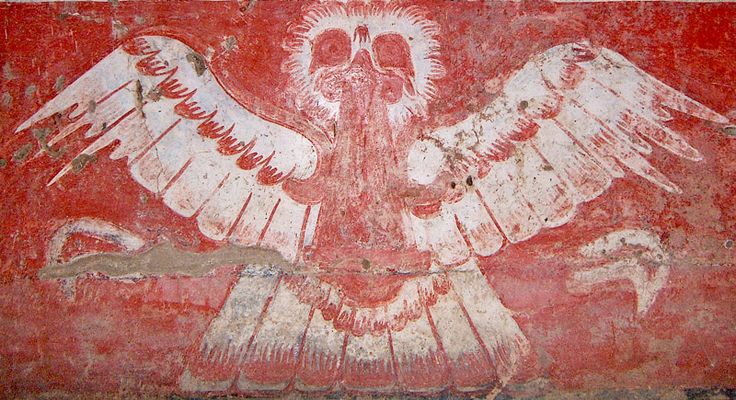
“You cannot destroy me, I move under the empire of words, of sacred words…The word nurtures my soul, it gives me vigor and strength.”
—Josías López K’ana, Maya writer, 1999
In his translation of the Popol Vuh, Allen J. Christenson observes that the opening chapters of the K’iche’ Maya sacred text “describe the creation of all things as if it were occurring in the immediate present,” as though, at the very moment land first emerges, time was already “folding back upon itself to transport the reader into the primordial waters of chaos.” The generative act unfolds within the “womb of the sky,” where the thoughts and words of the deities Heart of Sky (Huracán) and Sovereign and Quetzal Serpent bring forth “the germination and creation of the trees and the bushes, the germination of all life and creation.” This first dawn—this cosmic birth and sacred beginning—is catalyzed by and mediated through the question: “How shall it be sown?” The world is born as seed and word: a germination that is at once sown and sprinkled, flowering and withering, sprouting and decaying—a temporal simultaneity in which regeneration and impermanence coalesce.
Yet this sowing is not merely agricultural; it is also textile and textual—an act of sewing, and an act of speaking. Creation unfurls as a weaving: a cosmic quilt whose thread is the word, spun on the spindle of utterance: “Merely their word brought about the creation of it. In order to create the earth, they said, ‘Earth,’ and immediately it was created.” From these opening lines, it becomes evident why Argentine philosopher Rodolfo Kusch describes being, in an Indigenous cosmo-ontological framework, as a “mere estar… linked to the concept of shelter and germination.” In this vision, being not a fixed essence (ser), but a living, rhythmic, rooted becoming—sustained through continuous weaving and speaking. Speech is not simply expressive but constitutive: the unfolding, pulse, and generative force of being itself. It is not only metaphysical and cosmological, but ontologically and temporally productive: a sprouting of continuity. For the Maya, whose cosmology renders the very notion of linear erasure meaningless, what more powerful counter to colonial silencing than the temporal-ontological act of continuation? What stronger resistance to disappearance than to re-sow the cosmos and reweave the Mayan cosmovision through the fecundity of the word? Thus, when contemporary Mayan poets are described as “weaver-poets… at the forefront of present sociopolitical and cultural expressions of resistance,” it is not merely because they are “guardians of memory and tradition,” but because they are agents of cosmogenesis. Their poetry is not representation but resurgent becoming: a cosmo-ontological poiesis of being. As Kusch writes of Indigenous knowledge that “multiplies like the sown land through ritual,” so too does their verse germinate past and future into a continuum that blossoms in the present—a continuity in which the Maya universe does not wither, but perpetually blooms.
In articulating how Indigenous knowledge is mediated and actualized through ritual, Rodolfo Kusch invokes the term yachacun, defined as “related to growing, multiplying, bringing into existence.” This generative process culminates in ritual, which “manipulates the invisible limits of a transcendent and sacred world” and thereby transcends epistemological representation. Ritual, as Kush emphasizes, is not merely symbolic performance but a modality of ontological integration: “not only the medium to fill the emptiness of a subject, but [that which] also transcends it and balances the ill-fated and the auspicious…acting as components of the cosmos.” Within this framework, poetic language—deeply interwoven with ritual practice—becomes inseparable from ritual’s onto-cosmological function. Herein lies the “continuity of knowledge”: in a metaphysical ecology where revelation is not disclosure but flowering. To “discover what is secret,” Kusch writes, is not merely “to let a word escape,” but “to explode; to bloom (a tree); to open (a flower).” Revelation, in this sense, is florality. In Quechua and Aymara, this flowering is both etymologically and cosmologically rooted in the bud: the Amyara term amu—meaning “bud of the flower”— lies at the core of amtaña, “the idea of remembering.” The act of “filling…to complete, to fulfill,” thus implies a return to the amu: a reintegration of “the original rending…or tearing of the cosmos,” the ontological rupture from which “indigenous wisdom is conceived” and through which it continues to germinate. To remember is to “achieve the bud of the flower,” while to speak is to gestate the cosmos anew.
This conception of poetry as ontological and cosmological flowering—knowledge as sacred word in bloom—resonates with the Nahuatl difrasismo in cuīcatl in xōchitl, “flower and song,” a metonymic pairing that fuses duality into a singular utterance: “the song, the ‘weavings’ of the poet.’” In this worldview, poetry is not merely a lyrical artifact but a ritual act—a rebalancing of cosmic forces. It is the labor of the weaver: stitching visible and invisible, past and present, into a fabric of continuity. In both ancient and contemporary Maya poetics, this woven knowledge—cosmological, linguistic, ancestral—is a sprouting into being, a floral unfolding of time that braids ancestral past with emergent future into a living flow. As Kusch writes of Quechua and Aymara ritual, the “cosmic flower” is that which “reconciles opposites” and “balances the duality”—a synthesis achieved only through what he calls “a ‘bursting or sprouting’…a violent eruption of the sacred.” Maya poetry, rooted in this ontological architecture of ritual, thus enacts a cosmological labor: the renewal of equilibrium through the blossoming of the word.
This foundational duality—the rhythmic oscillation and interdependence of antagonistic yet co-constitutive forces such as order and disorder, day and night, life and death—pulses as the metaphysical heartbeat of the Mesoamerican world. This cosmological principle, which is not a binary opposition but a generative tension, emerges in the opening lines of the Popol Vuh, where “in the darkness and in the night… they conceived light and life,” and where primordial obscurity and fecund illumination are not opposed but inextricably entwined. The three Thunderbolts—Youngest, Sudden, and Huracán—form “Heart of Sky” and catalyze the “creation and formation” that arises “like a cloud, like a mist.” Within this intermediary, ever-unfolding state, the poetic word takes root. In K’iche’ Maya poet Humberto Ak’abal’s (1952-2019) poem “Tejedor” (“Weaver”), this generative dualism unfolds through elemental imagery: thunder and water collide in a “prolonged and sonorous echo” as “the downpours collapse.” Yet within the storm, laughter erupts: “laughter / is in the thunder— / the end of winter.” As in the Popol Vuh, creation is inseparable from destruction; germination arises through dissolution. Ak’abal’s image of a rainbow that “confirms / the voice of the storm” positions speech as a conduit of cosmic equilibrium—voice not as resolution but resonance, a seismic vibration that holds opposites together. This enactment recurs in Ak’abal’s “Oración” (“Prayer”), where the speaker invokes: “Let the door of the sun open / let the door of the moon open.” These celestial forces, animate and relational, are summoned in conjunction, not contrast, so that “the light does not allow / the darkness to pass over.” In both poems, dualities function as openings—portals through which being flows. Light and darkness, storm and rainbow, laughter and collapse are not distinct opposites, but interwoven forces suspended in a conflux of commingling tension. The verb “pass over,” rather than “conquer” or “subsume,” situates the speaker on the same balancing path, walking toward a cosmological equilibrium “so not to lose / the marks of our path.” These marks are simultaneously spatial, temporal, ontological, and territorial—not remnants of the past, but signs of an ongoing journey, a continuity sustained through ritual utterance.
As Nancy M. Farriss explains in her nuanced analysis, the Mayan conception of time is inseparable from the dualism that arranges the Mesoamerican cosmovision and cannot be reduced to a merely cyclical model. In Maya thought, “linear time is incorporated into an all-encompassing cyclical pattern,” in which cosmic time “returns endlessly to the beginning,” and “human time intersects with the turn of the…cycles in ‘a succession of eternities.’” Time must therefore be conceived as taking on “two different shapes,” functioning itself as a structuring metaphysical force in perpetual dualistic tension: “time is cosmic order, its cyclical patterning the counterforce to the randomness of evil.” This complex temporality underlies Yucatec Maya poet Briceida Cuevas Cob’s (1969–) poem “Irás a la escuela” (“You Will Go to School”), which repeatedly employs the future tense to tell the addressee, “you will decipher hieroglyphics, / written by dust, wind, and sun,” and that “you” will “return to your home… to read …the crackle of the fire…[which] holds a mirror in its heart… upon which your soul is imprinted.” The mirror is not a metaphor for self-reflection but an ontological conduit—one that returns the subject to a cosmological origin. This movement is not regression but rebalancing: a dualistic return to the moment of cosmogenesis, where creation and remembrance converge in an oscillatory equilibrium. It is precisely this dualistic orientation that Gloria Elizabeth Chacón theorizes as kab’awil, a K’iche’ term meaning “double vision,” or what she calls a doble mirada—a dual gaze that enables contemporary Maya poets to “see in the darkness and in the lightness, to see close and far” simultaneously. Kab’awil functions as a strategy within what Chacón terms “Indigenous cosmolectics,” the aesthetic practices of contemporary writers rooted in Mesoamerican worldviews. Like Kusch’s estar as rooted germination, Chacón’s cosmolectics “refutures the tendency to differentiate cosmogony from epistemology,” resisting epistemic violence and countering the “sociological imagination” that seeks to “produce a mestizo synthesis” in which “Indians…eventually disappear.” Kab’awil is therefore not synthesis but simultaneity: it inhabits rather than resolves duality by making visible both the ancestral and the contemporary at once. It affirms multiplicity through duplication—much like Kusch’s image of the “sown land,” where knowledge proliferates through ritual repetition.
When Cuevas Cob’s speaker deciphers hieroglyphics written by dust, she enacts the cyclical regeneration of ancestral being, echoing Chacón’s claim that Maya poets “defy temporality” through the kab’awil “reclaiming…hieroglyphs and the oral tradition.” Oriented toward both ancestral epistemologies and the global literary sphere, kab’awil enables Mayan writers to percieve ancestral and contemporary realities simultaneously—reflecting the Mesoamerican understanding of duality as inextricably intertwined and inherently coexisting. Within this poetic and philosophical structure—the articulation of Mayan cosmological continuity within a medium often governed by Western temporal linearity—the imagery of the womb and hearth reflects Kusch’s conceptualization of estar as dwelling, “being-in-the-house,” or the “womb where woman conceives”—a notion drawn from the Aymara utcatha, which connotes shelter, germination, and rootedness. The fire’s mirror becomes a site of cosmological reentry, where the poem’s “you” glimpses their soul not as a static essence but as a process: flowering, becoming, continuous. In this cosmo-ontological poetics, the soul is not fixed but seeded—not merely remembered but re-enacted—and thus continues to bloom through language, ritual, and return.
Chacón emphasizes that the kab’awil gaze enables contemporary Mayan writers to merge “a modern book/textile” with “alphabetic/ideographic writing,” generating what she calls “ancestral continuity through the reproduction of textiles.” In this view, writing is weaving, and the poem becomes a textile—an interlacing of memory, materiality, and continuous, dualistic time. Chacón also underscores that kab’awil weaving is “deeply connected to gender and genre,” since in Mesoamerican thought, corporeality is inseparable from cosmology: the human body is “conceived of as intertwined with circumscribing the universe.” The complementary embodiment of feminine and masculine qualities—what she terms a “kab’awil ontology”—is a “vital component” of both the “Mesoamerican social fabric and…the cosmos.” This cosmological dualism shapes Cuevas Cob’s poetic critiques, particularly her challenge to double standards around femininity and sexuality. Drawing on the moon/sun duality, the womb as a site of cosmic rebirth, and the continuity between land and bond, she enacts “a kab’awil cosmolectics that allows her to play with pre-Columbian and modern temporalities” and to “continually reproduce…Mayan culture and history.” In “You Will Go to School,” knowledge resides not in institutional or abstract domains but in domestic, corporeal, and cosmological space: the cosmic womb becomes the kitchen hearth, and sacred glyphs are inscribed directly on the feminine body—“in their heels”—while their breasts “poured out life upon the earth,” transfiguring domestic labor and bodily nourishment into cosmogenetic ritual acts.
In “Night of Eclipse,” Cuevas Cobs writes of a woman who, “in the darkness… lit the village / with the light that spilled / from her womb,” reframing the womb as biological function but as cosmological conduit—joining eclipse and radiance, absence and generation, past and present. The unborn child and the illuminated village are folded into a single moment of dual illumination: human and cosmic, feminine and divine. A similar metaphysical weaving appears in Maya Tzotzil poet Ruperta Bautista Vázquez’s (1975—) poem “Embroiderers,” where a “young girl’s hands / embroiders her grandparent’s knowledge / on the traje [dress/suit] of her town.” Once again, knowledge is transmitted texturally—stitched into cloth as ancestral presence—and structured by dualism: “In her mind an old woman embroiders a heart in red threads, / her descendents in blue threads.” A “young woman’s heartbeats” and an “old woman’s pulse,” past and present, continuity and renewal, are threaded into a shared embodied weave. Time is not superimposed upon the present, but “peacefully enters / the bodies of the two women” and “bear[s] them / towards the thirteen heavens,” suffusing the present with an ancestral past and enacting a Mayan temporality in which past and future do not displace each other but move, flow, and fluctuate in tandem—germinating the same cosmogenetic continuity also invoked by Ak’abal and Cuevas Cob.From Ak’abal to Cuevas Cob to Bautista Váquez, knowledge emerges as what Kusch terms “a knowledge of modalities”—a knowledge inseparable from temporality and embodiment, “not a knowledge…that can be closed or…alienated from a subject,” but one “closely related to ritual,” and to the subject who “handles or manipulates it.” This epistemology, as enacted through their poetics, is not merely a remembrance of the Mayan past, but a dynamic modality of flowering, unfolding through the kab’awil gaze that structures their work. Through this double vision—simultaneously contemporary, alphabetical, and written, and ancestral, sacred, and cosmological—these poets braid myth and history, past and present, creation and destruction into the very continuum that sustains the cosmos. This ritual poetics of cosmic continuity is structured by the same dualistic temporality central to the Popol Vuh—a temporality that moves neither in a circle, nor in a line, but through a cyclical-linear rhythm that always returns to the moment of creation. The poetic word becomes a reentry into the cosmogenetic utterance that first birthed the universe, enacting not only restoration but rebirth: a sprouting already shadowed by withering, a germination already laced with decay, a death from which renewal threads forth. Far from only being an act of cultural resistance or historical remembrance, the poetics of Ak’abal, Cuevas Cob, and Bautista Vázquez is ontological. It is being as becoming—a ritual flowering of knowledge, an inhabitation of the in-between, a dwelling within the pulse of continuity. Their words sprout forth not only the ancestral Mayan cosmovision into present and future, but also reach backward—toward the first speech, the first sowing, the first cosmic germination—to sustain the cyclical permeance of the universe. It is the generative becoming of both Maya being and cosmos in the form of a cosmic flower—one that continually blooms, withers, and reblooms into eternity. For in the Mayan vision, eternity is not stillness, but is itself a continuous, cyclical, poetic flowering.
Bibliography
Ak’abal, Humberto. Hablo para taparle la boca al silencio. 1st ed. Selección de textos y diseño: tsunun. León, Guanajuato, México: Tsunun, 2020.
———. Poemas seleccionados. Tsunun. Accessed May 14, 2025. https://www.akabal.com/.
———. “Twelve Poems by Humberto Ak’abal.” Translated by Earl Shorris and Sylvia Sasson Shorris. Jaguar Tongues, October 1, 2005. Originally published in Guchachi ‘Reza’ (Iguana Rajada), Revista de la Casa de la Cultura de Jugitin, Oaxaca, Quinta Época, Primavera de 1995, 49–50. https://wordswithoutborders.org/read/article/2005-10/twelve-poems-by-humberto-akabal/.
Bautista Vázquez, Ruperta. “Healers and Other Poems.” Translated by Paul M. Worley. Latin American Literary Review 45, no. 90 (2018): 66–74. https://lalrp.net/articles/66/files/submission/proof/66-1-292-1-10-20190116.pdf.
———. Xojobal Jalob Te’ / Telar luminario (Weaving Light). Translated by Paul M. Worley. Latin American Literature Today, October 2018. https://latinamericanliteraturetoday.org/2018/10/four-poems-ruperta-bautista-vazquez/.
Chacón, Gloria Elizabeth. Indigenous Cosmolectics: Kab’awil and the Making of Maya and Zapotec Literatures. Chapel Hill: University of North Carolina Press, 2018. http://www.jstor.org/stable/10.5149/9781469636856_chacon.
Christenson, Allen J., trans. and comm. Popol Vuh: Sacred Book of the Quiché Maya People. Norman: University of Oklahoma Press, 2003.
Cuevas Cob, Briceida. Ti’ u billil in nook’ = Del dobladillo de mi ropa. México: Comisión Nacional para el Desarrollo de los Pueblos Indígenas (CDI), 2008.
Farriss, Nancy M. “Remembering the Future, Anticipating the Past: History, Time, and Cosmology among the Maya of Yucatan.” Comparative Studies in Society and History 29, no. 3 (July 1987): 566–593. https://www.jstor.org/stable/179039.
Kusch, Rodolfo. Indigenous and Popular Thinking in América. Edited and translated by María Lugones and Joshua M. Price. Durham, NC: Duke University Press, 2010. https://doi.org/10.1215/9780822392514.
Worley, Paul M., and Rita M. Palacios. Unwriting Maya Literature: Ts’íib as Recorded Knowledge. Tucson: University of Arizona Press, 2019. https://doi.org/10.2307/j.ctvfjcwx1.
PDF Version
Spindles of the Sacred: The Metaphysical, Morphosyntactic, and Metonymic Threads that Weave the Mexica Cosmos

| He goes his way singing, offering flowers. And his words rain down Like jade and quetzal plumes. Is this what pleases the Giver of Life? Is that the only truth on earth? | No iuh quichihuaon teuctlon timaloa ye çan quetzalmaquiztlamatilolticaya conahuiiltia ycelteotl huia ach canon zço ceyan ypalnemoa ach canon azo tle nelli in tlaltíp |
“Xochi Cuicatl” (“Flower Song”), Cantares Mexicanos fol. 9v, translated by Miguel León-Portilla
In the numinous verses of the Cantares Mexicanos, a poet meditates on the enigmatic essence of xochicuicatl and poignantly wonders: “Is that the only truth on earth?” (León-Portilla 75). For the Nahuatl-speaking Mexica of the Central Mexican Highlands, xochicuicatl – a morphological fusion of xochitl (“flower”) and cuicatl (“song”) – transcended the bounds of metaphor, blooming forth as a metaphysical axis and sacred pursuit.1 It encapsulated and performed the Mexica hunt for the imperceptible and unrelenting hunger to commune with the ineffable dimensions of existence. Within the Mexica cosmovision, words, speech, and song were not mere communicative tools but sacred conduits – epistemologically generative and cosmologically revelatory – capable not only of unraveling but of weaving the very threads of reality itself. 2 As Mesoamerican linguist James Lockart illustrates, “no culture ever took more joy in words” (Lockart 375). In this richly vibrant intellectual and spiritual tradition, Classical Nahuatl emerges not as a static system but as a dynamic, multilayered tapestry, seamlessly interweaving the linguistic, aesthetic, and sacred realms of the Mexica cosmos.
At the heart of the Mexica cosmological and metaphysical framework pulses the vital, immanent force of teotl, an irreducibly complex concept that defies the dualisms, categorizations, and rigid boundaries characteristic of the Western tradition. Neither strictly a celestial deity nor a terrestrial object, teotl is a sacred yet immanent animating energy that embodies ceaseless transformation and the confounding interplay of dualistic forces.3 Nahuatl’s polysynthetic architectural fabric mirrors this pulsating metaphysical dynamism, integrating abstract, metaphorical, and spatiotemporal dimensions, while melding subjects, objects, and actions into singular, morphosyntactic units that resonate with the relational, ever-changing flux of teotl. Its distinctive linguistic features – such as animacy hierarchies, spatial-temporal deixis, and omnipredicative flexibility of nouns and verbs – encode the nepantla (middling tension) and olin (oscillatory motion) movements foundational to the Mexica cosmovision. This metaphysical elasticity and linguistic fluidity exemplify what James Maffie describes as the “process metaphysics” of the Mexica, wherein “inamic pairs” – interdependent yet antagonistic dualistic forces – animate the cosmos by dissolving and intermingling discordant binaries such as material/spiritual, transcendent/immanent, or divine/mundane. Through Nahuatl, the Mexica did not merely articulate but actively performed their metaphysical and cosmological principles, weaving language and reality into a sacred enactment of continuous and embodied becoming.
Maffie vividly characterizes the Mexica cosmos as “a grand weaving in progress,” with Nahuatl operating as the loom, intricately spindling the threads of teotl into a seamless, dynamic, animate tapestry of interrelation and transformation (Maffie 359). The intermeshing of Nahuatl with the Mexica metaphysical perspective resonates deeply with Benjamin Lee Whorf’s theory of linguistic relativity: “Every language is a vast pattern-system … by which the personality not only communicates but also analyzes nature … and builds the house of consciousness” (Whorf 252). Nahuatl exemplifies this entanglement of language and reality, particularly through its employment of difrasismo, an aesthetic and linguistic device that morphologically synthesizes dualisms – such as xochitl (flower) and cuicatl (song) – into the singular, metonymic compound xochicuicatl. These pairings transcend the boundaries of metaphor, deliberately embodying and enacting the oscillatory and intermingling dynamism of teotl, wherein convergence and divergence perpetually sustain the rhythmic heartbeat of existence. For the Mexica, the cosmos was neither static nor linear but “a world in motion,” animated by ceaseless undulations and oscillations unfolding within the sacred, morphing, multidimensional layers of the space-time continuum.
This ever-present dynamism found embodied expression through nahuallatolli (“hidden ritual language”) and xochicuicatl (“ritual flower songs”), uttered into existence via the morphologically versatile and polysynthetic cadences of Nahuatl. These linguistic forms did not merely reflect the Mexica worldview; they actively sustained and actualized their cosmological and epistemological frameworks. As an animating essence of teotl, Nahuatl transcends the role of a linguistic system or cultural artifact; it is a metaphysical force through which the heartbeat of the Mexica cosmos continues to palpitate. In a post-colonial world scarred by the erasure of innumerable reservoirs of Indigenous knowledge, allowing Nahuatl to fade into obscurity would unravel the sacred threads binding the Mexica worldview. Reclaiming and revitalizing it ignites the creative pulse of teotl, ensuring that the Mexica vision of the universe – an ever-flowering dance of life, energy, and transformation – remains luminous, resilient, and undying. To unfurl the knots intertwining Nahuatl with Mexica knowledge is to illuminate the braided relationship between language and reality, revealing how deeply interwoven they are within the fabric of existence. Moreover, it lays bare the inextricable, critical importance of Indigenous language reclamation projects toward healing the scars of colonial erasure, ensuring the endurance of a worldview steeped in motion, balance, and perpetual becoming.
As the pulsating core of Mexica cosmology, the linguistic intricacies of Nahuatl begin to unfold through the elucidation of teotl, a word whose richly layered metaphysical substance defies reductive translation. Historically, scholars like Alonso de Molina have obscured its intricate polyvalence by conflating teotl with monotheistic constructs like “God” or “Dios,” succumbing to what Richard Andrews incisively terms the “translational mirage” — the tempting yet misleading illusion that translation can fully encapsulate the complex nuances of a culturally and ontologically distinct concept (Molina 457).4 Classical Nahuatl’s oratorical style, distinguished by “highly repetitious, often circular, incremental, and subtly varying modes of expression,” amplifies these translational challenges, presenting an elusive and abstract philosophical depth that resists semantic simplification (Gingerich 365). Andrews, in his Introduction to Classical Nahuatl, sheds light on the disparity between translated Nahuatl expressions and their Mexica epistemological underpinnings:
The quality of meaning that the original utterance has for a native speaker of the source language is necessarily lost…for example, “I have become a widower” easily translates the Nahuatl onicihuamic. But how does an Indo-European mind grasp the meaning of that utterance which “literally” says “already I woman-died.” The meaning of the English utterance “I have become a widower” has nothing in common with the meaning of the Nahuatl utterance onicihuamic… Nuances, connotations, implications, and suppositions — unconsciously understood and felt dimensions of the source texts…are unavoidably replaced by other, different ones. Translational mirage hides all of this. (Andrews 18)
Far removed from the hierarchical, monotheistic, and dualistic ontology implied by “God” or “Deity,” Mexica metaphysics embraces what James Maffie defines as “ontological and constitution monism,” a cosmological framework that “denies any principled metaphysical distinction between transcendent and immanent, higher and lower, or supernatural and natural realities” (Maffie 12). At the heart of this cosmology vibrates a singular, eternally generative, and sacred force: “only teotl exists” (Maffie 12). From the human being to the bristly cactus, from the cataclysmic rainstorm to the formidable Aztec deity of war and sacrifice, Huitzilopochtl, every element of the universe constitutes and converges as a manifestation of teotl. This monistic, interrelational metaphysical paradigm dissolves any hierarchical distinctions, collapsing binaries such as the mundane and the divine, enabling each instantiation of teotl to seamlessly traverse, interweave, and animate the superimposed layers of existence.
Teotl is not a static anthropomorphic deity but an “always active, actualized and actualizing, ever-flowing energy-in-motion,” defined by ceaseless processes of transformation, oscillation, and cyclical renewal (Maffie 124). This dynamic essence reverberates through Nahuatl’s relational and morphosyntactic fluidity, which eschews rigid, etymologically distinct terms for the human and the divine in favor of contextually interconnected prefixes such as teo-, a bound morpheme that, as Bassett elucidates, “cannot stand alone” but signifies the infusion of “powers in something else” (Bassett 33). The generativity of this principle is vividly exemplified in the name of the Aztec capital, Teonochtitlan, where the prefix teo– conveys the sacred vitality that the Mexica believed permeated the city, animating its awe-inspiring splendor and the majestic force that sustained its grandeur.

Figure 1: The half-disc symbol depicted above is a recurring motif within the glyphic lexicon of the Codex Mendoza, serving as a phonetic marker for the element “-teo” (tl). This glyph embodies multifaceted connotations, including divine force(s), solar phenomena, and intricate Mexica calendrical systems. The specific instance illustrated here originates from folio 51 of the Codex Mendoza (housed in The Bodleian Libraries, University of Oxford).5

Figure 2: The compound glyph illustrated above signifies the place name Teonochtitlan, intricately anchoring each morphemic element in the sacred forces implied by the prefix teo-, serving as the conceptual root from which the remaining morphemes sprout, symbolically grounding the glyph in notions of sacred cosmic order. The glyph integrates the following morphological elements: teo(tl) (sacred energy), tonatiuh (the sun or a day), noch(tli) (nopal cactus fruit), nopal(li) (prickly pear cactus), -ti- (ligature), and -tlan (locative suffix), collectively evoking the sanctified centrality of the Aztec empire.6
In his seminal 1936 essay “An American Indian Model of the Universe,” Benjamin Lee Whorf eloquently elucidates that “every language contains terms that have come to attain cosmic scope of reference, … in which is couched the thought of a people, a culture, a civilization, even of an era” (Whorf 78). In his native English, he identifies such terms as “reality, substance, matter, cause, … space, time, past, present, future” and juxtaposes them with tunátya in Hope, a word encapsulating “the action of hoping, it hopes, it is hoped, for, it thinks or is thought of with hope” (Whorf 78). For the Mexica, whose cosmological framework situates “reality, cosmos, and all existing things” within an ontological paradigm of monistic unification and ceaseless transformation where “to exist – to be real – is to become, to move, to change,” Whorf’s notion of a linguistic encapsulation of a metaphysical focal point finds profound resonance in the ever-unfolding flux of teotl (Maffie 12). Within this cosmovision, existence is not a static state but an ongoing process, an unbroken interplay of movement, transformation, and metamorphosis – an eternal becoming that transcends the boundaries of temporality and fixity, embodying the relentless, sacred dynamism of the Mexica universe.
This ontological framework, which forgoes binary distinctions such as “being” versus “non-being” in favor of a continuous process of “becoming,” fundamentally reconfigures the syntactic necessity of a present-tense copula – a grammatical construct typically employed to link subjects with predicates and affirm the existence of states or qualities in static, explicit terms. Nahuatl’s polysynthetic architecture, characterized by intricate verbal inflection, compounding, and derivation, seamlessly integrates semantic and syntactic relationships within its morphological structures, obviating the need for independent copular element in the present tense. For example, the lexeme nicihuatl does not translate as “I am a woman,” as it might in English with the explicit copula “am,” but rather as “I-am-woman,” omitting any intermediary copula to indicate existence (Sobkowiak 13). This verbless nominal predicate encapsulates Nahuatl’s linguistic ethos, consisting of the prefix ni- (first-person-singular-subject), –cihua (the nominal root meaning “woman”), and [tl] (the absolutive suffix), all encoded within a single lexical unit (Sobkowiak 291). This morphological integration reflects the ontologically fluid existence central to Nahua metaphysics, where meaning emerges relationally and dynamically through context rather than through static assertions. In place of a fixed copular structure, Nahuatl predicates embed relational and contextual meaning, allowing semantic existence to unfold as profoundly contextual. The fixed, motionless ontology implied by copular verbs such as “to be” is supplanted by the oscillatory and ceaseless flux of teotl’s perpetual “becoming.” Analogously, neltiliztli – a Nahuatl term conveying “rootedness” – does not signify “truth” as an immutable epistemological endpoint but rather a continual striving to become “rooted on the earth, to avoid slipping as much as is possible” within a perpetually shifting cosmos (Purcell 158). This conceptualization extends to teotl, which does not embody “being” as a discrete state but instead manifests as an eternally transforming and regenerative force. At the epistemological and ethical core of the Mexica worldview, “truth” and “being” are not fixed absolutes but involve “continually establishing, maintaining, and re-establishing a balanced center within the constant motion” of teotl (Laack 344). The absence of a copula in Nahuatl syntax thus mirrors the Mexica understanding of existence as an interplay of contextual, relational flux, forcing meaning to arise from the dynamic interconnections that constitute the fabric of reality.
Like the ceaseless rhythm of tidal currents sculpting an ever-evolving shoreline, the Mexica cosmos unfurls as a dynamic choreography of perpetual motion and transformation, propelled by the cyclical generation and regeneration embedded in the “motion-change” patterns of teotl. This dynamic ontology is articulated through an interconnected triad of conceptual movements: olin (oscillation), malinalli (spindling), and nepantla (middling). Far from abstract cosmological abstractions, these forces constitute the kinetic framework of the teotl-infused universe, continually constructing and reconstructing itself through the unification and harmonization of dialectical opposites, or inamic pairs, in a state of reciprocal causation, interdependence, and ontological symbiosis. Olin, a term denoting oscillatory, swaying, and curvilinear motion, finds expression in phenomena as diverse as the pulsation of a heartbeat, the tremors of an earthquake, and the cyclical journey of the Fifth Sun.7 Central to the Mexica worldview, it encapsulates the nahui ollin (“Four-Movement”) rhythm, the fourfold temporal and spatial cycles of life, death, and renewal that characterize the Fifth Age. López Austin’s etymological excavation of olin, tracing it to its primitive radical –ol, meaning “line, curved surface, or volume,” unearths its deep semantic ties to vitality, animacy, and the generative principles of motion (López-Austin 25). From this linguistic root -ol emerges a constellation of five significant subbranches: “yol (‘animistic essence’) and teyolia (‘one of the animistic entities’), yolca (‘life’), yōyō (‘animal or insect’), yolqui (‘animal’), and yol-lo (‘vitality’ or ‘heart’)” (Maffie 188). These –ol derivatives not only anchor olin to the concept of animacy but also embody the oscillatory motion that weaves its vitality into the present spatiotemporal fabric of the Fifth Age, becoming a linguistic and metaphysical nexus that encodes the kinetic and animistic lifeblood of Mexica cosmology.
The cyclical whirling of nahui olin, imbued with semantic depth, signifies both “four” and “motion,” encapsulating its oscillatory traversal through the spatial praxis of the four cardinal directions (Laack 350). This dual signification, merging the temporal rhythms of the Fifth Age with directional flow, exemplifies the Mexica conception of teotl as “time-place” — a relational continuum that dissolves distinctions between temporal and spatial dimensions, unifying them into a singular, fluid ontology. The quintessential Nahua symbol of the quincunx – a four-petaled flower encircling a central point – materializes this synthesis with evocative geometric elegance. Beyond mapping the coordination of the cardinal directions, the quincunx encodes the cyclical temporality of the Fifth Sun, intricately entwining the oscillatory dynamism of olin with the mythic memory of the four preceding Suns or tōnatiuh. This emblematic geometry thus codifies a cosmological equilibrium within the teotl-infused time-place continuum central to Mexica metaphysics. In her seminal analysis of Mexica semiotics and linguistics, Aztec Religion and Art of Writing, Isabel Laack draws a striking parallel between Nahuatl’s agglutinative syntax and the modular structure of the quincunx, observing that “the structure of Nahuatl sentences and elegant speech is agglutinative in a cellular-modular way rather than linear and thus comparable to the central Nahua symbol of the quincunx, or four-leaved petal” (Laack 350). This cellular-modular configuration mirrors the enmeshed spatiotemporal matrix of the Mexica worldview, where, as Maffie notes, “all places are timed, and all times are placed” (Maffie 463). The prefix il-, which López Austin translates as “curve,” “turn,” and “return,” epitomizes this synthesis in Nahuatl’s lexical morphology (López Austin 193). When affixed to ilhuitl (“day”), il– anchors temporal cycles within a semantic constellation suffused with curving, rolling, and twisting motions, evoking the cyclical fluidity of time-place. The –il prefixed lexicon, encompassing terms such as “ilacatzoa (“to roll up”), ilhuicatl (“sky”), ilpia (“to tie”), and ilacatziuhqui (“twisted thing”),” illustrates how the Mexica “conceived time-place in terms of [the] spinning and weaving motion involved in creating cloth” (Maffie 463). Similarly, the suffix –yan, signifying “the place where something occurs or is habitually done,” reinforces this temporal-spatial unity. For example, the compound teilpiloyan (te– [impersonal object] + ilpia [to-tie-up] or [to-put-in-jail] + lo [passive] + yan [place-of-habitual-action]) signifies “prison” rendered as “the-place-when-where-people-are-tied-up” (Karttunen 335). Through such agglutinative interlacing of space and time, teotl emerges as both weaver and woven, animating the cosmos through the reciprocal, oscillatory weaving of time-place.
 |  |
Figure 3: The glyph depicted on the left, sourced from folio 853r of the Matrícula de Huexotzinco (preserved in the Library of Congress and made accessible via the World Digital Library), represents the Nahuatl term olin. The glyph’s composition – a central core of concentric circles surrounded by radiating lines extending outwards toward the four cardinal directions – visually manifests the pulsating energy and oscillatory motion emblematic of teotl.8 | Figure 4: The image on the right, originating from folio 853r of the Matrícula de Huexotzinco (preserved in the Library of Congress and made accessible via the World Digital Library) offers a black-line illustration embodying the Nahua concept of tonalli – a multifaceted term signifying day, sun, and the vital solar animating force. Rendered as a stylized floral motif, the glyph features four symmetrically arranged petals converging upon a central circle, a composition that invokes the Fifth Age sun. The visual arrangement encapsulates the quincunx, a quintessential Nahua symbol denoting cosmic balance, the harmony of the cardinal directions, and the vitality of teotl.9 |
The subsequent motion in the kinetic triad, Malinalli, characterized by spiraling and twisting movements, encapsulates the “motion-change involved in energy transmission between olin-defined life-death cycles of different things” (Maffie 14). This concept vividly evokes the tactile and sensory processes of spinning raw cotton into thread, the aromatic combustion of copal incense in ritual offerings, and the recitation of the numinous cuicatl (“songs”) that channel divine forces. The final motion, nepantla, representing the middling and intermixing motion between oppositional forces, emerges as “the key to understanding Mexica metaphysics” (Maffie 14). Within the harmonization of nepantla’s antagonistic tension, “teotl’s – and hence reality’s – continual self-generation, self-regeneration, and self-transformation” is actualized (Maffie 14). Maffie emphasizes that nepantla is “the most fundamental of the three,” serving as the critical kinetic framework through which teotl orchestrates its dynamic interplay of dualities, perpetually generating and sustaining the cosmos in its ceaseless flux. This cosmic dynamism is exquisitely captured through the metaphor of weaving, which situates teotl as a cosmic artisan: “a grand cosmic weaver who by means of olin, malinalli, and nepantla motion-change generates and regenerates reality, the Five Ages of the cosmos, and all existing things (Maffie 14). As Maffie poetically asserts, teotl manifests as “the weaver, the weaving, and the woven,” embodying the creative act itself while simultaneously constituting its product (Maffie 15). The intricate weaving metaphor resonates deeply within the polysynthetic morphosyntactic fabric of Nahuatl, whose agglutinative structures mirror the meticulous interlacing of relational and semantic elements into unified, cohesive wholes. Just as teotl sustains the cycles of the Fifth Sun through the interwoven triad of olin, malinalli, and nepantla, Nahuatl’s linguistic architecture enacts the dynamic and interconnected essence of Mexica metaphysical thought.

Figure 5: This image portrays a woman weaver engaged in the nepantla-defined motion of spinning cotton thread, utilizing a wooden spindle, a ceramic whorl, and a small ceramic bowl. Sourced from folio 68r of the Codex Mendoza ( housed in The Bodleian Libraries, University of Oxford), the scene is rendered with vivid detail, illustrating the interplay of Mexica artisanal practice and cosmological thought. The composition embodies the concept of nepantla – a liminal state of in-betweenness and transformation, as exemplified by converting raw cotton into thread.10
Nahuatl’s agglutinative morphology enables the creation of intricate, modular syntactic constructions that echo the Mexica cosmological emblem of the quincunx – a symbol that encapsulates dynamism, interconnection, and cosmic balance. In stark contrast to the rigid syntactic paradigms of many Indo-European languages, Nahuatl employs an intricate and profoundly flexible cellular-modular organization. Isabel Laack elucidates this structural modality, observing that it is “not only present in the language … but also in other parts of Nahua culture, such as the sociopolitical system, the material culture, and art and architecture,” forming “coherent wholes by arranging independent, self-contained parts either symmetrically, numerically, or in rotational order” (Laack 227). A salient feature of Nahuatl’s polysynthetic complexity is what John Bierhorst, the renowned translator of the Cantares Mexicanos, terms “hypertrophism” — a linguistic phenomenon wherein “many different ideas are formed into complex compounds [that] combine subjects or objects with actions, colors, and materials” (Laack 226). These compounds intertwine subjects, objects, actions, materials, and sensory elements, encoding layers of meaning that seamlessly integrate material, multisensory, and symbolic realities. Lexemes such as chachalchiuhquetzalitztonameyo, translated by Gary Tomlinson as “the green-season-flower-songs turquoise-jade-shine,” and nicchalchiuhtonameyopetlahua, meaning “I turquoise-sunray-polish-it,” exemplify this hypertrophic synthesis, encapsulating not merely action but also sensory, material, and symbolic dimensions (Laack 226; Tomlinson 75). Laack eloquently captures how these extraordinary linguistic patterns reflect a worldview in which sensory, material, and conceptual layers of reality are intricately interconnected:
It is my impression that these extraordinary thinking patterns might be an expression of an underlying worldview in which different layers of reality are seen as closely connected to one another. According to the idea of the nahualli, distinctive qualities realized themselves in the layers of reality that the human senses could experience, such as colors and visual appearance, the characteristics of certain materials, behavior patterns, the seasons of the year, or complex entities such as flowers and songs. (Laack 227)
Furthermore, Laack postulates that Nahuatl’s agglutinative “conceptual parataxis” extends “not only at the individual sentence level but also in distinctive patterns of the larger structural organization in oratorical Nahuatl” (Laack 226). Drawing on Tomlinson, she highlights how ritualistic Nahuatl poetic verses eschew linear narrative progression, instead orbiting around central motifs, feelings, or characters:
“The individual strophes often seem, indeed, to orbit around the theme or set of themes of the song they make up rather than pursuing a progressive elaboration, narrative or lyrical, of the topics at hand” (Laack 226; Tomlinson 61).
This linguistic orbiting mirrors the Mexica metaphysical framework, in which motion, interrelation, and cyclical balance underpin not only Nahuatl’s poetic architecture but also the cosmos itself.
The nominal and locative predicates of Nahuatl exemplify an extraordinary sensitivity to the animacy and spatiotemporal contextualization of the subject, reflecting a linguistic architecture that diverges significantly from the structural conventions of Indo-European languages. Dispensing with nominal case systems and pronominal gender distinctions emblematic of many Indo-European systems, Nahuatl foregrounds animacy as both a linguistic and cosmological organizing principle, bypassing rigid grammatical structures in favor of a fluid, relational approach. This animacy distinction manifests most notably vividly in pluralization: animate nouns undergo morphological inflections to denote plurality, while inanimate nouns are construed as inherently uncountable. For instance, tlahtolli (“word”) remains invariant regardless of quantity, reflecting its inanimate classification, whereas weweh (“old man”) pluralizes as wewehmeh (“old men”) through the reproductive process of reduplication, wherein a segment of the root word is reiterated to convey multiplicity (Wolgemuth 47). Reduplication in Nahuatl performs a plurality of semantic functions, encompassing distributive meaning (indicating iteration or multiplicity), intensification (amplifying emphasis or magnitude), or diminutiveness (implying smallness or endearment) (Wolgemuth 47). This morphological feature not only encodes distinctions of animacy but also embodies an underlying worldview predicated on interconnectedness and cyclical continuity. The reduplicative transformation of wewehmeh mirrors the Mexica conception of a cosmos characterized by recurring rhythms, interwoven patterns, and an unceasing flux of life and motion. In contrast to the rigid binary conceptualizations of animacy that dominate Western ontological frameworks, wherein entities are dichotomized as either animate or inanimate, Nahuatl articulates a supple continuum of animacy, extending vitality and agency to phenomena such as stars, mountains, and rivers – entities traditionally deemed inert within Western ontological traditions. Animacy in Nahuatl is intimately tethered to the capacity for movement, a principle resonant with the Mexica’s process-metaphysics of teotl. As Bassett elucidates, “objects and entities as animate or inanimate based primarily on their ability to move” (Bassett 11). For example, xihuitl (grass, plant life) is classified “as animate because it exhibits movement in the form of growth,” exemplifying the Mexica perception of the cosmos as “a world in motion” (Basset 14). This taxonomy of animacy, while hierarchical, resists static categorization. Bassett observes that “the organization of inanimate materials and animate beings along the spectrum is neither fixed nor static” but “remains relative,” contingent upon “the social agency a speaker perceives in or attributes to an object or entity and relevant to the dynamics of language in the lifeworld” (Bassett 14). This ontological elasticity finds its fullest expression in Mexica ceremonial practices where ostensibly inanimate objects, such as totiotzin (carved wooden idols), are transfigured into animate entities through sacred rites imbued with tonalli (solar-derived life force) and ixiptla (embodied essence). These ritual enactments enact and perform Nahuatl’s malleable cosmological and linguistic underpinnings, revealing its powerful capacity to mediate and actualize the Mexica understanding of a cosmos animated by ceaseless transformation (Bassett 17).
Nahuatl eschews the prepositional and case-marker frameworks emblematic of Indo-European languages, instead embedding spatial, temporal, and abstract orientations within “relational nouns,” multifaceted, bound morphemes that seamlessly integrate syntactic and semantic dimensions. Morphemes such as -pan (denoting “on,” “it,” “during,” “at,” or “for”) and -co (“place of”) lack independent functionality, operating solely as affixes whose contextual meaning emerges through their attachment to possessive prefixes or preceding nouns, echoing the Mexica metaphysical worldview, wherein meaning arises from interdependence and relationality. For example, locative suffixes such as kal-pan (kal– ‘house’ + –pan ‘surface’) translate as “on/in the house,” while i-pan (i– ‘its’ + –pan ‘surface’) denotes “on/in it,” (Launey 49). Nahuatl’s relational and locative grammar further extends to its richly vibrant toponymic traditions, where place names transcend static nominal classification, operating instead as dynamic adverbial constructions that encapsulate spatial, relational, and symbolic significance within a singular, evocative lexeme.11 For instance, Coacalc (“Place-of-the-House-of-the-Serpent”) employs the prefix -co to synthesize locative and metaphorical dimensions, situating the physical geography of “Place-of-the-House-of” within the animate, cosmological framework of the Mexica worldview, where the “Serpent” imbues the location with vitality. Additionally, Nahuatl morphemes frequently encode not only locational reference but also the trajectory and relational dynamics of movement. The locative prefixes on- and huāl-, for example, articulate nuanced directional and relational subtleties: on- signifies “a real or metaphorical movement towards other people or a process that is continuing or ongoing,” while huāl- denotes “a real or metaphorical movement that is focused on the subject,” thus encapsulating an interplay of contextually situated relationships between the speaker, subject, and external world (Launey 52). This morphological and semantic fluidity is exemplified in verbs like onhuetzi, which transcends a simple translation of “he falls” to convey “he-falls-away-from-into (the fire, the water, a gorge),” embedding within the verb not only the action but its spatial and relational context (Launey 47).

Figure 6: The compound glyph illustrated above represents the place name Coacalc, depicted on folio 24 of the Codex Mendoza (original manuscript housed in the Bodleian Libraries, University of Oxford). This intricate glyph combines a stylized depiction of a house structure (calli) with the image of a serpent (coatl) emerging from its interior. While the locative suffix co- is not explicitly visualized, it is semantically encoded within the glyph through the concept of the serpent being “in” or “at” the house. This visual synthesis encapsulates the Mexica approach to place-naming, imbuing symbolic and linguistic elements with spatial and cosmological significance.12
These intricacies of motion and the nuanced application of nonsystemic tense in Classical Nahuatl unveil a linguistic architecture where spatial and directional relations supplant fixed temporal anchoring. As Launey observes, in certain constructions, “the subject has to move before carrying out the action of the verb” (Launey 47). For example, in the verb conchīhua (“he’s-eating-it-up,” or “he’s-continuing-to-eat-it-up,” the emphasis shifts from the act of consumption to “the disappearance [of the food] from the situation,” foregrounding a deictic framework that privileges relational reference over the speaker’s subjective vantage point (Launey 47). Unlike the rigid deictic centers of many Indo-European languages, which are invariably anchored to the speaker, Nahuatl permits spatial loci distinct from the speaker to function as deictic anchors, illustrating a profound flexibility that reconfigures the relational and spatial dynamics between subject, verb, and action. Directional prefixes such as on- (“away from the speaker”) and huāl- (“toward the speaker”) epitomize this relational fluidity, seamlessly with almost any verb to encode nuanced spatial orientation and directional trajectories. For instance, conitta (“he’s-going-to-see-it”) is more accurately rendered as “he’s-seeing-it-toward-there,” while quihuālitta (“he’s-coming-to-see-it”) translates as “he’s-seeing-it-toward-here” (Launey 52). This particular directional encoding eliminates the need for prepositions commonly used in Indo-European languages to express locative complements, such as “be in,” “pass through,” or “depart from.” Instead, Classical Nahuatl embeds these spatial and relational dynamics directly within verbal morphology. As Sasaki notes, the spatial function of locatives “is disambiguated by virtue of other clues such as the lexical meaning of the verb, the translocative/cislocative directional prefix [or] the spatial relationship between the speaker and location” (Sasaki 294). This morphological encoding of spatiotemporal motion is exemplified in forms such as:
takowati (“he goes or will go to make purchases”)
takowaki (“he comes or will come to make purchases”)
takowakoya (“he came and made purchases and returned”)
In takowakoya, motion, completion, and even return simultaneously coalesce into a singular verbal complex, seamlessly integrating multiple spatiotemporal elements. Similarly, the distinction between ompá (“he is there”) and ompáyuh (“he is going there”) emerges from verbal morphology rather than the addition of discrete prepositions, underscoring the integrative and relational essence of Nahuatl grammar. This relational paradigm mirrors teotl’s continuous interlacing, braiding, and weaving motion-pattern energy. In Nahuatl’s pronominal, verbal, nominal, affixive, and agglutinative features, meaning arises “not through differentiation, but through permutations and transformation,” revealing a dynamic interplay where “only by way of interrelationships did each part yield its meaning, which was always relative, always locational,” encapsulating the Mexica worldview that eschews static fixity for a cosmos governed by flux (Clendinnen 168).
Dissecting the grammatical, morphosyntactic, and lexical intricacies of Nahuatl reveals its profound capacity to encode and enact the metaphysical core of Mexica cosmology, while unraveling its metaphorical and metonymic layers illuminates the sacred potency embedded within its linguistic architecture. The teotl-infused fabric of the Mexica cosmos does not adhere to a hierarchical ladder ascending toward divinity but blossoms as an imbricated, kaleidoscopic continuum, where superposed layers of reality interlace and converge in perpetual motion. This dynamic malleability is expressed vividly through Nahuatl’s flexible and expansive animacy spectrum, wherein all entities are imbued with the potential to metamorphose, transfigure, and traverse a chromatic prism of existence. Central to this conceptual framework is nahualli, a term often inadequately translated as “spiritual alter ego” or “shape-shifter.” Far from being anthropocentric, nahualli signifies the coessential interrelation of all cosmic entities, human and non-human alike, and embodies the notion that “all things in the cosmos share their tonalli with other entities in the cosmos” (Monaghan 141-143). This perspective reaches its linguistic zenith in transforming Nahuatl into nahuallatolli – the “language of the hidden, secret, and occult.” Derived from nahualli (the hidden, the veiled) and tlatolli (speech, word). Voiced primarily in ritual and shamanic contexts, nahuallatolli arises as a sacred linguistic and performative medium, navigating the liminal, traversable space between the immanent and the transcendent to unearth the otherwise imperceptible spindling threads of teotl. By imbuing the language with richly metonymic and metaphoric resonance, Nahuatl, as practiced in the form of nahuallatolli, transforms into both a conduit and architect of the sacred. Oscillating through olin, spinning through malinalli, and weaving through nepantla, the ritual manifestations of Nahuatl intermingle and fuse inamic pairs – visible and invisible, the tangible and the divine – becoming a medium for perceiving, apprehending, and performing the energy of teotl. The invocation of chalchihuitl (“jade”) and quetzalli (“feather”) in ritual discourse transcends mere reference to precious materials; it metonymically embodies and materializes the sacred qualities of vitality, beauty, and divine force. Similarly, the phrase in tlilli in tlapalli (“the black, the red”) operates as a synecdoche for wisdom and the cultivation of knowledge, encoding occult cosmological and occult depth within its metonymic formulation.
The teo- prefix and the reduplication processes inherent in Nahuatl further exemplify its ability to entwine the mundane and the sacred within a monistic, immanent ontological framework. As López Austin observes, “sacredness [to the Nahua] was more ‘a question of intensity’ than [a matter of] qualitative difference” (López Austin 139). Thus, as the shimmering streams of atl (“water”) deepen, it transforms into teoatl (“sacred water”), and as the tepetl (“mountain”) rouses and trembles, it becomes teotepetl (“sacred mountain”), infused with the omnipotent vitality of the teo- prefix. In her seminal work Time and Sacrifice in the Aztec Cosmos, Kay Read explicates the transformative potency of this prefix:
To indicate the importance of an object’s potency, the prefix teo- was implanted in a Nahuatl word. Something with potency was called teoyotl (something with the quality of power), teotl meant god (something potent), the sea or blood was called teoatl (potent water), and a very bad little boy was called teopiltontli (powerfully small or insignificant child). (Read 118)
The fluidity, omnipresent force of teotl reverberates through Mexica ritual, spiritual, and aesthetic practice, where “sorcerer-magicians” speaking in the nahuallatolli tongue can “talk to the forces of the cosmos in their personified form” (Laack 156). Similarly, the interlacing of “flower” and “song” in Nahua ritual discourse encapsulates “the Nahuas’ aesthetic of the sacred, the symbolic transformation of the human world into a garden full of flowers and singing birds,” reflecting the generative and creative Nahui blossoming of nahui olin (Burkhart 90). Within this cosmological paradigm, flowers bloom not as mere poetic or metaphoric symbols but as metonymic, lived embodiments of Mexica wisdom and sacred truth. As a “rootedness,” neltiliztli (“truth”) manifests the flowering shape of teotl, and as ritual song, art, and language coalesce within the ceaseless flux of teotl’s ever-changing and ever-present becoming, Nahuatl stands not as a static articulation of reality but as a dynamic creation and weaving of its filaments. The nepantla-infused linguistic and poetic interweaving of “flower” and “song,” like teotl’s intermingling interplay of dualities, manifest the Nahuatl power to actively perform the cosmovision through which it is articulated and materialized.
 |  |
Figure 7: The image on the left, sourced from Book III of the Florentine Codex (housed in the Biblioteca Medicea Laurenziana, Florence), depicts a ritual practitioner or poet engaged in speaking or singing. Emanating from the figure’s mouth are speech glyphs that symbolize articulated words, stylized to resemble flower petals or leaves. This visual metaphor emblematizes in xochitl in cuicatl, underscoring the sacred and creative nature of speech in Mexica thought.13 | Figure 8: The image on the right, sourced from Book II of the Florentine Codex (housed in the Biblioteca Medicea Laurenziana, Florence), portrays two seated figures engaged in a musical or verbal exchange. Flowing curvilinear sound glyphs visually connect the drummer and the speaker, symbolizing the dynamic interplay of rhythm and spoken Nahuatl.14 |
The sonorous cadences of xochicuicatl reverberate with the profound resonance of the Mexica cosmovision, encapsulating the nepantla-defined synthesis of two seemingly distinct yet intricately complementary concepts: xochi (“flower”) and cuicatl (“song”). This union of dual elements into a singular, cohesive expression reflects one of Nahuatl’s most profound poetic, linguistic, and symbolic devices: the difrasismo. First coined by Ángel María Garibay and variably translated as “parallelism,” “diaphrases,” or “two-phrase device,” the difrasismo transcends its constituent dualities, embodying an ontological multiplicity where the sum of the whole exceeds the value of its parts, reflecting the teotl cosmovision of interdependent opposite – forces that are mutually generative and reciprocally transformative. Within this framework, “Flowers” and “songs” surpass their ephemeral materiality and aesthetic value to function as sacred conduits for the vivification of the cosmos. They enact a performative interplay emblematic of the Mexica worldview, where art, language, and ritual operate as mechanisms for cosmogenesis. Similarly, the difrasismo in atl in tepetl (“the water, the mountain”) forges a union between atl (water) and tepetl (mountain) to articulate the concept of an altepetl (“city,” or “settlement”). This semantic convergence encodes Mexica understandings of settlements as microcosms of cosmic balance, harmonizing the life-sustaining vitality of water with the steadfast, primordial permanence of mountains. The altepetl, conceived through the difrasismo, becomes a site where the sacred and the mundane merge into a unified cosmic resonance. Mirroring the ceaseless heartbeat of teotl, the rhythmic interplay that pulses through xochicuicatl and altepetl animates every word, phrase, and metaphor, transforming them into a living, embodied articulations of a cosmos perpetually in motion.

Figure 9: This glyph, sourced from folio 34 of the Codex Osuna, symbolizes an altepetl, the foundational symbol of the Mexica city-state or territorial unit. At its center, the mountain (tepetl), adorned with sprouting plants and flowers, signifies the fertile, life-giving land integral to the concept of altepetl. Flowing water (atl) at the mountain’s base further emphasizes the indispensability of water resources as a sustaining force for life and agriculture. Together, these elements visually encode the symbiotic relationship implied by the difrasismo of altepetl.
According to Miguel León-Portilla, “all difrasismos were reflections of the fundamental Nahua idea of dual divinity” and “represented primal creative activity,” the difrasismo of “flower and song” offering a means to apprehend “the origin of all things and the mysterious nature of an invisible and intangible creator” (Léon Portilla 99). Ángel María Garibay similarly contends that the juxtaposition of two images in a difrasismo “serve[s] as a poetical depiction of a third concept,” suggesting that “flower and song” symbolize the essence of “poetry” (Garibay 112; Léon Portilla 99). However, Isabel Laack challenges these metaphorical interpretations, posing that these intersecting dualistic images function metonymically rather than metaphorically, wherein “the image was seen as belonging to the same experiential domain as the signified and an essential part of it” (Laack 350). Unlike metaphor, which operates vertically by superimposing one concept onto another, metonymy moves horizontally, rooted in relational contiguity, wherein one element evokes another within a shared experiential domain, thereby reflecting embodied reality. To elucidate the metonymic essence of difrasismos, Laack explores Nahua language theory:
Nahua language theory … did not merely assume that linguistic signs mirror reality, since this assumption rests on the idea that language represents a symbol system essentially separate from reality. Rather, Nahuatl, or some genres of Nahuatl, was most probably considered a natural language that assumed a direct relationship between the linguistic signs and reality. Thus, not only the individual images stood in a metonymic relationship to one another and potentially to a third concept (in the difrasismo) but also the language itself, most importantly its sound was considered a natural index of the same essential quality. (Laack 240)
This metonymic framework, in which all elements are anchored within the shared domain of embodied experience, reverberates with the immanent interrelationality of teotl. In this paradigm, ritual expressions such as xochicuicatl and nahuallatolli were believed “capable of directly influencing the movement of forces” because “manipulating the forces at the level of sound resulted in a change in the forces in general” (Laack 240). Framed within this paradigm, the difrasismo tlilli in tlapalli (“the black, the red”) does not merely symbolize “wisdom;” it directly refers to the materiality of ink and the act of writing, portraying inscription not as a metaphorical gesture but as process actively constitutive of wisdom itself. According to Laack’s interpretation, “flowers” and “song” do not converge as an abstract emblem of poetry but become tangible instruments for engaging with and actively shaping the perpetual motion-change at the heart of teotl. Xochicuicatl thus entails active participation in “flower,” symbolizing the oscillatory four-leaved, while simultaneously implicating the creation of “song” as an intentional act crafting and molding the malleable, ever)shifting layers of reality. This linguistic and cosmological intertwinement does not merely symbolize access to the sacred; it constitutes the lived, embodied experience of the cosmo’ rhythmic pulsations. Through its metonymic resonance and performative power, Nahuatl elevates the art of language into a fertile, generative force — a sacred medium through which the ceaseless becoming of teotl is simultaneously both expressed and enacted. The xochicuicatl, or “flower songs,” of the Cantares Mexicanos, wherein “time after time […] the singer sings forth blossomings, showers, and festoons of incarnate flowers,” transcend mere poetic meditations on ephemerality; they embody dynamic, animate performances of a cosmos perpetually in motion (Tomlinson 64). Resonating with ritual cadence and metaphysical vitality, these verses construct intricately woven, whispering chambers of embodied experience, manifesting “sound’s constitutive powers to influence and create reality, the powers to bring flowers into life” (Laack 241). The grammatical, metaphorical, and metonymic threads coursing through the veiled architectures of Nahuatl do not merely encode Mexica cosmological and epistemological principles; the language itself becomes the neltiliztli – the path towards rootedness – that sustains existence within the oscillating rhythms of teotl. As Benjamin Lee Whorf observed, “the world is presented in a kaleidoscopic flux of impressions which has to be organized …by the linguistic systems in our minds” (212-14). Yet, for the Mexica, the “kaleidoscopic flux” of teotl is neither subdued nor systematized by the structures of Nahuatl; rather, language and reality form inextricably intertwined, mutually constitutive inamic pairs, eternally entangled in a generative dance of motion and transformation. Nahuatl does not simply shape the Mexica perception of reality – it performs reality itself, threading the fabric of existence through its morphosyntactic, phonetic, and poetic loom. As the Mexica poet “goes his way singing, offering flowers,” and “his words rain down,” the sacred linguistic threads of Nahuatl not only manifest but actively tissue and entwine the cosmic fabric of teotl, continuously weaving the universe into an eternal tapestry of becoming, wherein Nahuatl, like teotl, becomes the weaver, the weaving, and the woven. For the Mexica, the ceaseless interweaving of language and reality is a flower that blossoms forth teotl from the enduring, ever-flourishing roots of neltiliztli – a reality that is, indeed, “the only truth on earth” (“Xochicuicatl,” fol. 9v, Cantares Mexicanos).
Works Cited
Bassett, Molly H. The Fate of Earthly Things: Aztec Gods and God-Bodies. University of Texas Press, 2015.
Bright, W. “With One Lip, With Two Lips – Parallelism in Nahuatl.” Language, vol. 66, no. 3, 1990, pp. 437–52. JSTOR, https://doi.org/10.2307/414607.
Burkhart, Louise M. The Slippery Earth: Nahua-Christian Moral Dialogue in Sixteenth-Century Mexico. University of Arizona Press, 1989.
Clendinnen, Inga. “Ways to the Sacred: Reconstructing ‘Religion’ in Sixteenth Century Mexico.” History and Anthropology, vol. 5, 1990, pp. 105–141.
Dexter-Sobkowiak, Elwira. “Language Contact in the Huasteca: The Impact of Spanish on Nahuatl.” University of Warsaw, 2022.
Gingerich, Willard. “Ten Types of Ambiguity in Nahuatl Poetry, or William Empson among the Aztecs.” Recovering the Word: Essays on Native American Literature, edited by Brian Swann, University of California Press, 1992, pp. 356–368.
Hansen, Magnus Pharao. “Polysynthesis in Hueyapan Nahuatl: The Status of Noun Phrases, Basic Word Order, and Other Concerns.” Anthropological Linguistics, vol. 52, no. 3/4, 2010, pp. 274–99. Project MUSE, https://doi.org/10.1353/anl.2010.0017.
Hill, Jane H. “The Flower World of Old Uto-Aztecan.” Journal of Anthropological Research, vol. 48, no. 2, 1992, pp. 117–44. JSTOR, http://www.jstor.org/stable/3630407.
Karttunen, Frances. An Analytical Dictionary of Nahuatl. University of Oklahoma Press, 1983.
León-Portilla, Miguel, et al. Aztec Thought and Culture: A Study of the Ancient Nahuatl Mind. Translated by Jack Emory Davis, University of Oklahoma Press, 1963.
Lockhart, James. The Nahuas after the Conquest: A Social and Cultural History of the Indians of Central Mexico, Sixteenth through the Eighteenth Century. Stanford University Press, 1993.
López Austin, Alfredo. The Human Body and Ideology: Concepts of the Ancient Nahuas. Translated by
Thelma Ortiz de Montellano and Bernard R. Ortiz de Montellano, vol. 1–2, University of Utah Press, 1988.
Maffie, James. Aztec Philosophy: Understanding a World in Motion. University Press of Colorado, 2014.
Molina, Alonso de. Vocabulario en lengua castellana y mexicana. Antonia de Spinosa, 1571.
Monaghan, John. “The Person, Destiny, and the Construction of Difference in Mesoamerica.” Res: Anthropology and Aesthetics, vol. 33, 1998, pp. 137–146.
Neumann, Franke J. “The Experience of Time in Nahuatl Religion.” Journal of the American Academy of Religion, vol. 44, no. 2, 1976, pp. 255–63.
Purcell, Sebastian, et al. “Confucius and the Aztecs on the Mean.” Comparative Studies in Asian and Latin American Philosophies, Bloomsbury Publishing, 2018, pp. 155–72. https://doi.org/10.5040/9781350007918.ch-007.
Read, Kay A. Time and Sacrifice in the Aztec Cosmos. Indiana University Press, 1998.
Hassig, Ross. Trade, Tribute, and Transportation: The Sixteenth-Century Political Economy of the Valley of Mexico. University of Oklahoma Press, 1985.
Sahagún, Fray Bernardino de. The Florentine Codex. Mid-16th century. 3-volume facsimile edition, Club Internacional del Libro, 1994.
Sasaki, Mitsuya. “Classical Nahuatl Locatives in Typological Perspectives.” Tokyo University Linguistic Papers (TULIP), vol. 31, 2011, pp. 287–316.
Tomlinson, Gary. The Singing of the New World: Indigenous Voice in the Era of European Contact. Cambridge University Press, 2007.
Whorf, Benjamin Lee, et al. Language, Thought, and Reality: Selected Writings of Benjamin Lee Whorf. 2nd ed., The MIT Press, 2012.
Wolgemuth, Carl. Nahuatl Grammar of the Townships of Mecayapan and Tatahuicapan de Juárez, Veracruz. Translated by Christopher S. Mackay, 2nd ed., El Instituto Lingüístico de Verano, 2007.
Wood, Stephanie, editor. Visual Lexicon of Aztec Hieroglyphs. Version 1.0, Wired Humanities Projects, University of Oregon, 2020 – present, https://aztecglyphs.wired-humanities.org.
— Online Nahuatl Dictionary. Wired Humanities Projects, College of Education, University of Oregon, 2000 – present, https://nahuatl.wired-humanities.org.
NOTES
- Although this study engages with a pantheon of preeminent scholars in Nahua studies and consults several renowned Nahuatl lexicons – most notably John A Bierhorst’s Nahuatl-English Dictionary and Concordance to the Cantares Mexicanos : With an Analytic Transcription and Grammatical Notes – the principal lexical resource is Stephanie Wood’s Online Nahuatl Dictionary. This meticulously curated digital repository synthesizes an extensive array of scholarly sources and expert contributions, offering a polyvocal and diachronic perspective. Unless otherwise indicated, the semantic interpretations employed in this analysis have been drawn from the nuanced variants presented in the Online Nahuatl Dictionary, with particular emphasis on those that most profoundly align with the cosmological and ontological frameworks intrinsic to the Mexica worldview. ↩︎
- Commonly referred to as the “Aztec,” the Nahuatl-speaking peoples who migrated into the Valley of Mexico in the late 1200s and established themselves around Tenochtitlan are also identified as the Nahua or the Mexica, with these terms often used interchangeably. To maintain a nuanced stylistic distinction between “Nahuatl” (referring to the language) and “Nahua” (referring to the broader ethnolinguistic group), while reserving “Aztec” primarily for the inhabitants of Tenochtitlan at the time of the Spanish conquest, this paper predominantly employs the term “Mexica” However, it will occasionally employ the other designations when specific contexts warrant their usage. ↩︎
- While this paper adopts the term teotl for the sake of conceptual clarity, it is crucial to acknowledge that the Mexica did “did not discuss teotl by itself,” nor did they conceive of teotl as an isolated abstraction, as it is employed here (Read 117). As Laack observes, “the Aztecs did not locate teteo outside or apart from the physical world,” nor did they differentiate teotl from the notion of “power” (Laack 54). ↩︎
- In his Vocabulario en lengua castellana y mexicana, Molina defines teotl as “Dios” and consistently employs terms such as “espiritualidad” and expressions like “sabiduría divina y espiritual” to elucidate words containing the teo- prefix, offering comprehensive definitions that span across pages 456–461. ↩︎
- Image sourced from The Visual Lexicon of Aztec Hieroglyphs, edited by Stephanie Wood (Eugene, OR: Wired Humanities Projects, University of Oregon, 2020–present), Version 1.0, accessed at https://aztecglyphs.wired-humanities.org/content/teotl-mdz51r. ↩︎
- Image sourced from The Visual Lexicon of Aztec Hieroglyphs, edited by Stephanie Wood (Eugene, OR: Wired Humanities Projects, University of Oregon, 2020–present), Version 1.0. Accessed at https://aztecglyphs.wired-humanities.org/content/teonochtitlan-mdz42r. ↩︎
- In Mexica creation mythology, the terms “Fifth Sun” and “Fifth Age” refer to the belief in a cosmic history comprising five distinct epochs, each envisioned as successive suns. These epochs symbolize cyclical patterns of creation and destruction, with the present era identified as the fifth. The current age, Nahui Ollin (Four-Movement), is characterized by perpetual motion and inherent instability. Each preceding cycle, or “sun,” culminated in a cataclysmic upheaval that necessitated the cosmos’ regeneration. ↩︎
- Sourced from The Visual Lexicon of Aztec Hieroglyphs, edited by Stephanie Wood (Eugene, OR: Wired Humanities Projects, University of Oregon, 2020–present), Version 1.0. Available at https://aztecglyphs.wired-humanities.org/content/olin-mh853r. ↩︎
- Sourced from The Visual Lexicon of Aztec Hieroglyphs, edited by Stephanie Wood. Version 1.0. Eugene, OR: Wired Humanities Projects, University of Oregon, 2020–present. Accessed at https://aztecglyphs.wired-humanities.org/content/tonalli-mh544v. ↩︎
- Adapted from Ross Hassig’s Trade, Tribute, and Transportation: The Sixteenth-Century Political Economy of the Valley of Mexico (Norman: University of Oklahoma Press), with source material drawn from folio 68 of the Codex Mendoza. ↩︎
- For further reference, see Figure 2 of Tenochtitlan. ↩︎
- Adapted from Ross Hassig’s Trade, Tribute, and Transportation: The Sixteenth-Century Political Economy of the Valley of Mexico (Norman: University of Oklahoma Press), with source material derived from folio 24 of the Codex Mendoza. ↩︎
- Fray Bernardino de Sahagún. The Florentine Codex. Mid-16th century. 2-volume facsimile edition. Madrid: Club Internacional del Libro, 1994. ↩︎
- Fray Bernardino de Sahagún. The Florentine Codex. Mid-16th century. 3-volume facsimile edition. Madrid: Club Internacional del Libro, 1994. ↩︎
PDF Version
‘A World in Reverse’: Guáman Poma de Ayala’s Temporal Reordering of Andean-Christian History in The First New Chronicle and Good Government
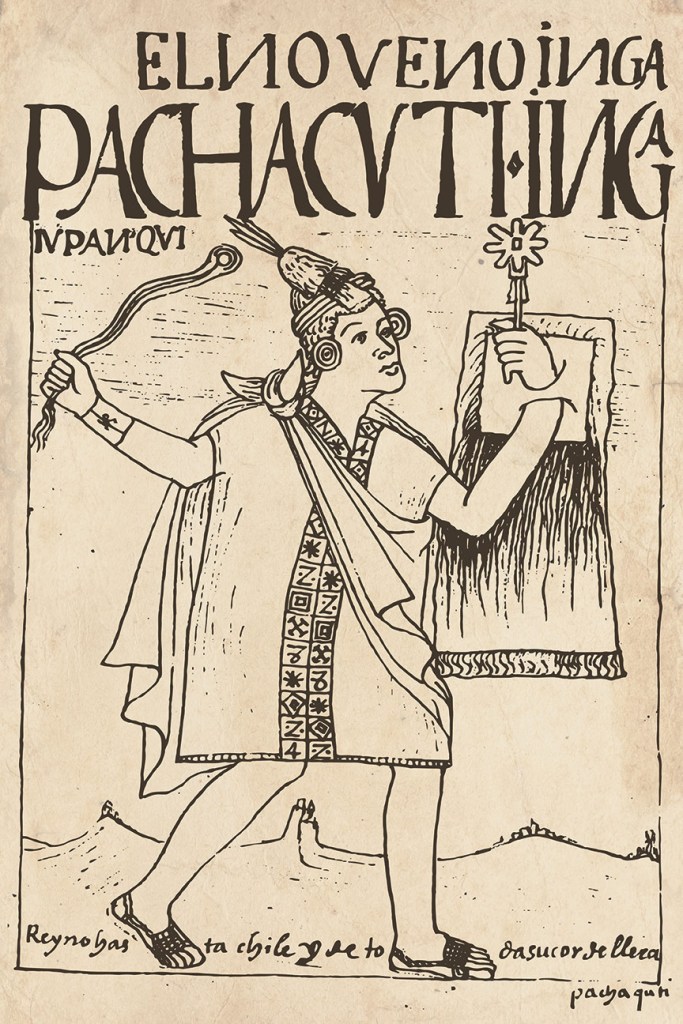
In “Delinking – The Rhetoric of Modernity, the Logic of Coloniality and the Grammar of de-Coloniality,” Walter D. Mignolo contends that the rhetoric of modernity and the logic of coloniality “works through the imposition of salvation,” operating via the “colonization of space and time to create a narrative of difference that placed contemporary languages ‘vernacular’ (indeed, imperial) languages and categories of thought, Christian religion and Greco-Latin foundations in the most elevated position.” In other words, the very architecture of colonial domination hinged upon a meticulously crafted temporality, one that constructed history as a veritable linear progression in which Indigenous peoples were permanently positioned as behind—a calculated maneuver that rendered them perennially in need of salvation, civilization, and subjugation. To sustain this logic—to justify the need to civilize, evangelize, and educate Indigenous peoples—coloniality necessitated the erasure of Indigenous epistemologies that conceptualized time not as a fixed, unidirectional progression, but as a cyclical and mutable construct. For if time is not an immutable, teleological sequence, then neither is history. And if history is not an indisputable, immovable march toward progress, then what need is there to colonize? Even the very title of Guáman Poma de Ayala’s The First New Chronicle and Good Government subverts colonial historiography, as it asserts his account as the first, his chronicle as history, and his way of knowing as truth. By embedding an Andean temporal framework into a traditionally linear Biblical narrative, by intertwining Andean mythological historiography with Christian genealogies, and by the very act of syncretizing religion and reinterpreting history itself, Guáman Poma rewrites a New Chronicle that places Andean people at the center of a universal Christian history—not as an uncontacted population awaiting salvation, but as a rich, complex culture that had always already been Christian, educated, and civilized without the forces of colonization.
Early colonial ideology framed history as a linear progression aimed toward Christian salvation, viewing the Americas as ‘new’ lands entering into history and Christianity only upon European contact. Scholars and theologians wracked their minds trying to figure out a way to make sense of why Biblical narratives lacked any mention of these lands and peoples. In A Natural and Moral History of the Indies, José de Acosta attempts to resolve this discordance by claiming that, “after the Universal Flood, of which all these Indians had knowledge,” the Incas strayed from their true Christian origins, replaced by rulers who “emerged from the cave of Pacaritambo” and asserted that “only they possessed the true religion” to justify their conquest. For Acosta, the Indigenous populations’ “natural capacity to receive good instruction” derived from their now-obscured Christian origins, a condition that could be rectified through their re-education into Christianity. Similarly, Guáman Poma’s chronicle integrates Indigenous history into the Christian narrative of Creation, Flood, and Redemption. Yet, in Guáman Poma’s New Chronicle, Andean history unfolds not behind but parallel to Christian history, reframing the Spanish conquest not as the linear ‘arrival of modernity,’ nor the ‘arrival of Christianity,’ but as a cyclical upheaval that evokes the concept of pachacuti—a Quechua term that merges pacha (the Andean space-time continuum) and kuti (a turn or reversal) to express a cyclical space-time rupture, a rhythmic process of death and rebirth into a new cosmic order. Hence, as Rolena Adorno observes, “on more than a dozen occasions, [Guáman Poma] complains that the proper order of things is reversed,” frequently invoking “the world upside down.” Rather than a one-way progression, Andean time is understood as cyclical and regenerative, defined by successive epochs of creation, destruction, and renewal, in which each pachacuti, often catalyzed by cataclysmic events such as floods and earthquakes, marks the end of one era and the beginning of a new—a complete reset and reordering of the world.
Adopting the Christian chronological ordering from Creation to present, Guáman Poma restructures historical time by dividing it into successive ages that flow in dual parallel streams—one tracing the lineage of the Incan kings, the other following the biblical passage from Adam to Christ. In Drawing 3, “God creates the world and gives it to Adam and Eve,” Guáman Poma pictures the Genesis narrative against the unmistakable background of the Andes mountains, a visual assertion that inscribes Andean lineage within the divine genealogy of humankind. By placing Vari Viracocha alongside Adam and Eve and linking Vari Runa—“who descended from Noah after the Flood”—to the first Inca king, Tocay Capac, he asserts a divine continuity that situates the Indigenous Andean peoples within the Christian origin story. Tocay Capac, he writes, was “of the lineage of the legitimate descendants of Adam and Eve and the progeny of Noah and the first of Vari Viracocha Runa and Vari Runa,” directly invalidating evangelical rationale that sought to expel Indigenous peoples outside of God’s sacred convent. In Guáman Poma’s account, the peoples of Peru are not only direct offsprings of one of the sons of Noah, but are also direct descendants of Adam and Eve, thereby destabilizing colonial narratives that cast the peoples of the Americas as an inferior or separate humanity.
Having established a common sacred origin, Guáman Poem then narrates how Andean and biblical histories diverge after the Flood, yet continue to unfold in parallel: as the biblical world proceeds through the lineages of Shem, Ham, and Japheth, the Andean world follows the line of Noah’s progeny in the Americas. In this period, Guáman Poma recounts, Cinche Roca “killed the first legitimate Inca, the descendant of Adam and Eve and Vari Viracocha Runa, the first king Tocay Capac,” and subsequently “gave the order and made it law that [his conquered subjects] worship the huacas, idols, and make sacrifices.” This moment marks the split from the primordial, monotheistic workshop of the first Incas to the subsequent idolatry that alienates them from their original Christian roots. Unlike Manco Capac, Guáman Poma stresses that “the first Inca, Tocay Capac, had no idols nor ceremonies,” venerating only the Christian God up until “the reign of the mother and wife of Manco Capac Inca.” The introduction of idol worship coincides with the ascent of Mama Huaco, whom he vilifies as “a great deceiver, idolater, sorceress, who spoke with the demons of the inferno and performed ceremonies and witchcraft.” He further castigates her within a moral discourse that conflates female sexuality and promiscuity with unholy corruption, underlining how she “slept with all the men of the town whom she liked.” By summoning a distinctly Christian moral framework, Guáman Poma frames Mama Huaco as an Andean Eve—a woman whose transgressions introduce sin, disorder, and separation from God. Just as Eve’s fall from Eden precipitates humanity’s exile from paradise, Mama Huaco was “the original inventor of the huacas, idols, witchcraft and enchantments,” who “deceived the Indians” into straying away from their divine provision.
From this narrative of deviation—akin to the Biblical Old Testament—sprouts the redemptive figure of Christ, whom Guáman Poma directly places within the Andean timeline. According to his account, Jesus Christ was born “when Cinche Roca Inca was eighty years old,” and soon after, he sent “the apostle Saint Bartholomew to visit the Indies of this kingdom of Peru” to “bring the miracle of God” and restore Christianity among the Indigenous peoples. This intervention predates the Spanish conquest by over a millennium, suggesting that evangelization was not an Iberian accomplishment from the sixteenth century, but rather an ancient, historical phenomenon that began in the first century A.D. The conversion of Anti, an Incan man later baptized Anti Viracocha, further reinforces this context: having recognized the power of the Christian God, Anti begs Saint Bartholomew, “for mercy and restitution,” ultimately affirming that “the poor man and his God were the most powerful,” and thus restoring the precedence of Christianity in the Andes. By strategically placing evangelization at the moment of Christ’s apostleship rather than at the moment of European contact, Guáman Poma positions the Indigenous peoples not as newly Christianized subjects but as a people who had long understood and worshiped the one true God—casting the Spanish colonizers, who arrived much later with greed and brutality, as the poorly behaved Christians.
From this moment forward, Guáman Poma recounts a series of recurring miracles and divine punishments, cyclical in nature, augmenting his argument that Christianity was deeply entrenched within the core of the Andean world long before European intervention. He laments that “no record was left of this because there was no one to write it down,” yet nonetheless asserts that the Incan kingdom was undoubtedly permeated with Christian faith. Notably, he employs the Quechua concept of pachacuti as a theological framework to describe these interventions, declaring that “the punishment of God” manifests as “pachacuti [cataclysm], pacha ticra [world upside-down].” Through this choice of language, Guáman Poma explicitly links pachacuti to historical cycles, explaining that “some kings were named Pachacuti,” precisely because they rose during these eras of profound cataclysmic upheaval. He then recounts a succession of natural disasters—from “the eruption of volcanoes” to “measles, smallpox, croup and mumps”—interpreting them not as random occurrences but as divine miracles and punishments in the shape to pachacuti, recalling the Andean understanding of history as a cyclical destruction and renewal.
With this Andean-Christian temporal framework in place, Guáman Poma transitions into the heart of his chronicle—the indictment of the present: “Another pestilence that God sends is the bad Christians to rob the possessions of the poor and take their wives and daughters and use them…the way the Indians of this kingdom depopulate and leave their towns…the death of many Indians in the mercury and silver mines.” Here, he deploys pachacuti not merely as a historical pattern but as a theological critique, directly inverting the Spanish colonial rhetoric that framed the conquest as a providential advent of salvation. Rather than heralding the dawn of Christianity, Spanish rule itself becomes the pachacuti—a catastrophic schism that has plunged the world into disorder, injustice, and moral corruption. The Spaniards do not appear as divine emissaries guiding a lost people to newfound faith, but as ‘bad Christians,” agents of havoc and destruction who have desecrated a land of legitimate descendents from Adam, Eve, and Noah—a Christian peoples who had already been worshiping God long before European arrival. As a divinely ordained pachacuti, Guáman Poma does not frame conquest as an irreversible event: just as past pachacuti cycles led to rebirth, violent Spanish rule is a “world upside down” that can and must be undone. The conquest, like the biblical flood, is not an ultimate endpoint but an impermanent disruption—a moment of destruction that precedes renewal. Just as Cinche Roca’s era of spiritual corruption was followed by the birth of Christ and the reintroduction of Christian faith, so too must the current pachacuti be rectified by reinstating Andean Christian order. If the King of Spain were a true Christian monarch, he would recognize the violence and brutality of the conquest as a perversion of divine law and move to rectify the injustices wrought by his “bad Christians.” By meticulously restructuring history through Andean temporality, Guáman Poma does more than place the Andes on equal footing with the Old World—he dismantles the very foundation of colonial logic. The Spanish conquest is not the beginning of Andean history, nor is it its inevitable conclusion—it is a mutable moment within an ongoing temporal cycle. Through his New Chronicle, Guáman Poma rewrites history itself, presenting not a colonial teleology but an Andean-Christian historiography in which the conquest is neither natural nor permanent, but a pachacuti awaiting divine restoration of justice.
Works Cited
Acosta, José de. Natural and Moral History of the Indies. Translated by Frances López-Morillas. Durham: Duke University Press, 2002.
Adorno, Rolena. Guáman Poma: Writing and Resistance in Colonial Peru. 2nd ed. Austin: University of Texas Press, 2000.
Guáman Poma de Ayala. The First New Chronicle and Good Government: On the History of the World and the Incas up to 1615. Translated by Roland Hamilton. Austin: University of Texas Press, 2009.
Gutiérrez Aguilar, Raquel. Rhythms of the Pachakuti. Durham: Duke University Press, 2014.
Mignolo, Walter D. “Delinking – The Rhetoric of Modernity, the Logic of Coloniality and the Grammar of de-Coloniality.” Cultural Studies 21, no. 2–3 (2007): 449–514.
PDF Version
Flowers Sing Metaphysical Songs: Nahua Philosophy in the Meta “Flower and Song,” “Another to the same tone, a plain one,” Cantares Mexicanos
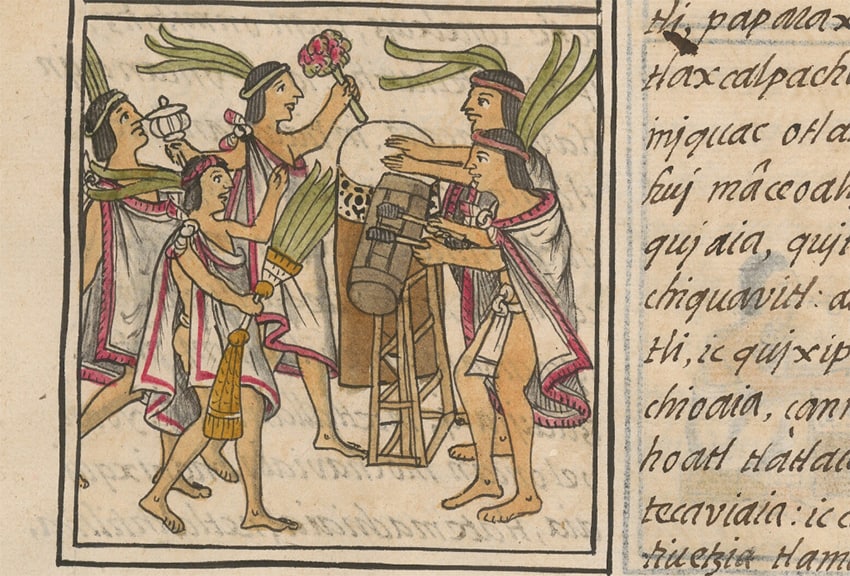
III Another to the same tone, a plain one
I am a singer, and I enter the flower house where the jade drum stands,
where Life Giver—where the lords—are awaited. The flowers are driz-
zling down. And among these rush-head lords, among these green
shoots, the flower copal, the incense, is spreading fragrance. These heart
pleasers make hearts drunk with fragrance before the Ever Present, the
Ever Near.
Yes, our songs are set free, our hearts are made drunk with flower fra-
grance, and with these sundry flower songs we lose our senses, regaling
the Ever Present, the Ever Near. How can you not be desirous, friend?
Stand up beside my drum! Adorn yourself with sundry flowers. Jades,
pine flowers! Lay them on your head! Lift these good songs and enter-
tain the Ever Present, the Ever Near.
What are you recalling? Where are your hearts? You scatter your heart, you
carry it here and there, your heart is troubled on earth. Where can you
be esteemed? Come return! Hear the good songs! Soften your heart with
flower water. They’re spreading fragrance. There! I, the singer, am lift-
ing good songs, entertaining the Ever Present, the Ever Near.
Friend, come see! Sunstruck flower drums stand beyond: they’re beaming:
like a fan of quetzal plumes they’re radiating green. And there beyond,
with these, the mat and throne of the Ever Present, the Ever Near, is
waited upon and honored. Quit the shadows! Come return with us! Lift
these songs! I, the singer, entertain the Ever Present so that light appears
within your breast.
What’s the use of my creating these, I who sorrow-sing, recalling princes,
precious bracelets, precious turquoise gems, quetzals who were fam-
ous, who were famed on earth, whose fame and glory still resound?
Where are we to go? Indeed, we only came to be born, indeed, our
home is beyond, where all are shorn, where life is infinite, where things
never end.
Where are we to go? Indeed, we only came to be born, indeed, our home is beyond, where all are shorn, where life is infinite, where things never end.
Cantares Mexicanos, Song III, “Another to the same tone, a plain one.”
When the Spanish first landed in the Americas, confusion began to instantly imbue both the Spaniards and the indigenous peoples as they sought to bridge two immensely different cultures without possessing the language to do so. The difficulty of communication between these two people stemmed not only from their highly different cultures, languages, and religions but from two entirely different understandings of reality. While European philosophy sought to understand a static, empirical reality to gain truth, Nahua philosophy sought to understand an evanescent, mutable reality to understand their path on earth. Scholar James Maffie calls Nahua philosophy a “path-seeking philosophy” and European philosophy a “truth-seeking philosophy” (Maffie). He writes, “when the Franciscans speak of ‘la verdad’ (truth understood semantically in terms of correspondence), the Mexica hear ‘nelitiliztli’ (‘well-rootedness,’ ‘genuineness,’ ‘authenticity’) or ‘nelli ohtli’ (rooted, true, or genuine path),” and from this fundamental differing, there arises a “double mistaken identity” when the two peoples communicate; each side is essentially “deaf” to what the other is trying to communicate (Maffie). At the heart of the Nahua metaphysics lies the concept of teotl, a dynamic, eternally transforming, generating, and regenerating force that continuously flows through everything like electricity, ceaselessly composing and constructing the cosmos. While Spanish Christianity sought to understand the universe through reading the Bible and practicing prayer, Nahua wisdom encouraged constant engagement with nature, existential thought, and artistic activity to better grasp teotl – the fabric of the cosmos. Nahuas thought of teotl like an artist continuously painting the cosmos and thus believed that human understanding of teotl is best acquired and expressed artistically through what they called “in xochitl, in cuicatl,” or “flower and song,” a Nahua metaphor for using art to gain and express insights about the ultimate, transcendent layers of reality. The words “flower” and “song,” along with the phrase “Ever Present, Ever Near,” constantly recur throughout the collection of song-poems Cantares Mexicanos. In the poem “Another to the same tone, a plain one,” the singer/speaker uses symbolic imagery of flowers and songs to sing a meta “flower and song,” a “flower and song” that grapples with and questions its own nature while attempting to bring both themselves and the listener towards a deeper metaphysical understanding of teotl, and thus the universe. The song-poem itself mirrors the nature of teotl while seeking to understand it, exploring its medium to both acquire and “sing” Nahua metaphysical wisdom and transcend the melancholy that accompanies the Nahua human condition.
Nahua metaphysics situates humankind within a fragile, evanescent universe subject to a cyclical state of flux. Nahua metaphysics sees teotl as the ultimate particle of the cosmos – composing, comprising, permeating, and shaping the universe in an ongoing process of self-generation. The cosmos and teotl are inherently interchangeable; teotl is the universe, and thus one must see reality as a “ceaseless processing, becoming, transforming” that is “always already becoming, continually in motion” (Maffie). Maffie maintains that this “ontological monism,” the notion that everything is reducible to teotl, along with teotl’s “process metaphysics,” or the image of teotl as a dynamic, ever-changing, self-becoming process rather than a fixed entity, establishes the foundation of Nahua metaphysics. Teotl seeks to balance “the cyclical struggle between paired complementary polarities or inamic pairs” through a process of autogenic creation that is “exemplified by mixing or shaking things together” (Maffie). Teotl is quintessentially artistic; it is a consummate cosmic artist painting its own canvas. Thus, the human understanding of teotl is best discovered and articulated through the process it so closely resembles – art.
Unlike Western Christianity, which often clearly distinguishes humans from their creator, Nahuas see creator-beings as sacred and divine forces that are not separate from but dependent upon humans. Humans owe their existence to creator beings and teotl, and since “creator beings constantly require the nourishment of human life forces and cannot exist without this nourishment,” humans are born with an innate moral obligation to participate in the renewal of the universe and engage with teotl (Maffie). The relationship between humans and creator-beings is thus a symbiotic, mutually interdependent process in which humans feed and nurture divine forces through sacrifice and art. The art of song-poetry becomes both a way of understanding the universe and ensuring its existence. Since nature is teotl and teotl is nature, nature, and poetry, like all things, are ever-flowing, living processes of movement, change, and transformation. Nature and art, or “flower and song,” are thus the beating, pumping heart of the cosmos.
The Nahua song-poem “Another to the same tone, a plain one” uses vivid imagery and symbolic representations of flowers and songs to implore the listener to embrace nature, worship the divine, and seek out wisdom, acting as a sort of meta “flower and song,” a “flower and song” that becomes its own metaphor; it is like a poem about the nature of poetry. The singer begins by introducing themselves in first person, acknowledging their role in the “flower and song” by proclaiming, “I am a singer,” before entering “the flower house where the jade drum stands, / where Life Giver—where the lords—are awaited” (1). Although Bierhorst translates the Nahuatl words “tloque, nahuaque” to both “Life Giver” and “Ever Present, Ever Near,” scholar Miguel León-Portilla writes that “tloque, nahuaque” can also be read as an epithet of teotl, and can instead be translated as “Lord of the Close, sometimes Ipalnemohuani, ‘Giver of Life,’ sometimes Moyocoyatzin, ‘He who Creates Himself’ (León-Portilla). By linking “the flower house” with “Life Giver,” or teotl, the singer implies that through their song, they transcend to a divine place where teotl and creator beings dwell, a sacred place of spiritual wisdom, thus, the “flower and song” immediately puts forth its own metaphor – by engaging in “flower and song,” or artist in ic activity, Nahuas can better understand and absorb teotl. Furthermore, flowers and nature in the song are almost always personified as continuously moving. The flowers are “drizzling down” and “spreading fragrance,” the “flower drums stand beyond: they’re beaming,” nothing in the poem remains stagnant because everything is teotl (5, 21). The singer, who through song figuratively “enters” a realm replete with spiritual knowledge, depicts the perpetual movement of teotl by personifying the flowers as constantly moving. The flowers are never static and always dynamic, mimicking the nature of teotl and demonstrating that they are one in the same.
Like a flower, teotl possesses roots and petals; it is a balanced rootedness that rises, bursts forth, and blossoms within the Nahua heart. For this reason, teotl, and thus philosophical wisdom, are best procured through one’s heart. The Nahuas saw humans as creatures who yearn to be rooted, who restlessly seek a balanced anchor for their lives, who yearn for a sort of “teotlized heart,” and who become imbued with teotl through “flower and song.” The Nahua heart asks: “what is the path (ohtli)? How can we Mexica maintain our balance while walking upon the path of life on the slippery earth” (Maffie)? The singer calls the flowers “heart pleasers” that “make hearts drunk with fragrance before the Ever Present, the Ever Near.” (8) The flowers in the song are “spreading fragrance” that pleasurably infuses the Nahua heart, and since flowers encompass knowledge of teotl, the “fragrance” that emanates from them can be metaphorically interpreted as the wisdom dispersed by nature. While the act of singing transports the singer to the “flower house” where teotl is “awaited,” the flowers make the Nahua hearts “drunk with fragrance,” or rather, permeated with wisdom. Through the “flower and song,” the singer is brought “before the Ever Present, the Ever Near,” thereby developing a more “teotlized heart,” a deeper understanding of the cosmos.
The singer glories and exults the bliss that comes with obtaining a heart drunk with teotl, “with these sundry flower songs we lose our senses, regaling the Ever Present, the Ever Near,” before asking the listener: “How can you not be desirous, friend” (10)? The singer celebrates the process of engaging with nature and art that led them on a path towards wisdom while simultaneously urging others to join them in the sacred process, to take part in eulogizing and venerating the creator-beings and teotl, and perform the necessary measures to preserve the universe. To uphold the process of balancing that existence depends on, the singer beseeches the listener to “Stand up beside my drum! Adorn yourself with sundry flowers,” urging the listener to marinate in nature and embrace it before entreating them to “Lift these good songs and entertain the Ever Present, the Ever Near,” thereby enjoining the listener to submerge themselves in flower and song so that they too can relish in the ecstasy that the singer enjoys (12). Proper Nahua ethical behavior requires one to contribute towards sustaining cosmic equilibrium, and “the consequences of improper behavior included in balancedness, disequilibrium, and disease” (Maffie). The song-poem evokes the melancholy of the Nahua human condition, the inherent imbalance in life that humans and teotl must endeavor to equilibrate, the yearning for equilibrium, and the tragedy of being born with a scattered, imbalanced heart that must be remedied. The singer captures this melancholy: “Where are your hearts? You scatter your heart, you carry it here and there, your heart is troubled on earth” (15). To cure this melancholy, the singer encourages the listener to “Hear the good songs! Soften your heart with flower water,” thereby “entertaining the Ever Present, the Ever Near,” or, in other words, collectively engage in “flower and song” to nurture and feed the creator-beings, weave the fabric of the cosmos, facilitating the generative process of teotl (17). Since the universe requires nourishment from humans which “consists of well-spoken words, song, dance, music, ceremony, incense, and blood,” humans must engage in practices of sacrifice and “flower and song” in order to live (Maffie). To “quit the shadows,” shadows being the melancholic imbalance of life, the singer suggests that one “entertain the Ever Present so that light appears within your breast,” the light being the balance that results from teotl’s process and emerges in an individual when they cultivate a “teotilized heart” (25). Through “flower and song, ” one can transfigure their melancholic, imbalanced heart into a heart drunk with teotl and filled with the “light” of equilibrium.
The song-poem, ripe with metaphysical wisdom and philosophical questions about the nature of existence, culminates with a meta question. The singer asks, “what’s the use of my creating these,” before asking, “Where are we to go” (31)? The “flower and song” gradually reveals that the answer, the reason for its creation, can be found within its metaphor, for the words “flower and song” denote that through exploring nature and art, one acquires metaphysical knowledge and a more “teotlized heart.” The song concludes by answering its final question: “Indeed, we only came to be born, indeed, our home is beyond, where all are shorn, where life is infinite, where things never end” (31). Maffie summarizes the Mexica ethical standard that demands human involvement in the ceaseless weaving of the universe: “as individuals, humans are born into a complex fabric of moral relationships obligating them to reciprocate for gifts they have received” (Maffie). Creating a “flower and song” mirrors the Neplanta-defined mutualistic relationship between humans and creator-beings; by creating it, humans nurture and nourish themselves while nurturing and nourishing the cosmos. For Nahuas, “we only came to be born” (31). Humans are born into the cosmic fabric of teotl, a universe constantly balancing, changing, and generating in an ongoing process of becoming. The Nahua spirit yearns for a “teotlized heart.” Like teotl, it seeks out balance through creation. Born into an imbalance, the Nahua home is balanced. Their home is not the earth, but somewhere beyond, “where all are shorn, where life is infinite, where things never end” (27). Humans are born into an evanescent reality dependent upon the creation of “flower and song,” the constant weaving of the cosmos. Thus, perhaps the enigmatic home that the song refers to, where “life is infinite, where things never end,” is not a place, but a process, for teotl is the consummate never-ending process. Maffie says, “balance is a process – balancing,” and thus, perhaps the Nahua home is a process – becoming.
Works Cited
Cantares Mexicanos: Songs of the Aztecs. 1a. ed. Translated, introduction and commentary by Bierhorst, John. Stanford: Stanford University Press, 1985.
León Portilla, Miguel. The Broken Spears; the Aztec Account of the Conquest of Mexico. Boston Beacon Press, 1962.
Maffie, James “Mexica (Aztec) Philosophy at the Time of the Conquest.” Humanities 110: Introduction to Humanities. 27 January 2023. Reed College. Portland, OR. Lecture.
Painting lo indígena and la feminidad into la mexicanidad: Post-revolutionary Artistic Representations of Mexican Identity
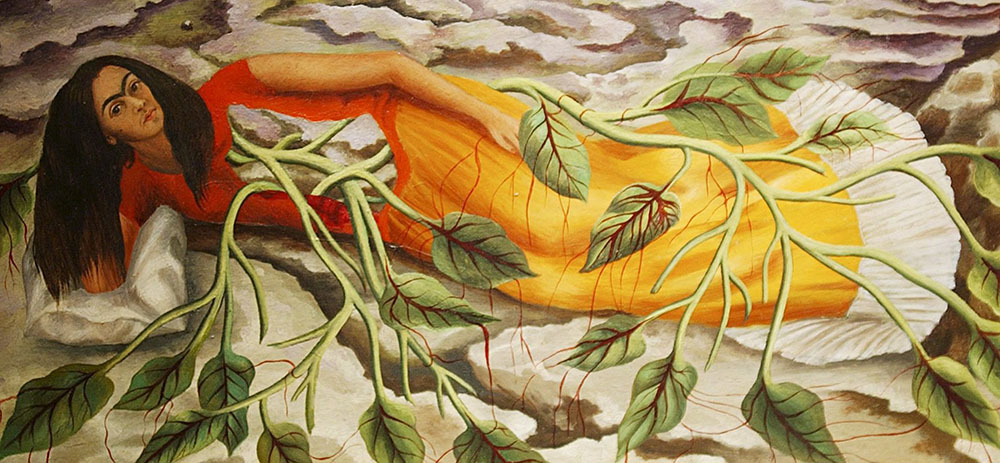
A nation is not just an observed body politic, but a carefully constructed entity. A sense of nationality is not just visually perceived but emotionally felt. A nation is “imagined as a community” and conceived as “a deep, horizontal comradeship” (Anderson, 7). To build a nation, therefore, is to forge a collective sense of identity amongst its people. Those born into a previously established nation often inherit this sense of collectivity. However, when a new nation emerges, it must find a thread that binds its people together. Such is the case of post-revolutionary Mexico – a marvelous fusion of indigenous and European culture, a medley of diversity, and a picture of hybridity. As Mexico sought to legitimize its status as a nation, Mexican artists painted a newfound Mexican identity in a country characterized by differences. Mexico began with an effacement of identity, an erasure of lo idígena that, years later, those fabricating a synergistic Mexican identity would have to revive and rekindle. In the years following the Mexican Revolution, establishing a united sense of Mexican identity became a primary objective as Mexico struggled to assert itself as a nation. Art respectively became a powerful tool for discovering and representing la mexicanidad, the essence of the Mexican soul that considers Mexico inseparable from its indigenous roots. Mexican muralists such as Jose Orozco and Diego Rivera sought to paint an all-encompassing picture of Mexican identity that embraced and celebrated its indigenous origins. However, blinded by exclusively masculine perspectives on history, these male muralists pictured Mexican women as passive, maternal figures rather than valuable, active participants in the unfolding of Mexican history. Paintings such as Jose Orozco’s Cortés y la Malinche and Diego Rivera’s La creación epitomize the characterization of Mexican women as indigenous, domestic, and docile recipients that dominated Mexican attitudes towards gender at the time. At the same time, however, one woman, vexed by the marginalization and alienation of women around her, decided to pick up her paintbrush and paint an image of mexicanidad that encompassed both lo indígena and la feminidad with a profoundly honest intimacy that used her individual, subjective pain to communicate the struggles of searching for mexicanidad. Through visual manifestations of her inner turmoil and painful struggle to reconcile her inner dualities, Kahlo distinguishes herself from her male contemporaries by painting a more inclusive picture of what it means to be Mexican – to be two in one.
As the Mexican Revolution subsided around 1920, the reformed government embarked on an endeavor to develop cultural programs dedicated to cultivating and spreading Mexican nationalism in education and the arts. The leader of the program, José Vasconcelos, aspired to foster artistic production that promoted the importance of lo indigenismo, Mexican indigenousness, and mestizaje, a term for interracial and intercultural mixing that Vasconcelos believed would create “la raza cósmica,” “the cosmic race,” or “the moral and material basis for the union of all men into a fifth universal race” (Vasconcelos, 403). Three Mexican muralists – often called “los tres grandes” or “the big three” – emerged from Vasconcelos’ vision as the painters of a renewed Mexican identity, a blossoming mexicanidad. State-sponsored Mexican murals reverted to the aboriginal culture and depicted folkloric elements of Mexico’s indigenous people to glorify ancient and contemporary native culture and refuse Spanish colonialism. As art became a vehicle for rediscovering the past, Mexico’s indigenous identity surfaced as the beating, pumping root of mexicanidad. Although “los tres grandes” proclaimed to paint an image of mexicanidad that uplifted Mexico’s previously subjugated and oppressed – its indigenous population – they excluded a group of marginalized people and thus propagated the exclusivity they so vehemently professed to reject. In the male-dominated world of state-sponsored Mexican art, the women of Mexico remained unseen, unheard, and invisible. For “los tres grandes,” Mexican national identity was essentially masculine.
In El laberinto de la soledad, Mexican poet Octavio Paz personifies the standard view of women held by post-revolutionary Mexico when he compares all Mexican women to the figure of La Malinche, the native mistress of Cortés, considered a traitor who opened her country to foreign invasion: “Her passivity, open to the outside world, causes her to lose her identity […] she is no one; she disappears into nothingness; she is Nothingness. And yet she is the cruel incarnation of the feminine condition” (25). Mexican women were confined to a private, domestic sphere and cast into the passive roles of wives, mothers, teachers, or helpers. In contrast, the murals envisioned men as glorified heroes and leaders who could fight for freedom, shape Mexico, and change the world. The revolution solidified a patriarchal image of Mexico that associated masculine virility with social transformation. Although male muralists paved the way for lo indigenismo to emerge, their male-dominated artistic spaces subordinated female identity to a degraded status. Within these murals, to be Mexican, first and foremost, meant being male. Female mexicanidad was but a mere refracted image of the Mexican man.
The murals of Diego Rivera and Jose Clemente Orozco, two of “los tres grandes,” embodied the image of Mexican identity as a gendered mestizaje. Rivera and Orozco almost always represented women in secondary roles. Their murals fostered a sense of mexicanidad as one-half female, indigenous, and passive, and the other half male, European, and dominant. Diego Rivera’s mural La creación encompasses both the gender differentiation and sense of indigenous pride promoted by post-revolutionary Mexican ideals.

The mural illustrates the creation story with vibrant, brightly-hued symbols, colors, and themes that converge Christian and Aztec iconography to exalt Vasconcelos’ concept of mestizaje. Traces of European and Christian influence appear in the draped robes the figures wear, along with the musical instruments they play. Looming over the entire piece are two divine, winged figures that resemble traditional Christian angels. Mestizo men and women surround the mural’s center, depicting a male figure with arms spread wide above a lush jungle of animals and leaves. The allegorical figures that encircle the center are endowed with both European and indigenous characteristics, ranging from light complexions and blond hair to those with brown skin and dark hair. The mural’s center divides the feminine figures to the left side and the masculine figures to the right. On the feminine side, women represent beauty, divinity, and performing arts, maintaining traditional, passive feminine roles. The two bottom figures, dark-skinned, primitive, and distinctly indigenous, look up towards the brighter, more modern, and Westernized utopic vision of enlightenment. The indigenous man and woman at the bottom are represented as allegorical figures of Adam and Eve, while the angelic figures at the top evoke the cosmic image of a Christian heaven. Directly below the Christian heaven lies the emblem of the ancient Aztec Eagle and Cactus myth – a legend as important to Aztec culture as Adam and Eve are to Christianity.
The primary male figure’s centralized position, located between the Christian heaven and Aztec legend, presents him as a representation of the ideal Mexican, combining both European and indigenous culture. La creación construes mexicanidad as an identity that acknowledges Mexico’s indigenous past and embraces a more Western, modernized future. The mural presents mestizaje as the dominant ideology surrounding the ideal Mexican. For Rivera, mexicanidad encompasses both femininity and masculinity, indigeneity and Europeanness, but the figure that emerges as the personification of Mexico is undoubtedly male.
Octavio Paz was not alone in considering the historical and symbolic figure of La Malinche, emblematic of all Mexican women. The figure of La Malinche has been warped countless times throughout Mexican history to fit and formulate changing conceptions of Mexican identity and nationality. For a muralist constructing a gendered mestizaje, recasting and shaping the historical icons of La Malinche and Cortés – two halves that embody Mexican mestizo identity – allowed for a reinterpretation of Mexican identity that extolled mestizaje and legitimized the subaltern status of an indigenous woman. In Cortés y la Malinche, Orozco used this method to represent a vision of mexicanidad similar to the one portrayed in La creación – indigenous, European, and masculine.

Although Orozco does not employ as many Western techniques as Rivera does in La creación, his fresco combines the image of a European, Cortés, with that of an indigenous, La Malinche. Once again, the male figure is placed in a more dominant stance while the female figure maintains a position that conjures passivity. The couple is joined hand in hand as if engaged in the act of union. However, Cortés, pressing his right knee against her legs, lifts his left arm to prevent Malinche from any movement or action, symbolizing her subjugation and assimilation. While both seated figures are naked and occupy a similar amount of space, Cortés’s body, drawn with taut muscles and a solid firmness, is colored with a bright vibrance that gives him an air of invulnerability. Orozco, like Rivera, evokes a Mexicanized, allegorical image of Adam and Eve through the figures Cortés and Malinche. Like Adam and Eve, Cortés and Malinche represent a mystical source of creation, the mother and father of Mexico. Orozco’s portrait, therefore, sees mexicanidad as a combination of the European, dominant male Cortés and the indigenous, vulnerable female Malinche. Underneath this unified image of mestizaje is the lifeless body of a native, representing the subjugation of indigenous identity in the construction of mexicanidad. In Orozco’s painting, Mexican identity is the miscegenation of indigenous and European peoples and the subjugation and oppression of indigenous and female Mexicans. The male mestizo prevails at the cost of subjugating the indigenous woman.
In an artistic and political environment that associated Mexico with masculinity, Frida Kahlo cultivated mexicanidad by negotiating female identity in her work and rejecting the exclusivity of her male counterparts. While “los tres grandes” painted highly publicized and politicized murals that manufactured a mexicanidad exclusive to men, Kahlo used the private, intimate, and personal artistic medium of self-portraiture to portray her individual experience as a Mexican woman who represented a dual form of marginalization. In doing so, she painted a dualistic image of Mexican identity that encompassed not only indigenous and European qualities but elements of masculinity and femininity as well. Kahlo’s painting braids and interlaces opposites and dualities – the self and the other, the public and the private, the body and the mind, and the oppressor and the oppressed. She used traumatic and harrowing Mexican iconography to expose the psychological pain of both the female and the Mexican condition. Her paintings reflect the nationalist ideology of post-revolutionary Mexico that revered indigeneity while also resisting the oppressive masculinity associated with mexicanidad in the works of “los tres grandes.” Through investigating her own subjectivity, Kahlo redefines the concept of a mestizo/a.
In Las dos Fridas, Kahlo juxtaposes symbols of pain with dualistic symbols of mexicanidad that reveal her painful struggle to reconcile the opposing dualities inherent in Mexican identity. In the painting, she is two Fridas: a lighter-skinned Frida in a Victorian hairdo, apparel adorned with pompously elegant frills and lace, and a darker-skinned Frida dressed in a traditional, native Tehuana costume. The two women are inextricably linked together by a thin artery connecting their two hearts, one of which is nearly bleeding to death. Kahlo uses the image of an open heart, a fundamental Aztec symbol, and the native Tehuana dress to reassert the indigenous values she believes are inextricable from mexicanidad.

Unlike the Orozco and Rivera murals, femininity dominates Las dos Fridas, as men are nowhere to be found. In her uniquely feminine space, women are both subjects and objects simultaneously, liberated from the oppressive, masculine gaze that burns in the eyes of Orozco’s Cortés and pervades the atmosphere of La creación. Contrary to how women are depicted in hunching, sedentary, and passive positions in the murals of Orozco and Rivera, Kahlo remains seated in an upright, formal position that symbolizes strength and dominance and rejects her subjugated feminine role. In both Las dos Fridas and La creación, Mexico appears to be pre-Columbian and post-revolutionary at the same time. However, in Frida’s world, Mexico’s indigenous and European aspects are mutually dependent, unlike the hierarchical structure in La creación that positions Western modernity above indigeneity.
In both Las dos Fridas and Cortés y la Malinche, holding hands symbolizes the union between European and indigenous identities. However, in Las dos Fridas, Europeanness and indigeneity are connected by a linkage that surpasses mutually exclusive polarities, while Cortés and Malinche are bound together by a cycle of subjugation and domination that forces female and indigenous identities to be eradicated and replaced with a masculine, European one. The turbulent skyscape and openly exposed bleeding hearts in the painting make visible the inner turmoil of Kahlo’s inner conflict, the struggle to balance opposing polarities to achieve selfhood. Intrinsic to ancient Aztec belief is the idea that the universe comprises inamic pairs, opposing dualities, that must continuously be balanced and reconciled in a never-ending cycle. Likewise, inseparable from the mestizo soul is the need to balance two distinct racial and cultural identities. Las dos Fridas, therefore, visualizes the experience of mexicanidad and mestiza identity as one symbolic duality and highlights the emotional struggle of reconciling these disparate parts into a unified whole.
From the land of the Aztecs to modern Mexico, Mexico has always been a place of opposing dualities. In the years following the Mexican Revolution, artists and politicians endeavored to harmonize these polarities into one singular national identity. While “los tres grandes” painted murals that endorsed the concept of mestizaje and sought to construct a unified version of mexicanidad by juxtaposing and combining European and Aztec qualities, they often relegated women to a position of passivity that excluded their possession of mexicanidad. In frescos such as Rivera’s La creación and Orozco’s Cortés y la Malinche, mexicanidad was associated with either masculinity, subjugation, or hierarchy. Rather than dual forces being balanced, one dominates over the other. In these murals, Europeanness dominates over indigeneity, and masculinity dominates over femininity, a genuinely unified image of mexicanidad from emerging. However, in the self-portrait Las dos Fridas, the hybridity of race, sex, and gender coalesces to negotiate the intricate tensions between identity and marginality that pervade modern Mexico. In Las dos Fridas, Kahlo’s identity becomes emblematic of all Mexican identity. It incorporates and equilibrates masculinity and femininity along with Europeanness and indigeneity to construct a collective image of mexicanidad that each and every Mexican, not just men, can see their reflection in. For Kahlo, to be Mexican is to be situated in-between. Like the hearts of the two Fridas, Mexico is a nation that ties together dualities that often seem irreconcilable. The image of Mexico as a nation emerges like a bridge above water, connecting and rising above the remnants of its colonial past.
Works Cited
Alejandra Anreus, Leonard Folgarait, and Robin Adèle Greeley. “Manifesto of the Syndicate of Technical Workers, Painters and Sculptors” (1923-1924), in Mexican Muralism: A Critical History, ed. (Berkeley: University of California Press, 2012), 319-321.
Anderson, Benedict. Imagined Communities: Reflections on the Origin and Spread of Nationalism. Rev. ed. New York: Verso, 1998.
FRIDA, KAHLO. LAS DOS FRIDAS/THE TWO FRIDAS. OLEO SOBRE TELA/OIL ON CANVAS, 1939. MUSEO DE ARTE MODERNO, JSTOR, https://jstor.org/stable/community.15671746.
OROZCO, CLEMENTE JOSE. CORTES Y LA MALINCHE/CORTES AND LA MALINCHE. FRESCO/FRESCO, 1926. INBA, JSTOR, https://jstor.org/stable/community.15679993.
Paz, Octavio, 1914-1998. The Labyrinth of Solitude: Life and Thought in Mexico. The Philanthropic Ogre. New York :Grove Weidenfelds, 1985.
Rivera, Diego (Mexican painter, 1886-1957). Creation. Fresco, encaustic and gold leaf, 1922-23. JSTOR, https://jstor.org/stable/community.11900028.
Vasconcelos José and Jaén Didier Tisdel. The Cosmic Race = La Raza Cósmica. Centro De Publicaciones Dept. of Chicano Studies California State University Los Angeles 1979.
 Ava Linda Feliz-Sutter