
Amora
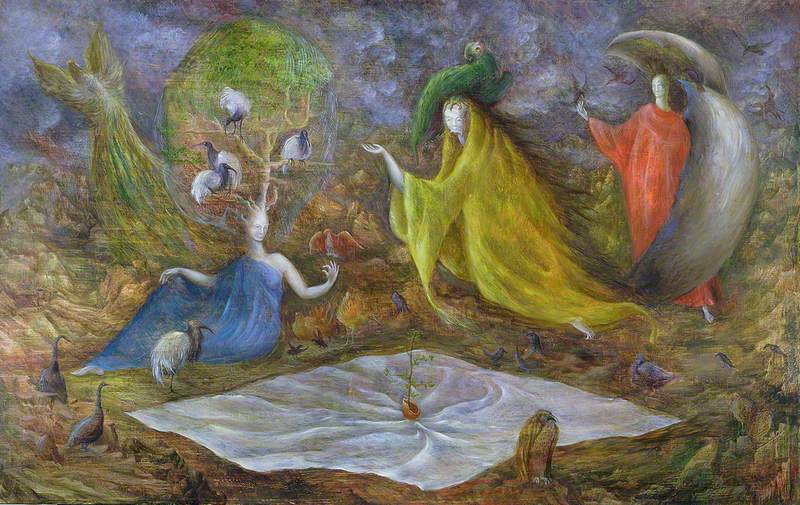
“So Scheherazade began.”
— A Thousand and One Tales of the Arabian Nights
Amora Rosalquía was born cradled in a bed of wild passionflowers, whose frilled violet petals, drunk with the ecstasy of blooming life, exhaled a fragrance so potent it was said to have roused the soul of the Rosalquía home from centuries of slumber. At the fall of her first tear, the motes of dust suspended in the humid air lit like fireflies, stirring the ancient tendons of the tezontle-stone walls, who trembled awake at once to shield her newborn gaze from the molten glow. The emerald bougainvillea vines—whose roots had entwined with Rosalquía blood since the first dawn of Santa Rosa—sprawled through the cracked adobe in a fevered bloom, unfurling like the vexed wings of a mother quetzal to weave a fierce green cocoon around her purple-plumed cradle.
Amora spent most of her childhood alone—a solitude that, though sharp at times, drew her toward places other girls never thought to look. Day after day, she wandered vine-draped alcoves and ochre corridors, parting leaves like velvet drapery, trailing her fingers along the ridges of volcanic stone, as if each fissure held some secret spell. She whispered dreams into the walls, convinced the spirits of her ancestors slept within—dormant, yet listening. As she ripened into adolescence, the house began to murmur back. At times, she felt its mossy breath whistling through shadow and bloom, a hush drifting across her skin. With every graze and shiver, she grew more intimate with its stones, sensing their longing to wrap her in old Rosalquía magic, to unveil the mysteries curled inside their bones. What began as a lonely girl’s strange imagination bloomed into the labyrinth that would one day become Amora Rosalquía’s mind.
Her mother bestowed upon her a beauty as elusive as dusk: a shadowed warmth in the coils of her obsidian hair, a moonlit glow beneath the olive sheen of her skin—as if sun and moon had seared her in a single fevered kiss. From her father, she inherited an intensity that throbbed through her veins like the jungle’s drumbeat—both intoxicating and fearsome to behold. Yet it was neither beauty nor spirit that made Amora so singular. What others mistook for childish fancy soon revealed itself as something far rarer. A fire had been stitched into her soul—so luminous, so strange, so wild—the villagers of Santa Rosa swore it could have been lit only by the gods. Amora Rosalquía bore the gift of a true storyteller.
From the moment her gift came to light, Amora was no longer seen as merely a girl. She became the blessed daughter of Santa Rosa—a living talisman of its jungle breath and volcanic blood. Her skin shimmered with the jade of the canopies. Her eyes twinkled with the turquoise-lit veins of the cenotes. Her blood thrummed with the primordial pulse of the mountains. It was glaring and undeniable: the molten heart of the land had poured its fire straight into her soul.
Even Amora stood in awe of what blazed within her. She painted the faintest hues and sculpted the subtlest textures of her every sensation: the smoky nectar of passionflowers warming in her throat, the sultry musk of vines clinging to her skin, the golden-green light fractured through the canopy in prisms. Her father’s palace rose from the soil and glared through the overgrown foliage like a half-sunken jewel—strung with jade, rimmed in obsidian, tiled in turquoise. But it wasn’t her honey-umbered home that set her imagination alight. It was the land itself—the tangled marshes, mist-laced mangroves, moss-matted roots, and jaguars that prowled through rustling foliage like spectral beasts—that kindled her flame and breathed life into her stories. She spun the myths of Santa Rosa into song: brave warriors who slit the bellies of pumas with obsidian blades, fearless women who toiled and burned beneath the unrelenting sun, gods and goddesses whose laughter once mingled with the hummingbirds at dawn—each woven into a melody so vivid and sharp it swelled warm tears from even the coldest eyes.
Word of her gift spread like wildfire. Whispers of a celestial beauty whose voice could hush the wind and beckon the stars reached faraway lands, luring strangers to brave jungles for just one glimpse of her tale-telling magic. Her visions stretched far beyond the present—backward into the primeval womb that bore the cosmos, and forward into the tragedy already etched into her fate. From her very first breath, Amora had known: they would come for her land.
The visions struck with monstrous clarity: a procession of pale riders silhouetted against a bleeding horizon, their horses tearing through palms like vipers, hooves churning her beloved savanna into a maelstrom of dust and decay. Spears glinted like shards of light. Arrows shredded the blackened sky. Swords cleaved the thick tropic swelter—and with each stroke, the steel sliced not only heat and flesh, but some deeper sinew of her soul.
Her parents called the village doctor, unable to understand why their daughter’s gaze kept locking to the clay floor. But Amora wasn’t staring into nothing. She was watching the future unravel in merciless detail: banners dancing triumphantly against a vermilion sky, their blood-bright pigments mocking the devastation below. Forests stripped to bone. Huts collapsing into smoke. Villagers fleeing the chains of slavery—their cries swallowed by a sky gone carnivorous, arrows striking them down mid-scream.
She wanted to scream when the bougainvillea vines were hacked and hewn, torn mercilessly asunder. She longed to disappear when the passionflowers she once adored so fiercely bled their wine-dark hearts into desiccated soil. She ached to recoil as their ambrosial fragrance curdled into the metallic stench of death. But her body would not move. She stood frozen—impotent as a ghost in purgatory. Condemned to witness. Unable to act.
Amora understood then: they would come not as men, but as a ravenous gale—driven not by conquest, nor glory, nor even gold, but by a blind and bottomless hunger to consume all that pulsed. She knew what it meant for Santa Rosa. And still, through every vision, through each fevered nightmare, she remained a silent witness. Powerless before the cavernous chasm of fate. Cursed to bear a prophecy that no spell, no prayer—not even her sacred gift of words—could undo.
The air—once sweet with banana leaves and heliconias—curled into smoke and soot. The hearthstones that had once kindled her family’s warmth now blazed red-hot as funeral pyres. No prophecy, no vision, no warning could have shielded her from the piercing shriek of her own heart as it shattered, shard by shard, into the blood-drenched soil.
The vulturous gaze of her captors devoured her long before their hands ever reached her—but that did nothing to dull the pain. They took her first for her beauty, seizing her as one might seize land: defenseless, ripe to ravage, theirs to plunder. Bruises bloomed beneath their grip like poisonous blossoms. Each mark leached the light from her olive skin, leaving her blank—a canvas to bear the scars of their conquest. By nightfall, she lay hollowed and hopeless. Yet, quivering between surrender and survival, when the shadow of death leaned in to press its fatal kiss, Amora summoned the strength to draw one final breath. Not to beg—but to speak.
At first, her voice was no more than a patter of rain. But with each word, it swelled—gathering force, pouring forth in torrents that ensnared her captors in a spell for which they had no armor. Every syllable pulled them deeper into a world beyond their reach, submerging them in a thirst they had never known—and would never quench. By the time her final word fell, they had already chosen to spare her life—but only to bind her anew.
They sealed her inside the decomposing husk of what had once been her home. Now desecrated, it stood like a corpse. The windows gaped. Damp clung to the walls. The air reeked of mildew and smoke. The golden dust had congealed in her throat. With each passing day, Amora faded. Only in the pallid twilight—when dragged out to perform for eyes that no longer lusted for her flesh but for the marrow of her mind—were her shackles loosened. Night after night, they devoured her stories. They feasted on every syllable, ravenous for something they could not name—yet still forced her to feed.
Before captivity, no prayer had ever been holier to Amora than writing. It was not merely her companion or joy. It was her tether to memory, her compass through time. Her sanctuary. Her spell. So when she woke to find herself stripped—not only of her mother’s cacao-stained journal, not only of ink or parchment, but of the illusion that words might still offer comfort—a scream tore loose from her ribs. So raw it scraped her throat. So seismic it seemed to rattle the bones of the cellar. For a moment, she believed it might summon the stone walls—that they might stir to protect her once more. But she no longer knew their language. The tezontle had gone silent—vanished with the final bougainvillea vine. With the last passionflower. With the slaughter of the Rosalquía name.
Each night, she pressed her tear-damp cheek to the mildewed floor. The void gnawed at her—piece by piece—devouring rest, devouring memory, devouring even the outline of hope. Until only the ache remained. The dull, deep, bottomless ache of desolation.
One night, worn to the marrow by the toll of storytelling, Amora’s body finally surrendered to sleep. As her breath slowed, her spirit slipped through the veil of the waking world and sank into the grieving womb of Santa Rosa. The bougainvillea vines reached for her at once. Their moss-damp tendrils wrapped with such tenderness that her body seemed to dissolve into the loamy warmth of the soil. Before she could even register that she was dreaming, she was already wandering through fields of hibiscus.
As if afraid the dream might vanish—or worse, betray her secret joy—Amora began whispering into the violet petals. She confessed everything: the march of steel-hearted soldiers, the pillaged treasures, the chains that bound every woman, the silence that smothered every man who dared to resist. And then—suddenly—she remembered what she could do in this world.
She murmured farewell to the passionflowers and began to ascend a narrow spiral of stone and moonlight. At last, she stood once more in her childhood room. There, untouched upon her desk, lay her old cacao-leather journal.
With an urgency that bordered on rapture, she seized it. Ink spilled like blood across the page. Every broken song, every desolate prayer, every scattered memory poured forth. She conjured her captors in trembling, fractured cursive: fingers never far from the triggers of their pistols, belts always bristling with bullets, eyes gleaming with a hunger no flesh could satisfy. And yet—even then, as she etched their cruelty—she couldn’t help but imagine them, just for a moment, as young boys: voices still soft, faces still gentle, not yet bruised by the brutality they’d been taught to wield by the very hands meant to cradle them. The vision did not last. She awoke with a violent jolt to the crack of gunfire.
Crack. Crack. Crack.
Each shot tore her from her sanctuary. Each bullet flung her back into the fetid dark. Before she could even parse dream from waking, she was already beneath the cruel moonlight—forced once more to endure their rage.
The days blurred. Hope thinned. Their jagged laughter carved new wounds into her flesh—one rasp at a time. And yet—even shackled, even hollowed, even battered and broken—they could not cage the part of her that fled where her flesh could not follow.
In stolen scraps of sleep, she was unbound—tethered not to the men who broke her, but to memory, to soil, to song, to a world where she had once been whole. Night after night, she shut her eyes with desperate urgency, and the moment they obeyed, she returned. Barefoot through sun-drenched gardens, she inhaled cinnamon, exhaled vanilla and cloves, breathed in the scorched perfume of peppers and caramelized plantains rising from her mother’s hearth. Again and again, she anchored herself to the one truth that remained: she did not belong to her captors, but to the land that had first cradled her tears.
But the gunshots always came.
Crack. Crack. Crack.
By dawn, the soldiers were already firing into straw targets—and Amora was wrenched back into the damp dark of her cell.
As the years dragged their rusted chains across her flesh and the fog of captivity settled deeper into her marrow, Amora’s beauty began to unspool—not like a petal wilting beneath moonlight, but like a vine left to rot in the loneliest dark. Her azure eyes, once alight with hidden worlds, dimmed into dusk. Her lips, once hibiscus-soft and cherry-sweet, darkened into a bruised, bluish carmine—the hue of old blood. Her hair, once silken obsidian, thinned into brittle, gray-streaked strands. But worst of all was the starvation of her imagination. Once her lifeblood—wild and unbound—it had dwindled into a dying trickle. Her memories scattered like ash in fog. She was stranded. Lost. Estranged. Even from herself. Even from her dreams.
She knew all too well what this meant. Night after night, she scoured the wreckage of her mind, desperate for a single ember—one last story, one flicker of fire to keep the slaughter at bay. The instant her eyelids fell, she clawed inward with bloodied fingers—only to find vacancy. Blankness. Silence. And the silence shrieked louder than any scream.
Then they came. Not for her body—its sanctity had long been stripped—but for her voice. They arrived with rifles and brittle grins. They unbound her wrists and dragged her into the sickly twilight, cloaking desperation in cruelty. They jabbed her ribs with sticks. Flung stones at her shins. Nudged her with their boots. Sometimes even let out a kick—never to break, only to bruise.
“Come on, sweetheart,” one crooned, voice slick with mockery. “Just one little story, and we’ll let you go.”
They cackled. Roared. But their laughter rang hollow—off-key, off-balance.
“Speak, you wicked wretch!” barked another. His chuckle cracked. Beneath it: a tremor of fear.
Still, she said nothing. Her voice had vanished. Her stories—once armor, compass, world—had crumbled into dust. There were no words left to give.
“What in the devil’s name is wrong with her?” one spat, slamming his gourd of malt against the pyre’s frame.
“She’s no angel,” hissed another. “Enchantress? Ha. Just a shriveled hag.”
“A lying serpent,” growled the third. “A devil who spun dust into dreams. Who tricked us with her filthy, twisting tongue. Who made fools of us all.”
Amora stood still in the eye of their fury. Lips sealed.
For the first time in years, they removed the iron from her wrists—only to lash her to the splintered crosshatch of a pyre. The air reeked of resin, sweat, and rot. They hauled her uphill in a riot of boots and curses, smoke and spittle spewing from their mouths like venom.
“¡Bruja malvada! ¡Ramera de la selva!” they shrieked and howled. But their roars were jagged with dread.
At the summit, they doused her in gasoline. It slid down her spine in cold, stinging rivulets. Soaked her scalp with the promise of flame. Pooled at her feet with the certainty of pain. But before she could shed a single tear, it had already begun.
The fire leapt like a starving serpent, tongues licking her skin, heat curling around her limbs in ferocious spirals. And yet, as the flames pressed close, something deeper had already begun to stir.
Suddenly, memory ignited in her blood—hot, immense, whole. Every tale she had ever told flared through her veins, faster, brighter, fiercer than the fire consuming her flesh. Her lips, cracked and quivering, curled into the faintest smile.
In the heart of the pyre, Amora stood still. Not screaming. Not afraid. The flames, wild and rising, radiant as she once was, rose not to destroy her—but to unbind her. Her smile widened. It cut through the smoke. It stilled the tremble in her bones. At last, she remembered.
The fire, no longer her executioner, enveloped her in an incandescent cocoon. Pain softened into heat. Heat into clarity. Agony into strength. Smoke spiraled around her—not to smother, but to summon. To beckon her home. And in the scorched hush of charred hibiscus and mineral warmth, she rose. Her spirit—burning, unbound, feral—began its final ascent.
The hum of hibiscus shimmered through the haze. Petals fluttered—dark, delicate, and trembling. Guided by the crackle of burning wood and the hush of keening stone, Amora stepped through the spiraling fumes and climbed back to where she had always belonged.
At the summit, the door of her childhood room swung open.
There—steadfast, waiting—her journal lay open on the desk. She seized it without hesitation. Her fingers knew the rhythm by heart. Ink spilled across the cracked cacao-leather surface. With each word, she dropped deeper—sank once more into the cradle of her home. And then, like a passionflower breaking through frost, something began to bloom. What if she wrote a different story?
She summoned the bougainvillea to rise. She willed their tendrils to stretch backward and sprawl forward through centuries. She conjured the day of conquest—not to recount it, but to rewrite it. Turned anguish into defiance. Shrieks into hymns. She did not summon the vanquished, but a legion of warriors—bright, brave, fearless as flame. She recast the invaders as cowards. Her words became sword and shield, ember and seed, blade and root. From the cinders, she forged a fire no darkness could extinguish. And so she wrote:
Amora Rosalquía was born cradled in a bed of wild passionflowers, whose frilled violet petals stirred the slumbering stones of the Rosalquía home—who rose, blades of volcanic fire drawn as armor, to defend the sacred land from any who dared defile it.
With words spun into spells, Amora cloaked her village in living armor. When the day of conquest came, the bougainvillea rose in revolt—smothering screams, devouring bones like serpents starved for centuries. Santa Rosa lived on. And Amora sang, tale after tale, her voice growing as wild and eternal as the wind that thrums through the jungle.
As her pen stilled, the smoke curled skyward like a wayward spirit. Through the thinning fume, she glimpsed a pale procession of riders—their spineless silhouettes dissolving into the ash-thick dusk.
That night, beneath an indigo sky heavy with stars bent close to listen, Amora waltzed barefoot through the dust-softened pathways of Santa Rosa. Her skin fragrant with ash and hibiscus. Her heart blazing with triumph. It was her greatest story yet—one that drew pilgrims, wanderers, and dreamers from faraway lands. But Amora knew the deeper truth: she had not merely survived to tell the tale. Only she knew what she had truly done.
A few miles beyond the Rosalquía palace, a splintered pyre stood half-swallowed by soil. Its blackened beams brittle with age, its purpose long lost and forgotten—entombed within the thin marrow of silence and time.
In Santa Rosa, the bougainvillea still climb. Their ancient ascent unbroken, they cascade in torrents of crimson and jade, threading vines through the veins of the present—weaving root into memory, bloom into blood. Centuries later, the villagers still speak of a girl who conquered death, not with blade or fire, but with her ink and her dreams. Her story endures, bound in a weathered cacao-leather journal inscribed with a single name: Amora.
Hand to hand, heart to heart, it is read, remembered, and cherished anew.
And if you stand very still on the quietest of nights—when the cicadas fall silent, when the mist curls close to your skin, when bougainvillea presses against the windowpanes, and the first passionflower cracks its crimson bloom—some swear you can still hear her voice. Willowing through the dark. Whirling in the smoke. Cackling in secret flame. Stitching wind to vine, vine to song, song to blood. Since time immemorial, like the vexed wings of a mother quetzal, whispering her story into the breath of Santa Rosa—forevermore.
Crack. Crack. Crack.
The gunfire echoed with the crackle of the last flame, flickered with a glint of obsidian silk, then vanished into ash.
 Ava Linda Feliz-Sutter
Leave a comment